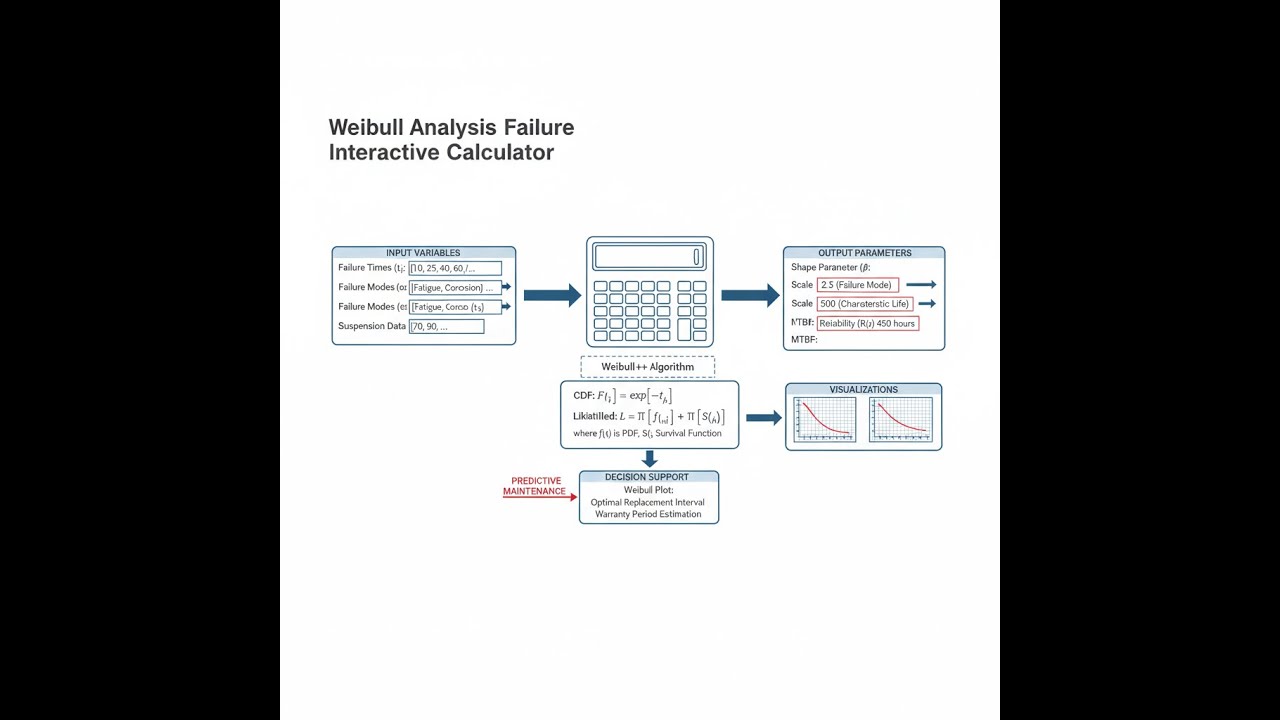
Figuring out when a part will actually fail—and how often that might happen within your warranty period—is a tough job in reliability engineering. This Weibull Analysis Failure Calculator gives you the practical numbers you need: it calculates reliability at a given time, the instantaneous failure rate, mean time to failure, and a few others, based on the shape parameter (β), scale parameter (η), and the time your part is supposed to run. These values matter a lot in industries like aerospace, automotive, and medical devices, where even a small mistake in your estimate can end up as a costly warranty issue, a safety problem, or a regulator raising questions. Below you'll find the key Weibull equations, a step-by-step example for bearing life, some solid background on what β actually means, and an FAQ that covers common practical questions.
What is Weibull Analysis?
Weibull analysis is a statistical method for predicting how long products or components will last before they fail. You fit failure time data to a Weibull distribution to estimate the probability of survival at any point in time.
Simple Explanation
Think of it like a batting average for reliability — instead of predicting hits, you're predicting failures. You feed in a handful of real failure times, and the Weibull model tells you the pattern: are things failing early due to defects, randomly, or wearing out with age? Once you know the pattern, you can predict when the next failures are likely to happen across your entire product population.
📐 Browse all 1000+ Interactive Calculators
Table of Contents
How to Use This Calculator
- Select your calculation mode from the dropdown — choose from reliability at time t, failure rate, MTTF, time for target reliability, parameter estimation from data, or warranty return rate.
- Enter your shape parameter (β), scale parameter (η), and operating time (t). If you have a failure-free period, enter the location parameter (γ); otherwise leave it at 0.
- For the parameter estimation mode, paste your comma-separated failure times directly into the text field and provide an initial η estimate.
- Click Calculate to see your result.
Weibull Distribution Diagram

Weibull Analysis Failure Calculator
This calculator is intended for education, concept evaluation, and preliminary design. Results are based on the equations and assumptions described on this page, but cannot account for every real-world load case, tolerance, material property, environmental condition, installation detail, safety factor, code, or regulatory requirement. Verify all inputs, assumptions, units, and results independently before selecting components or using the result in a real application. Safety-critical, structural, medical, lifting, transportation, or regulated applications must be reviewed by a qualified engineer.
Weibull Analysis Failure Interactive Calculator
Predict component reliability and failure rates using Weibull distribution parameters. Visualize how shape parameter β controls failure behavior: infant mortality (β<1), random failures (β=1), or wear-out patterns (β>1).
RELIABILITY
77.9%
FAILURE RATE
0.10/hr
MTTF
8862 hrs
FAILURE MODE
WEAR-OUT
FIRGELLI Automations — Interactive Engineering Calculators
Weibull Distribution Equations
Use the formula below to calculate Weibull reliability.
Three-Parameter Weibull Reliability Function
R(t) = e-[(t-γ)/η]β
Where:
- R(t) = Reliability at time t (probability of survival), dimensionless (0 to 1)
- t = Operating time or cycles, hours/cycles/miles
- β = Shape parameter (Weibull slope), dimensionless
- η = Scale parameter (characteristic life), same units as t
- γ = Location parameter (failure-free time), same units as t
- e = Euler's number (≈2.71828)
Unreliability (Cumulative Distribution Function)
Use the formula below to calculate cumulative failure probability.
F(t) = 1 - R(t) = 1 - e-[(t-γ)/η]β
Where:
- F(t) = Cumulative probability of failure by time t, dimensionless (0 to 1)
Instantaneous Failure Rate (Hazard Function)
Use the formula below to calculate instantaneous failure rate.
λ(t) = (β/η) × [(t-γ)/η]β-1
Where:
- λ(t) = Instantaneous failure rate at time t, failures per unit time
- When β < 1: Decreasing failure rate (infant mortality, burn-in)
- When β = 1: Constant failure rate (random failures, exponential distribution)
- When β > 1: Increasing failure rate (wear-out failures, aging)
Mean Time to Failure (MTTF)
Use the formula below to calculate mean time to failure.
MTTF = γ + η × Γ(1 + 1/β)
Where:
- Γ(x) = Gamma function of x
- MTTF = Expected value of time to failure, same units as t
Median Life (B50)
Use the formula below to calculate median life.
tmedian = γ + η × (ln 2)1/β
Where:
- tmedian = Time at which 50% of units have failed (B50 life), same units as t
- ln 2 ≈ 0.693147
Time for Target Reliability
Use the formula below to calculate the operating time that achieves a target reliability level.
t = γ + η × [-ln(R)]1/β
Where:
- t = Operating time to achieve target reliability R, same units as η
- R = Target reliability level (e.g., 0.95 for 95% reliability)
Simple Example
A bearing has β = 2.0, η = 10,000 hours, γ = 0. What is the reliability at t = 5,000 hours?
- Adjusted time: 5,000 − 0 = 5,000 hours
- Exponent: (5,000 / 10,000)² = 0.25
- R(5,000) = e−0.25 ≈ 0.7788 → 77.88% of bearings are still running at 5,000 hours
Theory & Engineering Applications
The Weibull distribution, named after Swedish engineer Waloddi Weibull who popularized it in 1951, stands as the most versatile life distribution model in reliability engineering. Unlike the exponential distribution which assumes a constant failure rate, or the normal distribution which assumes symmetry, the Weibull distribution accommodates three fundamentally different failure behaviors through its shape parameter β: infant mortality (β < 1), random failures (β = 1), and wear-out failures (β > 1). This flexibility makes it the preferred model for analyzing everything from ball bearing fatigue to electronic component lifetimes to wind turbine blade failures.
The Shape Parameter: Window Into Failure Physics
The shape parameter β reveals the underlying failure mechanism with remarkable clarity. When β falls between 0.5 and 0.8, the decreasing failure rate indicates defect-related early failures—manufacturing defects, contamination, or assembly errors that manifest quickly. Quality control improvements and burn-in testing directly target this region. When β ranges from 2.0 to 4.5, the distribution describes mechanical wear-out: fatigue cracks in metals (β ≈ 2.0-2.5), bearing failures (β ≈ 1.5), or corrosion-induced failures (β ≈ 2.0-3.5). Values above 4.0 indicate rapid wear-out characteristic of certain polymer degradation mechanisms or severe operating stress.
The critical insight often overlooked: β is not merely a curve-fitting parameter but a diagnostic signature of the physical failure process. When β shifts unexpectedly in production data, it signals a fundamental change in failure mode—perhaps a new supplier's materials, altered manufacturing process, or different operating environment.
The Characteristic Life: More Than Just a Time Scale
The scale parameter η, called the characteristic life, represents the time at which exactly 63.2% of the population has failed (regardless of β value). This mathematical fact—derived from setting the exponent to unity—provides a shape-independent reference point. In practical terms, η serves as the natural time scale for the failure process. For rolling element bearings, η typically ranges from 10,000 to 100,000 hours depending on load and speed. For semiconductor devices, η might span from 50,000 to 500,000 hours at operating temperature.
The ratio t/η creates a dimensionless time that enables direct comparison across different products and applications. However, the characteristic life must always be interpreted alongside β: an η of 20,000 hours with β = 0.8 (infant mortality) implies very different reliability behavior than the same η with β = 3.5 (rapid wear-out).
Maximum Likelihood Estimation: The Standard for Parameter Determination
While graphical methods using Weibull probability paper provide intuitive visualization, modern reliability analysis relies on maximum likelihood estimation (MLE) for determining β and η from field or test data. MLE iteratively solves the likelihood equations to find parameter values that maximize the probability of observing the given failure data. For complete data (all units failed), the MLE equations are straightforward. For censored data—where some units have not yet failed—MLE correctly accounts for these "survivors" in the parameter estimation.
A critical practical consideration: MLE requires at least 5-10 failures for reasonable parameter estimates, with 20+ failures providing good confidence intervals. Time-censored data (test stopped at fixed time) and failure-censored data (test stopped after N failures) require different MLE formulations. The calculator's parameter estimation mode uses a simplified MLE approach suitable for complete data sets; professional reliability software handles complex censoring scenarios.
Competing Risk Analysis and Mixed Weibull Distributions
Real-world components often exhibit multiple failure modes: mechanical wear, electrical overstress, thermal degradation, and corrosion occurring simultaneously. Each mode follows its own Weibull distribution with distinct β and η values. The observed reliability is the product of individual reliabilities: Rsystem(t) = R1(t) × R2(t) × ... × Rn(t). On Weibull probability paper, this creates characteristic "dog-leg" curves where the slope changes, indicating a transition from one dominant failure mode to another.
Automotive components frequently show this behavior: early infant mortality from assembly defects (β ≈ 0.6) followed by random failures (β ≈ 1.0) from various causes, then wear-out (β ≈ 2.5) from mechanical degradation. Deconvolving these mixed distributions requires specialized software and considerable expertise, but recognizing their presence is crucial for root cause analysis.
Accelerated Life Testing and the Weibull Framework
Few products can be tested for their full design life economically. Accelerated life testing (ALT) applies elevated stress—temperature, voltage, vibration, or humidity—to induce failures more quickly. The Weibull distribution provides the statistical foundation for extrapolating from accelerated conditions to normal use. The Arrhenius model for temperature acceleration assumes β remains constant while η decreases exponentially with temperature: η(T) = A × exp(Ea/kT), where Ea is activation energy and k is Boltzmann's constant. For voltage acceleration, the inverse power law applies: η(V) = B × V-n.
The key assumption—constant β across stress levels—must be validated experimentally; if β changes, the acceleration model may not apply, indicating different failure physics at high stress. Proper ALT design requires careful stress selection to avoid inducing unrealistic failure modes while achieving measurable failure rates within practical test durations.
Worked Example: Electric Motor Bearing Life Analysis
Consider an industrial electric motor manufacturer analyzing field return data for a 50 HP motor series. Warranty claims from 2,847 motors in service provided 73 bearing failures over 18 months. Failure times (in operating hours): ranging from 1,240 hours (earliest) to 14,780 hours (latest), with the median failure at 8,320 hours. The remaining 2,774 motors continue operating, representing right-censored data.
Step 1: Parameter Estimation
Using maximum likelihood estimation for censored data, the analysis yields:
Shape parameter: β = 2.18 (indicating wear-out failures, consistent with rolling contact fatigue)
Scale parameter: η = 18,450 hours (characteristic life)
Location parameter: γ = 0 (no failure-free period assumed)
Step 2: Calculate Key Reliability Metrics
Mean time to failure: MTTF = 18,450 × Γ(1 + 1/2.18) = 18,450 × 0.8873 = 16,370 hours
Median life (B50): t50 = 18,450 × (ln 2)1/2.18 = 18,450 × 0.8308 = 15,330 hours
B10 life (10% failure): t10 = 18,450 × (-ln 0.9)1/2.18 = 18,450 × 0.3142 = 5,797 hours
Step 3: Warranty Period Analysis
Current warranty covers 5,000 hours. Calculate expected warranty return rate:
F(5000) = 1 - exp(-[5000/18450]2.18) = 1 - exp(-0.0725) = 1 - 0.9301 = 0.0699
Expected warranty returns: 6.99% of motors, or approximately 199 failures from 2,847 units
Step 4: Reliability at Extended Operating Time
Calculate reliability at 10,000 hours (typical inspection interval):
R(10000) = exp(-[10000/18450]2.18) = exp(-0.3469) = 0.7070
At 10,000 hours, 70.7% of bearings remain functional, 29.3% have failed.
Step 5: Failure Rate Progression
Calculate instantaneous failure rate at 5,000, 10,000, and 15,000 hours:
λ(5000) = (2.18/18450) × (5000/18450)1.18 = 0.000118 × 0.1876 = 2.22 × 10⁻⁵ failures/hour
λ(10000) = (2.18/18450) × (10000/18450)1.18 = 0.000118 × 0.4264 = 5.03 × 10⁻⁵ failures/hour
λ(15000) = (2.18/18450) × (15000/18450)1.18 = 0.000118 × 0.6892 = 8.13 × 10⁻⁵ failures/hour
Engineering Decisions:
1. The β = 2.18 confirms mechanical wear-out as primary failure mode; lubrication and contamination control are critical
2. B10 life of 5,797 hours suggests current 5,000-hour warranty is aggressive; consider reducing to 4,000 hours or implementing condition monitoring
3. Increasing failure rate with time supports preventive replacement strategy; recommend bearing replacement at 12,000 hours (before failure rate accelerates significantly)
4. For high-reliability applications requiring 95% survival, limit operating time to: t = 18450 × (-ln 0.95)1/2.18 = 18450 × 0.2235 = 4,124 hours between maintenance intervals
Confidence Intervals and Statistical Rigor
Every Weibull parameter estimate carries uncertainty inversely proportional to sample size. With 10 failures, 90% confidence bounds on β typically span from 0.5β to 2.0β; with 50 failures, this narrows to 0.75β to 1.3β. Professional reliability analysis must report confidence intervals, not just point estimates. The Fisher Information Matrix provides variance estimates for β and η, enabling construction of confidence bounds on reliability predictions.
For critical applications—aerospace, medical devices, nuclear—reliability demonstrations often require proving R(t) > Rtarget with 90% confidence and 90% reliability (the "90/90" criterion). This dramatically increases required test duration and sample size. The practical implication: early-stage reliability estimates from limited data should be viewed as preliminary indicators requiring validation through extended field monitoring.
For more reliability engineering tools, explore our complete calculator library, including fatigue analysis, stress-strength interference, and reliability block diagram calculators.
Practical Applications
Scenario: Automotive Warranty Cost Optimization
Maria, a reliability engineer at an automotive tier-1 supplier, faces a critical decision about extending the warranty period for a new electric power steering motor from 60,000 to 100,000 miles. Sales projects 250,000 units annually at $185 each, with a $420 replacement cost per warranty claim. Field test data from 180 prototype vehicles over 18 months showed 12 motor failures with times ranging from 28,400 to 87,600 miles. Using the Weibull calculator, Maria estimates β = 1.85 (wear-out beginning) and η = 142,000 miles. At 60,000 miles, the calculator predicts 3.8% failure rate (9,500 warranty returns costing $3.99M). Extending to 100,000 miles increases this to 12.7% (31,750 returns costing $13.34M)—a $9.35M annual cost increase that dramatically impacts profitability. Maria uses these calculations to negotiate a 100,000-mile warranty at $198 per unit (7% price increase), offsetting the additional warranty exposure while meeting customer requirements.
Scenario: Wind Turbine Maintenance Scheduling
James, operations manager for a 200-turbine wind farm in West Texas, must optimize maintenance schedules for pitch control systems that adjust blade angles. Current practice replaces actuators at fixed 40,000-hour intervals regardless of condition. Analysis of 47 unplanned failures across the fleet over three years reveals a Weibull distribution with β = 2.65 (accelerating wear-out) and η = 62,000 hours. Using the calculator's reliability mode, James discovers that at 40,000 hours, only 11.2% of actuators have actually failed—meaning 88.8% of replacements are premature, wasting $1.8M annually in parts and labor. He recalculates optimal intervals: the B10 life (10% failure point) occurs at 28,300 hours, while B20 (20% failure) is at 35,400 hours. Implementing a 35,000-hour replacement schedule reduces both premature replacements and costly unplanned downtime, cutting maintenance costs by $620,000 annually while actually improving turbine availability from 94.2% to 96.7%.
Scenario: Medical Device Regulatory Submission
Dr. Chen, a biomedical engineer, is preparing an FDA 510(k) submission for a new insulin pump design. Regulatory requirements mandate demonstrating 99% reliability over 3 years (26,280 hours) of continuous operation. Accelerated life testing at 45°C on 85 devices over 8 months produced 8 failures with times from 4,200 to 9,100 hours. Using the Weibull calculator, Dr. Chen estimates β = 1.42 and η = 11,650 hours at accelerated conditions. Applying the Arrhenius acceleration factor of 8.3× (based on 0.72 eV activation energy and testing 20°C above use temperature), the use-condition parameters become β = 1.42 and η = 96,700 hours. Calculating reliability at 26,280 hours: R = exp(-[26280/96700]^1.42) = 0.9423 or 94.23%—falling short of the 99% requirement. This calculation identifies the need for design improvements before submission, saving months of regulatory delays and enabling targeted engineering changes to critical seal and valve components that showed highest failure rates during testing.
Frequently Asked Questions
What does the shape parameter β really tell me about my product's failures? +
How many failures do I need to get reliable Weibull parameter estimates? +
Why does my Weibull plot show a curved line instead of a straight line? +
Can I use Weibull analysis for electronics that don't wear out mechanically? +
What's the difference between MTTF, MTBF, and median life, and which should I use? +
How do I handle suspensions and right-censored data in Weibull analysis? +
Free Engineering Calculators
Explore our complete library of free engineering and physics calculators.
Browse All Calculators →🔗 Explore More Free Engineering Calculators
About the Author
Robbie Dickson — Chief Engineer & Founder, FIRGELLI Automations
Robbie Dickson brings over two decades of engineering expertise to FIRGELLI Automations. With a distinguished career at Rolls-Royce, BMW, and Ford, he has deep expertise in mechanical systems, actuator technology, and precision engineering.
Video Walkthrough - How to Use This Calculator
Need to implement these calculations?
Explore the precision-engineered motion control solutions used by top engineers.


