Recovering capital from a long-term investment isn't a guessing game; it's about applying the right math. If you miss the numbers on capital recovery, the whole economics of your project could fall apart. This Capital Recovery Factor calculator helps you work out the payment required to recover any initial investment over a set period, given your interest rate, number of periods, and present value. The CRF is a staple in engineering for equipment financing and infrastructure planning—where precise, grounded calculations are needed. Below, you'll find the CRF formula, a worked example, and detailed background so you can use this in real engineering situations. There's also a FAQ at the end.
What is the Capital Recovery Factor?
Capital Recovery Factor (CRF) is the number you multiply by an initial investment to get the periodic payment needed to fully pay off that investment (including interest) over a chosen time. It's a ratio—plug in your investment, multiply by CRF, and you've got your required payment for each period.
Simple Explanation
If you've ever set up payments for equipment, this is the calculation behind spreading payments so you've covered the cost and interest by the end—no overpay, no leftover balance. Higher interest rates or shorter payback periods mean a higher CRF, which leads to a larger payment every cycle. The math doesn't care about feelings: supply the numbers, and it'll show what you need to budget.
📐 Browse all 1000+ Interactive Calculators
Table of Contents
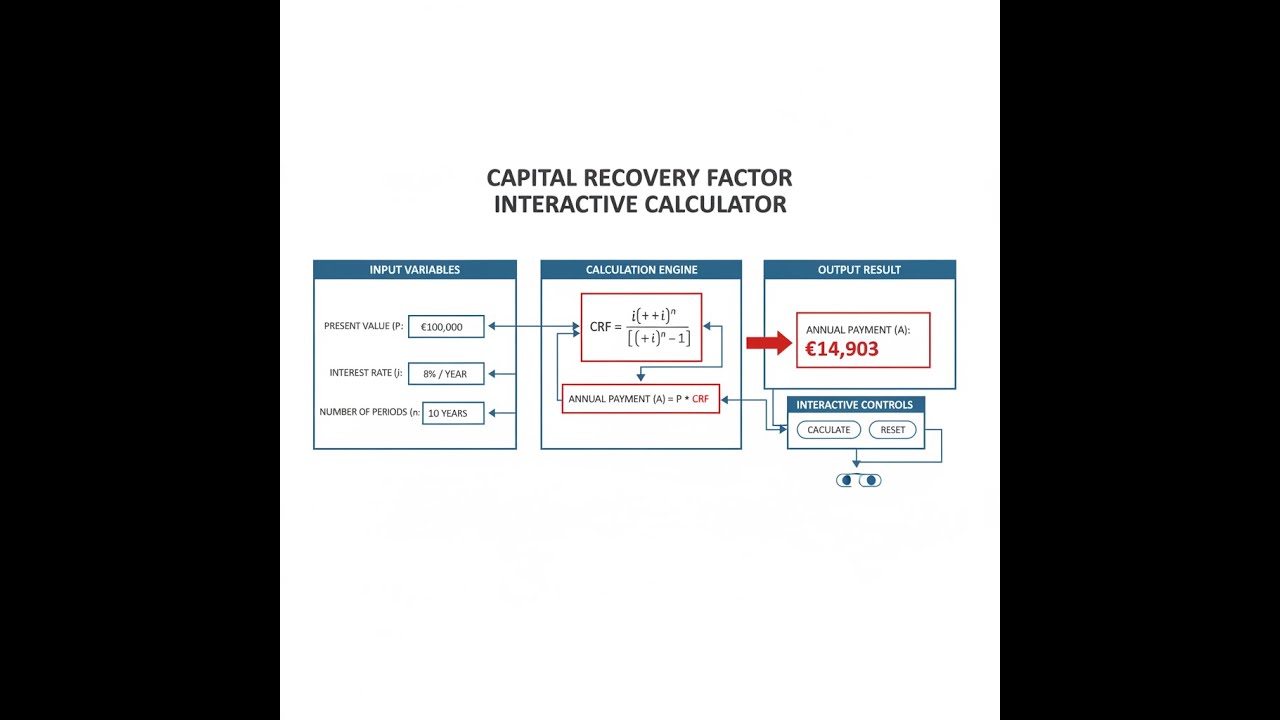
Visual Diagram

Capital Recovery Factor Calculator
How to Use This Calculator
This calculator is intended for education, concept evaluation, and preliminary design. Results are based on the equations and assumptions described on this page, but cannot account for every real-world load case, tolerance, material property, environmental condition, installation detail, safety factor, code, or regulatory requirement. Verify all inputs, assumptions, units, and results independently before selecting components or using the result in a real application. Safety-critical, structural, medical, lifting, transportation, or regulated applications must be reviewed by a qualified engineer.
- Select what you're solving for in the dropdown—CRF, annual payment, present value, interest rate, number of periods, or future value.
- Enter your Present Value (the initial investment), Interest Rate (per period), and Number of Periods. If you're solving for something else, fill in the relevant values for that field.
- To see how the numbers work, click Try Example and look at the calculation using sample data. Adjust as you like.
- Hit Calculate to view the result and see the full calculation breakdown.
Capital Recovery Factor Interactive Visualizer
Move the sliders to see how changing the interest rate or timeline impacts your payment requirements. You’ll watch the CRF formula work in real time.
CAPITAL RECOVERY FACTOR
0.1490
ANNUAL PAYMENT
$14,903
TOTAL PAYMENTS
$149,029
TOTAL INTEREST
$49,029
FIRGELLI Automations — Interactive Engineering Calculators
Equations & Formulas
Here's the math for calculating the Capital Recovery Factor.
Capital Recovery Factor (CRF)
CRF = [ i(1 + i)n ] / [ (1 + i)n − 1 ]
where:
CRF = Capital Recovery Factor (dimensionless)
i = interest rate per period (decimal form)
n = number of compounding periods (dimensionless)
Annual Payment (A)
A = P × CRF
where:
A = uniform annual payment ($)
P = present value or initial investment ($)
CRF = Capital Recovery Factor (dimensionless)
Present Value from Payment
P = A / CRF = A × [ (1 + i)n − 1 ] / [ i(1 + i)n ]
This is the present worth factor, the inverse of CRF
Special Case: Zero Interest Rate
CRF = 1 / n (when i = 0)
When no interest is charged, capital is recovered by equal portions over n periods
Simple Example
Initial investment (P): $10,000
Interest rate (i): 10% per year
Number of periods (n): 5 years
CRF = [0.10 × (1.10)5] / [(1.10)5 − 1] = 0.2638
Annual payment (A) = $10,000 × 0.2638 = $2,638 per year
Theory & Engineering Applications
CRF is a basic tool for engineers to turn up-front costs into a set of equal payments, accounting for both paying back the initial money and covering interest. Unlike simple "spread the cost over the years" math, this makes sure you cover the time value of money. It doesn't matter if you're thinking about getting your money back from a machine or a bridge; the same concept applies.
Mathematical Foundation and Derivation
The CRF formula comes straight from annuity math: you start with the formula for the present worth of a stream of equal payments, then rearrange it so you solve for the payment instead. It's just a ratio, used to translate a lump-sum cost into a required payment. The terms come from compounding—(1 + i)^n is the effect of stacking up interest, while the numerator is arranged to make sure interest and principal are both recovered. If you change the interest rate by even 1% over a long project (10–30 years is common in engineering), your payments can swing by more than 8–15%. If you work in areas where rates are unpredictable, be careful—standard CRF assumes the rate stays fixed for the whole project, which almost never happens in practice.
Engineering Economics and Project Evaluation
Most replacement analyses, lease-vs-buy studies, or economic life calculations start with the CRF. In these cases, you combine CRF (to recover the initial outlay) with regular annual costs to get your equivalent annual cost (EAC). The lowest EAC tells you which option is cheapest over time—sometimes the higher up-front cost wins out after you pay attention to all the numbers and not just purchase price.
In manufacturing, CRF lets you directly compare machines or automation with different lifespans and capital needs. For example, you might look at a $500,000 robot with a 15-year life and compare it to an $200,000 manual process that lasts only 8 years. Using CRF and actual numbers, you can see which setup really costs more each year when everything is levelized out, not just up-front cost.
Infrastructure and Public Works Applications
Public works and infrastructure projects—things like roads, water systems, or power plants—run for decades. Here, CRF tells you how much to set aside or charge users each year so you’ll have paid off the original investment (and interest). Discount rates matter a lot; they reflect the minimum return or "opportunity cost" that funds must earn. For municipal projects, public agencies typically use social discount rates of 3–7%, which can drive payment calculations and budget planning for years ahead.
When figuring rates for utilities, CRF is central. Say a water authority puts $50 million into new infrastructure at a 40-year life; they need to set rates that recover not just annual costs, but that full capital with interest. CRF determines what part of the yearly bill covers "payback" so the utility can meet its obligations and keep systems funded.
Energy Systems and Life-Cycle Cost Analysis
For solar, wind, and other renewables, up-front capital is most of the expense. Ongoing costs are relatively minor. Whether it's a battery or photovoltaic field, CRF turns the huge one-time cost into a set annual "capital charge." Levelized Cost of Energy (LCOE) divides that charge by the output to get a comparable number ($/kWh), no matter how the energy is produced. Real LCOE analysis also needs to factor in system performance and degradation, so you get a realistic sense of per-unit costs over decades.
Take a commercial solar project—if you don't use CRF correctly, you'll either under- or overestimate what that yearly payment should be. It's not just the sticker price, it's the timeline, rate, and system output that all must be dialed in to make valid comparisons or investment calls.
Detailed Worked Example: Manufacturing Equipment Acquisition
Problem: A company considers buying a CNC milling center for $385,000 with a 12-year service life and minimal salvage value. The first-year O&M cost is $42,000, going up by $3,200 each year. Their required return is 9.5%. What are (a) the CRF, (b) the annual capital recovery, (c) first-year total annual cost, and (d) present worth of all costs over 12 years?
Solution:
Part (a): Calculate CRF
Given: P = $385,000, i = 0.095, n = 12 years
CRF = [i(1 + i)n] / [(1 + i)n − 1]
CRF = [0.095(1.095)12] / [(1.095)12 − 1]
Compute (1.095)12 = 2.9716
CRF = [0.095 × 2.9716] / [2.9716 − 1]
CRF = 0.2823 / 1.9716
CRF = 0.14316
Part (b): Annual Capital Recovery Payment
Acapital = P × CRF
Acapital = $385,000 × 0.14316
Acapital = $55,117 per year
Part (c): Equivalent Annual Cost (Year One)
EACyear1 = Acapital + O&Myear1
EACyear1 = $55,117 + $42,000
EACyear1 = $97,117
For O&M escalating each year, use gradient factors:
Gradient G = $3,200 per year
Gradient-to-annual factor (A/G, 9.5%, 12) = 4.439
AO&M = $42,000 + $3,200 × 4.439 = $56,205
Total EAC = $55,117 + $56,205 = $111,322 per year
Part (d): Present Worth of Total Costs
Use present worth factor (inverse of CRF):
PWF = [(1 + i)n − 1] / [i(1 + i)n] = 1 / 0.14316 = 6.9847
PWtotal = EAC × PWF
PWtotal = $111,322 × 6.9847
PWtotal = $777,541
This present worth is the up-front amount needed today to cover all costs—capital and operating, paying attention to money's time value. The real economic load is much higher than just the initial price tag if you factor in all future obligations and interest.
Limitations and Practical Considerations
CRF assumes fixed interest and regular intervals, which is often not true in practice. Actual loans may have variable rates, non-uniform payments, or other wrinkles. CRF also misses risks like tech becoming outdated, future regulations, or events you can't forecast. If you're in a volatile sector, don't trust any single interest rate—run sensitivity analysis and consider using simulations or broader analysis to understand possible outcomes, not just one "answer."
For more financial engineering calculators, see the FIRGELLI engineering calculator library.
Practical Applications
Scenario: Fleet Replacement Decision for Logistics Company
Maria runs numbers on buying or leasing 15 delivery vans. At $38,500 each, or $725/month to lease, and an eight-year service life with $6,200 salvage per van, she uses a 7.25% capital rate and gets CRF=0.16384. That means capital recovery per van is $6,308/year, plus $2,400 to operate, totalling $8,708. The lease costs $8,700 annually—a very slim margin. With a $3.25 monthly savings when buying (after including salvage), Maria can show exactly why the purchase option edges out leasing, if only by about $1,200/yr for the whole fleet. These are practical numbers for a real capital decision—not guesses.
Scenario: Solar Energy Investment Analysis
A facility engineer wants to justify a $1.2 million, 500 kW solar array over 25 years with 0.6% yearly output loss. Finance requires 8.5%. With CRF=0.09347, annual capital cost is $112,164, but the system saves $82,500/yr on electricity, minus $8,000 maintenance, for a net of just $74,500—not enough against the annual capital charge. With a tax credit dropping the investment to $840,000 and the charge to $78,555, the project edges barely positive. Missing the tax credit swings the cash flow negative; the numbers are that tight. These calculations are grounded in actual project finance constraints.
Scenario: Municipal Water System Expansion
For a $12.5 million water plant expansion, the city engineer works out payments over 40 years at 4.75% (CRF=0.05545), which means $693,125 a year in payments. Split over 18,000 new customers, that's $38.51/connection/year purely in capital payback, about $3.25/month each. This calculation translates directly into budgeting and rate-setting proposals for the city council—so the numbers stand up to public scrutiny.
Frequently Asked Questions
Free Engineering Calculators
Explore our complete library of free engineering and physics calculators.
Browse All Calculators →🔗 Explore More Free Engineering Calculators
About the Author
Robbie Dickson — Chief Engineer & Founder, FIRGELLI Automations
Robbie Dickson brings over two decades of engineering expertise to FIRGELLI Automations. With a distinguished career at Rolls-Royce, BMW, and Ford, he has deep expertise in mechanical systems, actuator technology, and precision engineering.
Video Walkthrough - How to Use This Calculator
Need to implement these calculations?
Explore the precision-engineered motion control solutions used by top engineers.


