Neutron activation for producing radioactive isotopes is all about knowing your numbers before you start: target mass, neutron flux, cross section, and irradiation time. Miss one and you either won’t make enough isotope or you'll waste expensive reactor hours. This Isotope Production Activation Calculator helps you get a straight answer for final activity, required neutron flux, how long to irradiate, how much target to use, or how much activity you’ll have after a delay. You need those numbers when scheduling medical isotope runs, planning neutron activation analysis, or working out industrial source strengths. Below you’ll find the equations, an example with lutetium-177, detailed theory, and FAQ for real-world contexts.
What is neutron activation?
Neutron activation happens when you hit stable atoms with a stream of neutrons, turning some of them into radioactive isotopes. The more neutrons per second hitting your target and the longer you irradiate, the more you make—up to a point called saturation activity, where production and decay are in balance.
Simple Explanation
Picture a bucket with a hole: as you fill it (activate with neutrons), water leaks out (radioactive decay). At first, the water level rises quickly because there’s little decay. But eventually, the rate in equals the rate out—saturation. The calculator shows you how close you are to that point for your inputs.
📐 Browse all 1000+ Interactive Calculators
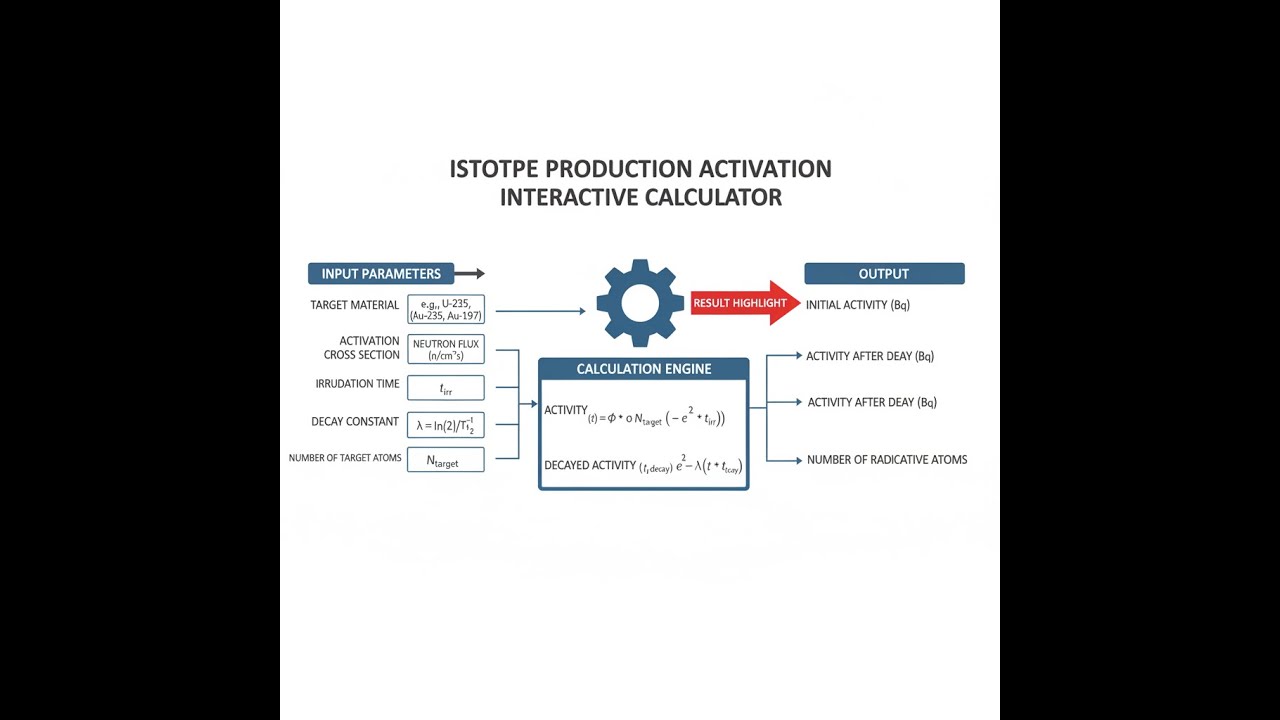
Visual Diagram: Neutron Activation Process

Isotope Production Activation Calculator
This calculator is intended for education, concept evaluation, and preliminary design. Results are based on the equations and assumptions described on this page, but cannot account for every real-world load case, tolerance, material property, environmental condition, installation detail, safety factor, code, or regulatory requirement. Verify all inputs, assumptions, units, and results independently before selecting components or using the result in a real application. Safety-critical, structural, medical, lifting, transportation, or regulated applications must be reviewed by a qualified engineer.
Neutron Activation Interactive Visualizer
This visual shows how isotope build-up happens over time under neutron bombardment. Change the neutron flux, cross section, and irradiation duration to see how fast you approach saturation activity and what that curve looks like.
CURRENT ACTIVITY
9.9×10¹¹ Bq
SATURATION
1.0×10¹² Bq
% OF SATURATION
99.3%
FIRGELLI Automations — Interactive Engineering Calculators
Activation Equations
The main formula for neutron activation is below. Plug in the relevant numbers to find how much activity you’ll make from a given target in a neutron field.
Fundamental Activation Equation
A(t) = φ σ N (1 − e−λt)
Where:
- A(t) = Activity at time t (Becquerels, Bq or disintegrations per second)
- φ = Neutron flux (neutrons per cm² per second)
- σ = Neutron capture cross section (cm², typically expressed in barns where 1 barn = 10−24 cm²)
- N = Number of target atoms available for activation
- λ = Decay constant (s−1) = ln(2)/t½
- t = Irradiation time (seconds)
Number of Target Atoms
N = (m × NA × f) / M
Where:
- m = Mass of target material (grams)
- NA = Avogadro's number (6.022 × 10²³ atoms/mol)
- f = Isotopic abundance (fractional, 0 to 1)
- M = Atomic mass of target isotope (g/mol)
Saturation Activity
Asat = φ σ N
Description: This is the absolute maximum activity that target and neutron conditions allow, assuming endless irradiation. After about 4-5 half-lives you’re close to this maximum (≥95%). Longer runs don’t make much more activity—just more decay heat and handling challenges.
Activity After Decay
A(tdecay) = A0 e−λtdecay
Where:
- A0 = Initial activity at end of irradiation (Bq)
- tdecay = Time elapsed since end of irradiation (seconds)
Note: Use this if you need to know how much activity is left after a cool-down or shipment delay.
How to Use This Calculator
- Pick what you want to solve—Final Activity, Required Neutron Flux, Irradiation Time, Target Mass, Activity After Decay, or Saturation Activity.
- Enter your input values: neutron flux in n/cm²/s, target mass, cross section (barns), atomic mass (g/mol), isotopic abundance, and half-life (hours). The calculator will prompt for only the values it needs for your selected mode.
- Enter irradiation time (hours), or—for the decay mode—provide initial activity and decay time instead.
- Click Calculate to get the answer.
Simple Example
Suppose you want to know the final activity after irradiating a cobalt-59 sample.
- Neutron Flux: 1 × 10¹³ n/cm²/s
- Target Mass: 0.1 g
- Cross Section: 37.18 barns
- Atomic Mass: 58.693 g/mol
- Isotopic Abundance: 68.077%
- Half-Life: 1.5 hours
- Irradiation Time: 6 hours
- Result: approximately 9.93 × 10¹¹ Bq (99.3% of saturation)
Theory & Engineering Applications
Neutron activation is a straightforward route for making radioactive isotopes: a stable nucleus absorbs a neutron and becomes unstable, emitting radiation as it decays. This happens in stars, but we replicate it in nuclear reactors, particle accelerators, and special neutron sources when we need isotopes for medical, industrial, or research uses. The math and physics—cross sections, neutron energy, decay constants—are well-understood and, operationally, pretty reliable as long as you keep your facility parameters straight.
Neutron Capture Cross Sections and Reaction Probability
Cross section (σ) gives you the odds a neutron hits and activates a specific atom. The bigger the cross section, the more likely an atom will “catch” a neutron when bombarded. Most thermal neutron (about 0.025 eV) cross sections are much higher than fast neutron ones—there’s a strong energy dependence, so using the wrong neutron energy means you might get almost no activation. For example, cobalt-59 at thermal has a cross section around 37 barns, so activation is efficient even for small samples, while gold-197’s 98.7 barns means you can activate traces for analytical work. If you’re not sure of the neutron spectrum (thermal vs. fast), your results may be off by an order of magnitude.
Energy does matter: many reactions (like (n,γ)) are very strong at thermal energies, but some medical and industrial isotopes need fast neutrons or high-energy thresholds. Kinetics and practical output usually favor thermal unless you specifically want (n,p), (n,2n), or other reactions only triggered by energetic (fast) neutrons. Reactors and neutron generators differ significantly here—always check what your facility provides.
Activation Kinetics and Saturation Behavior
The production curve for activation is exponential—activity ramps up fast at first and then slows down, asymptotically approaching the so-called saturation activity. After about 4-5 half-lives, you’re basically at saturation. Going to longer times gives you little additional activity, but it does increase heat load, logistics complexity, and the risk of higher waste. For short-lived isotopes, optimal irradiation is often less than a day; for longer-lived medical isotopes, several days is common but going longer is rarely justified except for special requirements. If your process has delays or a cold chain, you’ll also need to factor in decay losses after irradiation.
There’s also a trade-off for long-lived isotopes: beyond a certain point, reactor operating costs and risk outweigh tiny gains, so always plan out the minimum run that delivers enough activity with margin for processing losses.
Flux Characterization and Spatial Distributions
Don’t trust catalog neutron flux numbers blindly: flux varies by position, moderator, and core power. In practice, lab reactors run 10¹²–10¹⁴ n/cm²/s thermal flux, but your position might be 10–15% below the advertised value due to shielding, geometry, or target self-shielding (especially with thicker samples). Some reactors offer both thermal and fast flux positions—know which your application actually needs, as it can affect yield drastically. For the best accuracy, use a flux monitor wire irradiated alongside your target and normalize calculations to that measurement.
Fast flux values are much lower, rarely used for standard neutron activation analysis but important for certain isotopes that require a fast spectrum. Cyclotrons and D-T generators have very different—often peaked and non-Maxwellian—neutron spectra. Always match calculation assumptions to real-world spectra or use empirical measurements when available.
Worked Example: Lutetium-177 Production for Radiotherapy
Lutetium-177 (t½ = 6.647 days) is widely used for targeted cancer therapy and medical imaging. Here’s an example workflow using a typical research reactor to activate enriched lutetium-176 in an oxide matrix:
Given Parameters:
- Target material: 500 mg of lutetium oxide (Lu₂O₃) enriched to 78% 176Lu
- Neutron flux: φ = 3.8 × 10¹³ n/cm²/s (thermal)
- Cross section: σ = 2,090 barns for 176Lu(n,γ)177Lu
- Atomic mass of 176Lu: M = 175.943 g/mol
- Irradiation time: 14 days (just over twice the half-life)
- Lu₂O₃ molecular mass: 397.93 g/mol
Step 1: Calculate mass of pure 176Lu: lutetium is 87.94% by mass in Lu₂O₃; multiply target mass, fraction of Lu in Lu₂O₃, and enrichment.
Step 2: Calculate number of 176Lu atoms by dividing mass by M and multiplying by Avogadro’s number.
Step 3: Calculate decay constant as λ = ln(2) / (half-life in seconds).
Step 4: Convert cross section from barns to cm², get saturation activity (product of flux, cross section, and atom count).
Step 5: Plug in irradiation time to get actual activity achieved (“buildup factor”).
Step 6: Estimate processing decay by applying the decay law for a fixed time (e.g., 48 hours).
Result: In this setup, you’d get about 58 TBq (1,578 Ci) of Lu-177 from 500 mg starting material after all processing delays. Beyond 14 days irradiation you gain little; near 77% saturation is typical for two half-lives of run time. Tinkering with run time or enrichment is how producers balance cost, throughput, and activity needed per patient.
Production Routes and Target Selection
Deciding on a target and production route depends on what product you want and what’s available. Direct (n,γ) activation of natural targets often gives you “carrier-added” material—mixed radioactive and stable isotopes—which can be a problem when you need high purity or specific activity for medical use. Enriched targets boost specific activity by reducing inert material, but cost and supply can be significant. In some cases, indirect reactions (like (n,p), (n,2n), or fission products) offer higher yield or carrier-free material, but this usually requires additional separation and chemistry afterwards. If you need the highest specific activity (for radiopharmaceutical use), enriched target material is usually necessary—natural targets often just can't get you there.
Some routes give practically pure product (changing atomic number, so no stable isotopic carrier), while others need enrichment and chemical separation. Always consider downstream handling: extra steps may be justified if they simplify patient dosing or comply with regulations. Most practical workflows use a mix of reactor, target, and chemical steps to get the needed product in usable form within logistical and budget limits.
Reactor Operating Considerations
Pushing for maximum yield stresses the system: targets get hot (decay heat builds up), neutron damage accumulates, and activation byproducts must be handled safely. For example, saturating a 10-gram cobalt target at 10 kCi produces about 1 kW decay heat—enough to require substantial cooling and thermal management. Capsules are usually aluminum or titanium for heat transfer and minimal neutron absorption. Double containment, often with helium, allows for leak detection and safe operation. Radioactive gases and fission products involve further controls: charcoal, caustic scrubbers, and negative-pressure systems are common for volatility risks. Longevity of reactor internals also matters—high activation can leave you with expensive waste, so optimize target composition, geometry, and cycle time for minimum toxicity and maximum utility.
For related calculations and engineering planning, see other engineering calculators covering shielding, decay, and reactor system design.
Practical Applications
Scenario: Nuclear Medicine Production Scheduling
Supplying medical isotopes reliably comes down to precisely matching produced activity to real patient need—too little and you’ll run short; too much and it decays before use. For example, producing I-131 for therapy involves optimizing irradiation time and mass in a set reactor slot, while factoring the decay loss during post-processing and delivery. The calculator gives you a good starting estimate—refine with your facility’s measured flux and real process times to zero in on delivery targets.
Scenario: Archaeological Neutron Activation Analysis
In analytical labs, small samples—like archaeological pottery or geological materials—are irradiated to activate trace elements for gamma spectroscopy. The calculator helps figure out if you’re likely to hit your detection window for short-lived nuclides (e.g., sodium-24 in clays) and how long to wait post-irradiation before interference dies down. You can avoid retesting or wasted reactor time if you get timing and dose right the first time.
Scenario: Industrial Radiography Source Manufacturing
Industrial radiography sources (e.g., Ir-192) need reliable, predictable activity outputs for safe pipeline and weld inspections. If your standard target mass and irradiation time don’t reach the specified activity—usually due to limited half-life or lower flux than booked—you have to adjust either mass or cycle schedule. The calculator can be used for pre-production checks or for adjusting mid-campaign if facility conditions change, preventing missed delivery or overexposure.
Frequently Asked Questions
Why doesn't my actual produced activity match the calculator prediction? +
What neutron flux values are typical for different types of facilities? +
How do I account for multiple competing reactions in the same target? +
Why is specific activity important for medical isotope production? +
How does target burnup affect long irradiations? +
What safety considerations apply when handling activated materials? +
Free Engineering Calculators
Explore our complete library of free engineering and physics calculators.
Browse All Calculators →🔗 Explore More Free Engineering Calculators
About the Author
Robbie Dickson — Chief Engineer & Founder, FIRGELLI Automations
Robbie Dickson brings over two decades of engineering expertise to FIRGELLI Automations. With a distinguished career at Rolls-Royce, BMW, and Ford, he has deep expertise in mechanical systems, actuator technology, and precision engineering.
Video Walkthrough - How to Use This Calculator
Need to implement these calculations?
Explore the precision-engineered motion control solutions used by top engineers.


