When working on optical setups, spectrometers, or quantum electronics, you need to know the wavenumber—how tightly waves are packed in space—not just their frequency in time. This interactive tool calculates both the angular wavenumber (k) and the spectroscopic wavenumber (ν̃) from various inputs like wavelength, frequency, photon energy, phase velocity, or effective mass. Getting wavenumber right matters in IR or Raman spectroscopy, antenna design, semiconductor analysis, and designing optical coatings. You’ll find the basic formulas, a multi-layer coating example, practical notes on dispersion and refractive effects, and even an FAQ below.
What is Wavenumber?
Wavenumber tells you how many cycles or radians of a wave fit into a certain length. It’s about how waves repeat in space, not time. More wavenumber means the wave “oscillates” through space more rapidly.
Simple Explanation
Picture wavenumber like the stripe density on a barcode—the more stripes per centimeter, the higher the wavenumber. When light enters glass from air, the “stripes” get squeezed together: wavenumber increases, wavelength shrinks, frequency (color) stays constant. There are two notations: one for cycles per distance (direct count), one for radians per distance (for math in wave equations)—they differ by a factor of 2π.
📐 Browse all 1000+ Interactive Calculators
Table of Contents
Wave Diagram

Wavenumber Interactive Calculator
How to Use This Calculator
This calculator is intended for education, concept evaluation, and preliminary design. Results are based on the equations and assumptions described on this page, but cannot account for every real-world load case, tolerance, material property, environmental condition, installation detail, safety factor, code, or regulatory requirement. Verify all inputs, assumptions, units, and results independently before selecting components or using the result in a real application. Safety-critical, structural, medical, lifting, transportation, or regulated applications must be reviewed by a qualified engineer.
- Pick a calculation type — options include calculation from wavelength, frequency, photon energy, angular wavenumber, spectroscopic conversion, or using a dispersion relation.
- Enter your values in the input fields—use wavelength in nm, frequency in THz or GHz, energy in eV, or wavenumber in rad/m as needed for your mode.
- If the wave is in a medium (not a vacuum), add the refractive index.
- Click Calculate for results.
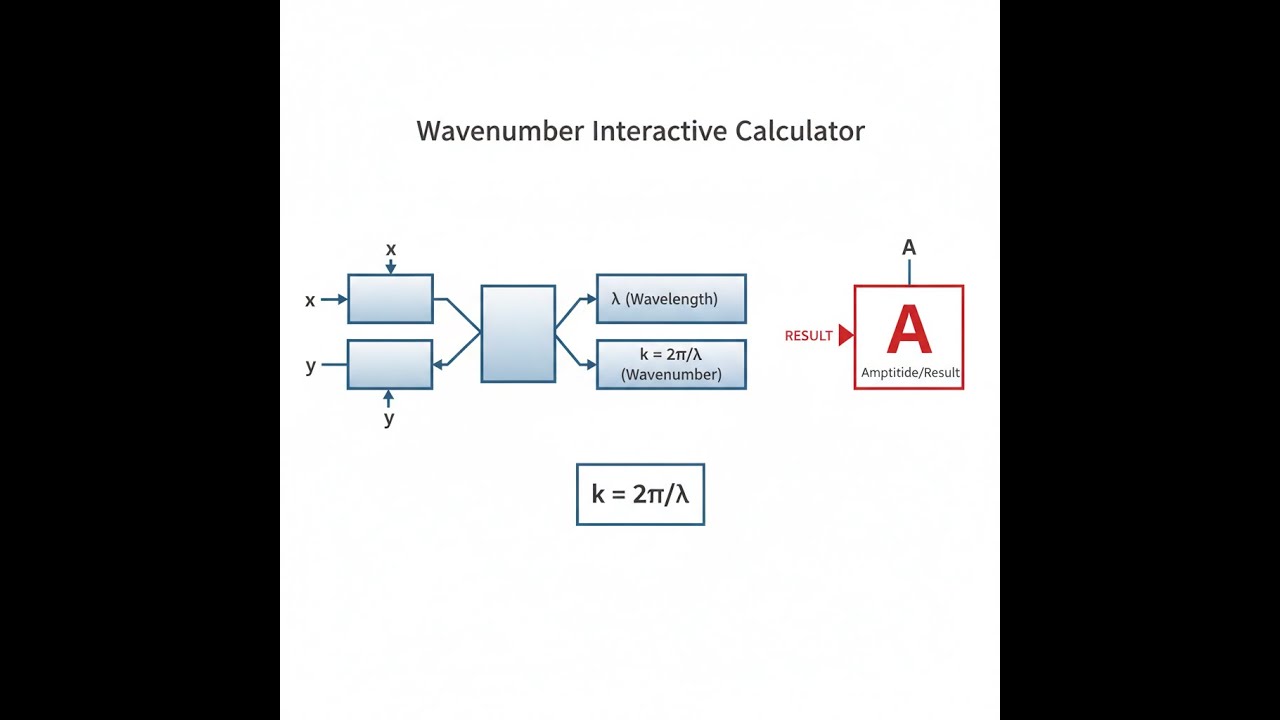
Wavenumber Interactive Visualizer
Use this visualizer to see how wavelength, frequency, and refractive index change wave spacing in real time. Move the sliders and watch how waves get compressed in denser materials, affecting the wavenumber calculation.
Angular k
1.14×10⁷
Spectroscopic ν̃
18,182 cm⁻¹
Frequency
545 THz
FIRGELLI Automations — Interactive Engineering Calculators
Fundamental Equations
Below are the main formulas for getting wavenumber from wavelength, frequency, phase velocity, or photon energy.
Angular Wavenumber:
k = 2π/λ = 2πf/vp = ω/vp
Spectroscopic Wavenumber:
ν̃ = 1/λ
Dispersion Relation (Free Space):
ω = ck
Quantum Dispersion:
E = ℏ²k²/(2m*)
Medium with Refractive Index:
k = nk0 = 2πn/λ0
k = angular wavenumber (rad/m)
ν̃ = spectroscopic wavenumber (cm⁻¹)
λ = wavelength (m)
λ0 = vacuum wavelength (m)
f = frequency (Hz)
ω = angular frequency (rad/s) = 2πf
vp = phase velocity (m/s)
n = refractive index (dimensionless)
E = energy (J or eV)
ℏ = reduced Planck constant = 1.054571817 × 10⁻³⁴ J·s
m* = effective mass (kg)
c = speed of light in vacuum = 299,792,458 m/s
Simple Example
Take green light in vacuum: 500 nm wavelength, refractive index 1.0.
- Angular wavenumber: k = 2π / (500 × 10⁻⁹ m) = 1.2566 × 10⁷ rad/m
- Spectroscopic wavenumber: ν̃ = 1 / (500 × 10⁻⁷ cm) = 20,000 cm⁻¹
- Frequency: f = 599.6 THz
- Photon energy: 2.480 eV
Theory & Practical Applications
Wavenumber measures how “dense” a wave is in space—the number of cycles fit into a distance. It’s the spatial analog of frequency. The angular version (k = 2π/λ) fits well with wave equations; the spectroscopic version (ν̃ = 1/λ) is common in IR/Raman because it links right to energy (E = hcν̃).
Dispersion Relations and Phase Velocity
The formula ω = vpk ties angular frequency and wavenumber through the phase velocity. In vacuum (em waves), it’s simply ω = ck: group velocity and phase velocity are the same. Once you hit a dispersive medium, things get more complicated. In fibers at 1550 nm, dispersion in silica shifts velocities so different colors (wavelengths) go at different rates (e.g. dvp/dλ ≈ -0.02 m/s/nm), which causes spreading of short pulses—practically, this means you hit a bandwidth limit (around 10 Gbit/s over 80 km in standard single-mode fiber without extra tweaks).
Materials show dispersion through the refractive index’s frequency dependence (n(ω)). The Sellmeier equation handles this for clear dielectrics. Semiconductors are a bit messier, because their electronic band structure gives very nonlinear dispersion. Using the parabolic approximation near the Γ-point in GaAs (E(k) = ℏ²k²/(2m*)), with m* = 0.067me, you get k = 5.27 × 10⁷ rad/m for electrons at 100 meV. The corresponding wavelength (119 nm) is much shorter than light but shows up in electron diffraction.
Spectroscopic Applications and Energy Units
Infrared spectroscopy always cites peaks in cm⁻¹ rather than wavelengths, because each vibrational state’s spacing scales directly with wavenumber. So, a typical C-H stretch near 2850 cm⁻¹ is 0.3533 eV—this is true no matter what instrument you measured with. Storing peaks as ν̃ numbers means spectral libraries are easy to build and compare, unlike when you use wavelength (which is tied to instrument geometry).
Raman uses the same logic but cites shifts from the laser line. Example: if you use a 532 nm laser (ν̃laser = 18,797 cm⁻¹), a feature at 1332 cm⁻¹ Stokes shift gives an absolute scattered light wavenumber of 17,465 cm⁻¹ (that’s 572.5 nm). You can immediately calculate that means a 165.2 meV phonon in diamond.
Refractive Index Effects and Optical Path Length
When light goes from air into a material with refractive index n, the wavenumber grows to k = nk0 (k0 in vacuum) while frequency holds steady. For a 1064 nm laser into BK7 glass (n = 1.5067), wavelength drops to 706.2 nm and k rises by 50%. This lets you focus tighter and build thin-film devices. The total phase shift is k × optical path (n × geometric length)—matters in coatings and etalons for interference.
Group velocity dispersion (GVD) quantifies how much pulses stretch. At 1550 nm, standard SMF-28 fiber gives +17 ps²/km; a short 1 ps pulse nearly doubles width over 1 km. Whenever you need ultrafast lasers and want to preserve those short pulses, you end up using negative dispersion components (chirped mirrors/prisms).
Worked Example: Multi-Layer Optical Coating Design
Problem: Design a quarter-wave anti-reflection stack for a silicon photodetector (nSi = 3.48) at 850 nm, alternating TiO2 (nH = 2.35) and SiO2 (nL = 1.46). Get the thickness and wavenumber in each layer and find the phase shift through a high-low (H-L) pair.
Solution:
Part A: Physical layer thickness: n·d = λ0/4
For TiO2: dH = 850 nm / (4 × 2.35) = 90.43 nm
For SiO2: dL = 850 nm / (4 × 1.46) = 145.55 nm
Part B: Wavenumber in each layer:
Vacuum k0 = 2π / (850 × 10⁻⁹ m) = 7.3912 × 10⁶ rad/m
TiO2: kH = 2.35 × 7.3912 × 10⁶ = 1.7369 × 10⁷ rad/m; wavelength inside = 361.7 nm
SiO2: kL = 1.46 × 7.3912 × 10⁶ = 1.0791 × 10⁷ rad/m; wavelength inside = 582.2 nm
Part C: Phase shift through each layer: TiO2: ΦH = 1.7369 × 10⁷ × 90.43 × 10⁻⁹ = 1.5708 rad = π/2 SiO2: ΦL = 1.0791 × 10⁷ × 145.55 × 10⁻⁹ = 1.5708 rad = π/2 Total for H-L pair: π rad (180°)
Part D: Reflectance check: One H-L pair: effective impedance neff = nL²/nH = 0.907 Air/coating: R1 = 3.5% Coating/silicon: R2 = 34.4% Bare silicon: Rbare = 30.6% A single H-L pair doesn’t cut reflectance much. Real AR coatings use more pairs—3 to 5 layers bring reflectance well below 1% via destructive interference.
Part E: Spectroscopic wavenumber at 850 nm: ν̃ = 1 / (850 × 10⁻⁷ cm) = 11,765 cm⁻¹ This shows up in ellipsometry—fringe spacing between maxima/minima lets you check thickness without cutting a test coupon.
Antenna Arrays and Spatial Filtering
For phased arrays, wavenumber is like spatial frequency. If elements are spaced d = λ/2, your spatial “sampling rate” is ks = 2π/d = 4π/λ. To prevent unwanted lobes, the maximum scanned wavenumber must stay below ks/2. In a 10 GHz radar (λ = 3 cm), d = 1.5 cm gives k = 209.44 rad/m and you get up to ±90° scan before lobes show up. You can space even tighter for more directionality, but element coupling becomes a problem.
Quantum Mechanics and Crystal Momentum
In solids, k isn’t ordinary momentum—it’s “crystal momentum” (ℏk), valid due to the periodic lattice. By Bloch’s theorem, states live only within |k| ≤ π/a (a = lattice constant). Silicon (a = 5.431 Å) gives a zone edge at 5.788 × 10⁹ rad/m. But the real conduction band edge is at much lower energy than a free electron would predict. In indirect gap materials, you need a phonon’s k for an electron to cross from valence to conduction band—the “conservation of momentum” is in k, not real space.
Measurement Techniques and Calibration
FTIR spectroscopy uses a stabilized HeNe laser to calibrate path difference, giving absolute wavenumber accuracy under 0.01 cm⁻¹—a big improvement over grating monochromators (limited by angular gear precision). Spectral processing natively works in ν̃, since all peak positions and width calculations stay linear and reliable as you add data to a library.
For further wave calculations, check out our engineering calculator library.
Frequently Asked Questions
Free Engineering Calculators
Explore our complete library of free engineering and physics calculators.
Browse All Calculators →🔗 Explore More Free Engineering Calculators
About the Author
Robbie Dickson — Chief Engineer & Founder, FIRGELLI Automations
Robbie Dickson brings over two decades of engineering expertise to FIRGELLI Automations. With a distinguished career at Rolls-Royce, BMW, and Ford, he has deep expertise in mechanical systems, actuator technology, and precision engineering.
Need to implement these calculations?
Explore the precision-engineered motion control solutions used by top engineers.


