Anytime you're sizing a power supply, picking wire, or trying to keep a motor out of trouble, you’re really just working with voltage, current, and resistance. With this Ohm’s Law Calculator, you can solve for voltage, current, resistance, and power as long as you know any two values. It’s a tool you reach for in electronics design, wiring up cars, or piecing together actuators. You’ll find the core formulas, a sample problem, extra technical details, and a practical FAQ below.
What is Ohm's Law?
Ohm’s Law ties together voltage, current, and resistance in any basic electrical circuit. If you know two of them, you can always work out the third. Once you’ve got those, power is straightforward too.
Simple Explanation
Picture electricity like water in a pipe. Voltage is the pressure pushing water along. Current is the flow rate through the pipe. Resistance is how tight the pipe is—higher resistance, less flow at the same pressure. Ohm’s Law just quantifies that relationship for circuits.
📐 Browse all 1000+ Interactive Calculators
Circuit Diagram

Ohm's Law Calculator
How to Use This Calculator
This calculator is intended for education, concept evaluation, and preliminary design. Results are based on the equations and assumptions described on this page, but cannot account for every real-world load case, tolerance, material property, environmental condition, installation detail, safety factor, code, or regulatory requirement. Verify all inputs, assumptions, units, and results independently before selecting components or using the result in a real application. Safety-critical, structural, medical, lifting, transportation, or regulated applications must be reviewed by a qualified engineer.
- Enter your known Voltage (V) in volts — leave blank if unknown.
- Enter your known Current (I) in amperes — leave blank if unknown.
- Enter your known Resistance (R) in ohms or Power (P) in watts as your second known value.
- Click Calculate to see your result.
Enter any two values to calculate the remaining electrical parameters:
📹 Video Walkthrough — How to Use This Calculator
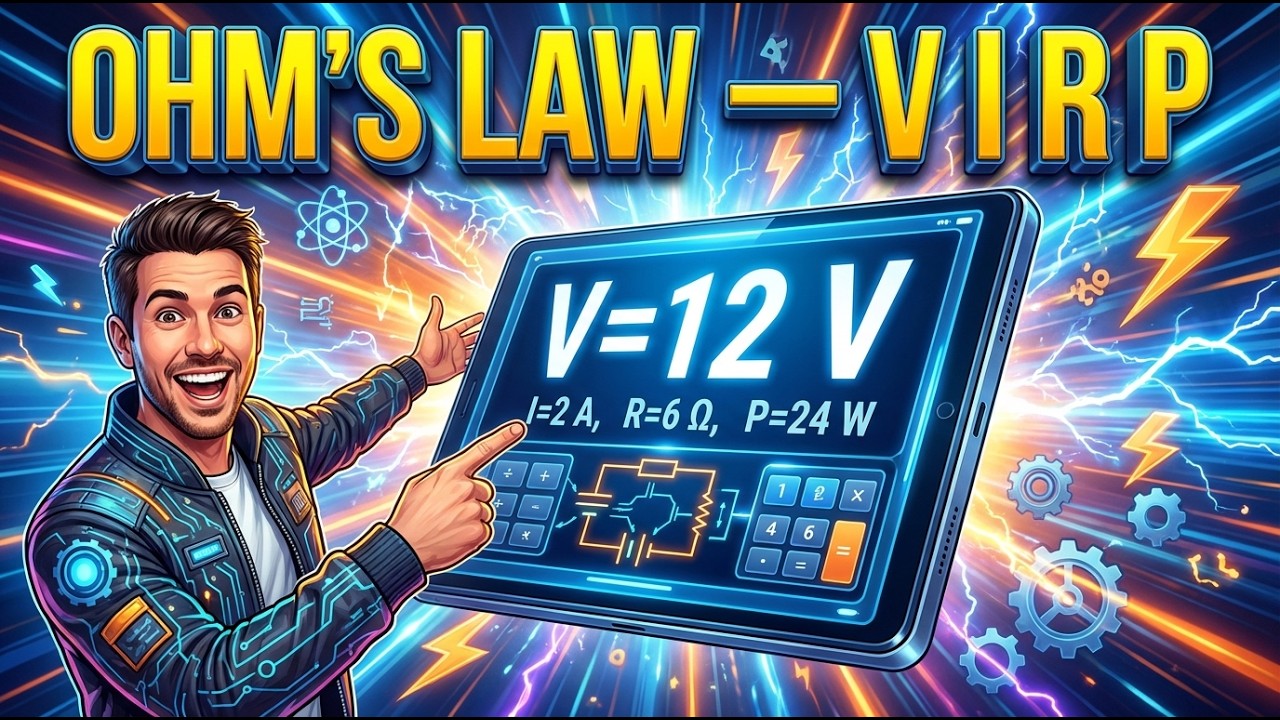
Ohm's Law interactive visualizer
Watch how voltage, current, resistance, and power relate to each other in real-time. Adjust any two values to instantly see the complete electrical circuit analysis with animated formulas and visual feedback.
RESISTANCE
4.0 Ω
POWER
36 W
FIRGELLI Automations — Interactive Engineering Calculators
Mathematical Equations
Use the formula below to calculate voltage, current, resistance, and power using Ohm's Law.
Ohm's Law Fundamental Equations
Basic Ohm's Law:
V = I × R
Voltage equals current times resistance
Power Equation:
P = V × I
Power equals voltage times current
Alternative Forms:
I = V / R R = V / I
P = I² × R P = V² / R
Simple Example
Given: Voltage = 12 V, Resistance = 4 Ω
Current: I = V / R = 12 / 4 = 3 A
Power: P = V × I = 12 × 3 = 36 W
All 4 values — V, I, R, P — solved from just 2 inputs.
Understanding Ohm's Law in Electrical Systems
Ohm’s Law is one of the most basic rules in electrical work. It’s a starting point for looking at voltage, current, and resistance in circuits. The calculator here is meant to cut through manual math when you’re figuring out basic parameters for circuit design or when troubleshooting something that isn’t working the way it should.
The Physics Behind Ohm's Law
Named after Georg Ohm, the law is simple: apply voltage to a resistor and you get current according to V = IR. If you double the voltage, you double the current—at least for materials that have constant resistance (ohmic materials). Most wires and resistors behave this way at everyday temperatures, so the law usually holds when you’re working with basic electric circuits.
The standard V = IR relationship works well for resistors, metal conductors, and a lot of “normal” parts working within their rated specs. If you start pushing currents or voltages beyond usual levels, resistance can change, which can throw off your numbers.
Power Relationships and Energy Considerations
The power equation P = VI tells you how quickly electrical energy gets turned into heat, light, or movement. In motors or actuators, the real-world concern is how much of that electrical input actually gets put to work, and how much turns into heat you have to get rid of.
Getting these numbers right is how you avoid cooking parts or leaving performance on the table. For FIRGELLI linear actuators, matching the power supply to the job and protecting against overheating comes back to voltage and current calculations.
Practical Applications in Actuator Systems
When you’re laying out actuator systems, Ohm’s Law gives you ballpark estimates for current draw and power needs. The calculator is most useful for picking the right supply, making sure your wires can handle the current, or choosing relays and controllers that aren’t undersized.
Take a 12V actuator with a 2.4 ohm motor: open circuit (no load), you get about 5 amps (I = 12/2.4 = 5A). Once you load it, actual current rises—because what the system sees as “resistance” includes more than the static coil resistance, and depends on speed, back-EMF, and load.
Worked Example: Actuator Power Calculation
Here’s a sample spec for a FIRGELLI actuator:
- Operating Voltage: 24V DC
- No-load Current: 2A
- Full-load Current: 8A
Plug into Ohm’s Law:
No-load Resistance: R = V/I = 24V/2A = 12 ohms
No-load Power: P = VI = 24V × 2A = 48 watts
Full-load Effective Resistance: R = V/I = 24V/8A = 3 ohms
Full-load Power: P = VI = 24V × 8A = 192 watts
You can see that under full load, power requirements ramp up fast. That has real consequences for wire sizing, power supply specs, and thermal protection—especially if you need your system to handle worst-case scenarios.
Design Considerations for Electrical Systems
In day-to-day design, don’t forget that Ohm’s Law gives you the ideal numbers. Real systems drift for a variety of reasons:
Temperature Effects
Resistance tends to climb as things get hot, especially with most metals. So your calculated current might drop as wiring or motor windings heat up. For anything running at high or fluctuating temperatures, check datasheets for temperature coefficients or derate accordingly.
Dynamic Loading Conditions
Loads that change in use—like motors—mean “resistance” (or more precisely, total opposition to current) isn’t fixed. When an actuator works against a heavy load, current increases and you need to account for this in control and protection circuits.
Voltage Regulation and Supply Considerations
Most power supplies don’t hold their output voltage perfectly steady under heavy load. Voltage sag means your numbers from Ohm’s Law are only as good as the supply’s ability to maintain rated output under real loading.
Advanced Applications and System Integration
If you’re using advanced controls like PWM or variable drives, the average voltage seen by the load changes over time. The core relationships of Ohm’s Law still underpin current and power, but you have to use average (RMS) values for calculations, not just the DC supply voltage.
In positioning applications, motor current can be used to infer load or stall conditions. Reading current, applying Ohm’s law, and watching load trends can help fine-tune closed-loop control or trigger safety shutdowns when something moves out of range.
Safety and Protection Circuit Design
Overcurrent protection—whether fuses, breakers, or electronic circuits—starts by knowing the normal and maximum circuit current from Ohm’s Law. Add a margin for startup surges or worst-case loading. It’s not foolproof, but it prevents a lot of headaches and toasted components.
Actual practice is to size protective devices to “just barely” avoid nuisance trips on startup, but not so large that real faults go undetected. The only shortcut is measurement—compare calculation with real results.
Efficiency Optimization
Reducing wasted energy usually means increasing circuit voltage (within component ratings) to deliver the same power with less current. Lower current cuts down wire losses (I²R), makes power supplies more manageable, and helps you run more efficiently—especially for longer cable runs or when multiple actuators move at once.
Frequently Asked Questions
📐 Browse all 1000+ Interactive Calculators →
About the Author
Robbie Dickson
Chief Engineer & Founder, FIRGELLI Automations
Robbie Dickson brings over two decades of engineering expertise to FIRGELLI Automations. With a distinguished career at Rolls-Royce, BMW, and Ford, he has deep expertise in mechanical systems, actuator technology, and precision engineering.
🔗 Related Engineering Calculators
More related engineering calculators:
- Wire Gauge Calculator Voltage Drop AWG
- Power Supply Sizing Calculator
- Battery Runtime Calculator Ah to Hours
- Led Resistor Calculator Current Limiting
- Capacitor Charge Discharge Calculator RC Circuit
- Resistor Color Code Calculator
- Transformer Turns Ratio Calculator
- Motor Torque Calculator Hp Rpm Torque
- Linear Actuator Force Calculator Incline With Friction
- Electric Motor Sizing Calculator
Browse all engineering calculators →
Need to implement these calculations?
Explore the precision-engineered motion control solutions used by top engineers.


