If you want to see how much pressure a fluid loses as it moves through a pipe, filter, or orifice, you're looking for differential pressure—which is just the pressure difference between two points in the system. You'll often check two spots: one before, and one after the restriction. This calculator lets you figure out ΔP, flow rate, upstream/downstream pressure, pipe pressure drops, and filter differential using details like density, pipe and filter geometry, viscosity, and flow. Differential pressure is a day-to-day measurement in hydraulics, HVAC, and process control work. The page lays out the formulas, a step-by-step engineering example, practical background, and a FAQ tailored to real typical jobs.
What is Differential Pressure?
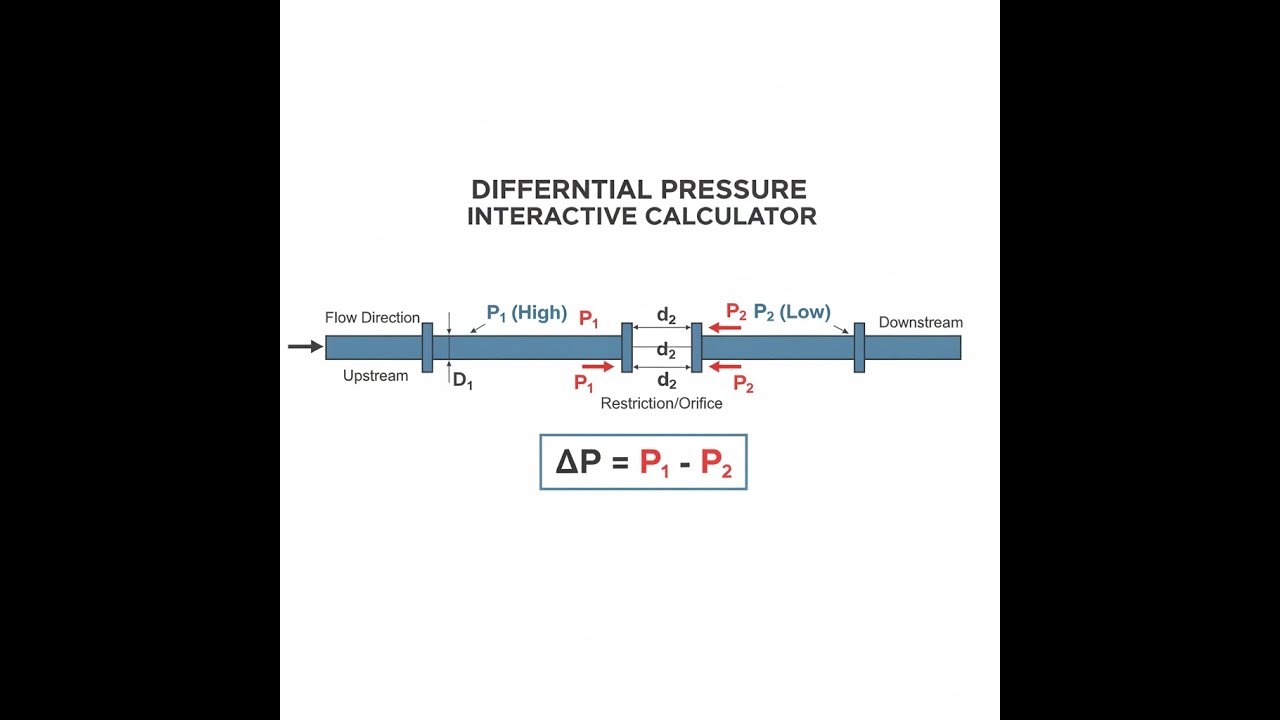
Differential pressure (ΔP) is the pressure loss as fluid moves from one point to another in a pipe or across some restriction. Usually, you measure upstream and downstream, for example before and after a filter, or across a valve. The difference tells you how much pushing force is lost getting past the obstacle.
Simple Explanation
Picture water moving through a garden hose that has a kink. Pressure will build up before the kink and drop after. That’s the differential pressure. If you make the restriction tighter or move fluid faster, the differential pressure rises. Engineers look at this value when checking flow, spotting a clogged filter, or working out what size pump they'll need.
📐 Browse all 1000+ Interactive Calculators
System Diagram

Differential Pressure Calculator
How to Use This Calculator
This calculator is intended for education, concept evaluation, and preliminary design. Results are based on the equations and assumptions described on this page, but cannot account for every real-world load case, tolerance, material property, environmental condition, installation detail, safety factor, code, or regulatory requirement. Verify all inputs, assumptions, units, and results independently before selecting components or using the result in a real application. Safety-critical, structural, medical, lifting, transportation, or regulated applications must be reviewed by a qualified engineer.
- Select your calculation mode from the dropdown — choose from differential pressure, flow rate, upstream/downstream pressure, pipe pressure drop, or filter ΔP.
- Enter the required inputs that appear for your selected mode — these may include pressures, fluid density, pipe diameter, orifice diameter, flow rate, viscosity, or filter geometry.
- Confirm your units match those shown next to each field (kPa, m, kg/m³, etc.).
- Click Calculate to see your result.
Differential Pressure Interactive Visualizer
Watch how fluid flows through restrictions and see real-time pressure drops across orifices, pipes, and filters. Adjust flow parameters to understand the relationship between velocity, geometry, and differential pressure.
DIFFERENTIAL PRESSURE
25.8 kPa
DOWNSTREAM PRESSURE
224.2 kPa
VELOCITY
17.7 m/s
FIRGELLI Automations — Interactive Engineering Calculators
Core Equations
Use the formula below to calculate differential pressure.
Basic Differential Pressure
ΔP = P1 - P2
Where:
- ΔP = Differential pressure (Pa, kPa, or psi)
- P1 = Upstream pressure (Pa, kPa, or psi)
- P2 = Downstream pressure (Pa, kPa, or psi)
Use the formula below to calculate orifice flow rate from differential pressure.
Orifice Flow Rate (ISO 5167)
Q = Cd A2 √[2ΔP / (ρ(1-β4))]
Where:
- Q = Volumetric flow rate (m³/s)
- Cd = Discharge coefficient (dimensionless, typically 0.60-0.62 for sharp-edge orifices)
- A2 = Orifice cross-sectional area (m²)
- ΔP = Differential pressure across orifice (Pa)
- ρ = Fluid density (kg/m³)
- β = Diameter ratio d/D (dimensionless)
Use the formula below to calculate pressure drop in a pipe using the Darcy-Weisbach method.
Darcy-Weisbach Pressure Drop
ΔP = f (L/D) (ρv²/2)
Where:
- ΔP = Pressure drop (Pa)
- f = Darcy friction factor (dimensionless)
- L = Pipe length (m)
- D = Pipe diameter (m)
- ρ = Fluid density (kg/m³)
- v = Flow velocity (m/s)
Use the formula below to calculate filter differential pressure using Darcy's Law.
Filter Differential Pressure (Darcy's Law)
ΔP = (μQt) / (KA)
Where:
- ΔP = Differential pressure across filter (Pa)
- μ = Dynamic viscosity (Pa·s)
- Q = Volumetric flow rate (m³/s)
- t = Filter thickness (m)
- K = Permeability of filter media (m²)
- A = Filter cross-sectional area (m²)
Simple Example
Upstream pressure P₁ = 200 kPa. Downstream pressure P₂ = 150 kPa.
ΔP = 200 − 150 = 50 kPa (= 7.25 psi = 0.5 bar).
That 50 kPa is the differential pressure across the restriction — whether it's a valve, filter, or section of pipe.
Theory & Practical Applications
Fundamental Physics of Differential Pressure
Differential pressure is just the pressure drop between two spots in a fluid system. This idea is simple, but the details matter. In real applications, you'll see pressure loss from friction in the pipe walls, turbulence, and restrictions. At the core, you're looking at energy losses in the system, not just textbook conservation. In practice, measuring the pressure drop is often much easier than measuring actual velocity, and it gives you enough to calculate flow or spot trouble like blockages, provided you know the constraints and fluid properties.
When fluid speeds up through a narrower section, static pressure drops. But most systems aren't ideal—viscous losses and turbulent mixing add more pressure loss than Bernoulli alone would predict. This is why the Darcy-Weisbach equation and the empirically-determined friction factor get used so much. In industry, you often don't have the luxury of "clean" conditions, so you lean on differential pressure because it's practical, robust, and diagnoses more than one problem at once.
Orifice Plate Flow Measurement: Practical Considerations
Orifice plates get used in industry because they’re cheap, simple, and physically tough. No moving parts means little to go wrong. Still, there's more to it than bolting on a plate: the discharge coefficient Cd isn't constant. It changes with Reynolds number, the ratio between orifice and pipe diameter (β), and where you put your pressure taps (the tap location matters more than most people realize). Standards like ISO 5167 give you ballparks, but these numbers only hold when you operate in the turbulent flow range—usually Re > 4000. Move much below that, and your numbers start to drift.
One thing often missed is that the differential pressure you measure isn’t all recoverable. Energy turns into turbulence and heat, not just static pressure. Roughly half to most of it is “lost”—meaning your pump has to make up for it with more work (and more operating cost over time). You have a tradeoff: if you want better metering accuracy (which usually means more ΔP), you burn more energy. If you want to save energy, measurement gets less accurate. In applications where you need both, venturi meters or flow nozzles can do better, offering less permanent loss, but they cost more up front and take up more space. In short: you’ll need to be clear about your priorities at the start.
Filter Differential Pressure Monitoring
If you work with filters (HVAC units, hydraulic returns, process lines), watching the ΔP across a filter is a direct way to tell when it's getting loaded or clogged. A clean filter has low ΔP, but as it fills up, ΔP climbs. Darcy’s Law fits well here: ΔP goes up linearly with flow and is inversely proportional to permeability (which drops as a filter gets dirty).
But don’t set a fixed ΔP alarm without thinking about flow rate. If you trigger a warning at 50 kPa in all situations, you may end up replacing clean filters during high flow, or running clogged filters at low flow without noticing. The engineering workaround is to normalize ΔP by flow (ΔP/Q), which gives you a “resistance” metric—this isn’t thrown off by flow swings and only rises when loading or plugging actually happens. This method is practical for extending filter life and keeping the system operating safely without frequent unnecessary service.
Compressible Flow and Critical Pressure Ratios
For liquids, you can often ignore compressibility. But when you're dealing with gases and the pressure ratio across your restriction gets much below about 0.75, density changes start to matter, and simple formulas miss the mark. For orifice meters on gas, ISO 5167 recommends applying an expansion factor to account for this. Things change even more when the pressure ratio P₂/P₁ drops low enough (for air, roughly below 0.528)—at that stage, you reach choked (sonic) flow where mass flow maxes out, no matter how much you drop the downstream pressure.
In real equipment: If you're sizing safety valves or pneumatic controls, you need to know when you hit this choked flow limit. At that point, downstream pressure changes don't affect the flow—the upstream supply sets your maximum. This is a key check for system safety and to avoid overestimating what your pressure relief or control valve can actually pass in an upset event.
Industrial Applications Across Sectors
In pharmaceutical plants, small differential pressures separate clean rooms; gradients as small as 15–25 Pa are critical, and the difference between rooms is carefully monitored. Transmitter accuracy here needs to be tight, since getting it wrong can mean shutdowns or batch loss.
Aerospace hydraulics rely on differential pressure to see if filters are clogging and if the bypass valve needs to open—these aren’t just nice-to-have features, but essential to keep flight-critical systems working. Typical setpoints are between 200–350 kPa, and if the limit is reached, flow bypasses the filter to maintain actuation (accepting the risk of running on unfiltered fluid for a short time).
In water treatment, ΔP across filtration membranes guides when to backwash. Dirt and fouling raise ΔP over time. Once it hits about 70–80% of the rated safe limit for the membrane, the control system triggers a cleaning cycle. Adjusting backwash timing based on ΔP instead of a timer reduces wasted water and extends membrane lifetime—no advanced controls, just good use of basic instrumentation readings.
Fully Worked Engineering Example: Filter Sizing for Hydraulic System
Problem: A mobile hydraulic system requires a return line filter to protect the pump from contamination. The system operates at a maximum flow rate of 95 L/min (0.001583 m³/s) using ISO VG 46 hydraulic oil (density ρ = 875 kg/m³, dynamic viscosity μ = 0.042 Pa·s at 40°C). The selected filter media has a permeability K = 2.8 × 10⁻¹¹ m², thickness t = 0.032 m, and effective filtration area A = 0.185 m². Calculate: (a) the clean filter differential pressure, (b) the differential pressure when filter permeability degrades to 40% of original due to contamination loading, (c) the filter replacement threshold if maximum allowable ΔP is 350 kPa, and (d) the permanent pressure loss assuming 15% pressure recovery.
Solution:
Part (a) — Clean Filter Differential Pressure:
Using Darcy's Law for porous media flow:
ΔP = (μQt) / (KA)
ΔP = (0.042 Pa·s × 0.001583 m³/s × 0.032 m) / (2.8 × 10⁻¹¹ m² × 0.185 m²)
ΔP = (2.128 × 10⁻⁶) / (5.18 × 10⁻¹²)
ΔP = 410,810 Pa = 410.8 kPa
Note: This exceeds the maximum allowable 350 kPa. The filter selection is inadequate. We need to recalculate required filter area:
Arequired = (μQt) / (K × ΔPmax)
Arequired = (0.042 × 0.001583 × 0.032) / (2.8 × 10⁻¹¹ × 350,000)
Arequired = 0.217 m²
Revised calculation with A = 0.217 m²:
ΔPclean = (0.042 × 0.001583 × 0.032) / (2.8 × 10⁻¹¹ × 0.217) = 350 kPa (at design maximum)
For proper margin, specify filter with A = 0.26 m² to provide clean ΔP approximately 75% of maximum:
ΔPclean = (2.128 × 10⁻⁶) / (2.8 × 10⁻¹¹ × 0.26) = 292.3 kPa
Part (b) — Differential Pressure at 40% Permeability:
When filter loads with contaminant, permeability decreases. At K = 0.40 × Koriginal:
Kfouled = 0.40 × 2.8 × 10⁻¹¹ = 1.12 × 10⁻¹¹ m²
ΔPfouled = (0.042 × 0.001583 × 0.032) / (1.12 × 10⁻¹¹ × 0.26)
ΔPfouled = 730.8 kPa
This far exceeds the 350 kPa maximum and would trigger bypass or system shutdown.
Part (c) — Filter Replacement Threshold:
The filter should be replaced when ΔP reaches 350 kPa. At this threshold, we can calculate remaining permeability:
Kthreshold = (μQt) / (ΔPmax × A)
Kthreshold = (2.128 × 10⁻⁶) / (350,000 × 0.26) = 2.34 × 10⁻¹¹ m²
Permeability degradation = (2.34 / 2.8) = 83.6% of original
The filter retains 83.6% permeability at replacement threshold — this provides safety margin before bypass activation.
Part (d) — Permanent Pressure Loss:
With 15% pressure recovery, permanent loss is 85% of differential pressure:
ΔPpermanent = 0.85 × 292.3 kPa = 248.5 kPa (clean filter)
Power loss = ΔP × Q = 248,500 Pa × 0.001583 m³/s = 393.5 W = 0.527 HP
This represents continuous parasitic power consumption. Over 2000 hours annual operation:
Energy waste = 393.5 W × 2000 h = 787 kWh/year
At industrial electricity rates of $0.12/kWh, this costs $94.40 annually in permanent pressure loss through the filter system.
Advanced Topics: Transient Differential Pressure in Pulsating Flows
Pumps and compressors that work in pulses (piston, plunger, reciprocating types) create rapidly changing pressure—much higher than the average. Standard pressure sensors tend to show only a moving average. To spot rapid spikes that can cause piping fatigue or noise, dampeners can be added, but they're only as good as their sizing and placement. For design or troubleshooting, use a high-frequency pressure transducer (at least 10–500 Hz depending on your equipment) to catch the peaks. This is vital for root cause analysis of vibration, wear, or noise in systems with strong pulsation.
Frequently Asked Questions
What causes differential pressure in a pipe system?
Why does the discharge coefficient vary for orifice plates?
How do I select the appropriate differential pressure range for a transmitter?
What is the difference between gauge pressure, absolute pressure, and differential pressure?
How does fluid viscosity affect differential pressure measurements?
Why do clean rooms require specific differential pressure control?
Free Engineering Calculators
Explore our complete library of free engineering and physics calculators.
Browse All Calculators →🔗 Explore More Free Engineering Calculators
- Irrigation Flow Rate Calculator — GPM per Acre
- Cavitation Check Calculator — NPSH Available vs Required
- Duct Sizing Calculator — Velocity Pressure
- Hydraulic Pump Flow Rate Calculator
- Fan Calculator
- Prandtl Number Calculator
- Broad Crested Weir Calculator
- Toggle Clamp Force Calculator
- Bolt Torque Calculator — Preload and Clamp Force
- Pneumatic Gripper Force Calculator
About the Author
Robbie Dickson — Chief Engineer & Founder, FIRGELLI Automations
Robbie Dickson brings over two decades of engineering expertise to FIRGELLI Automations. With a distinguished career at Rolls-Royce, BMW, and Ford, he has deep expertise in mechanical systems, actuator technology, and precision engineering.
Video Walkthrough - How to Use This Calculator
Need to implement these calculations?
Explore the precision-engineered motion control solutions used by top engineers.


