The leadscrew is the mechanical heart of any electric linear actuator, converting rotary motion from a motor into precise linear movement. Yet despite its critical role in determining actuator performance, the leadscrew often remains an overlooked specification — until an application demands higher efficiency, greater precision, or the ability to handle extreme loads. The type of leadscrew you select fundamentally shapes what your actuator can achieve: how fast it moves, how efficiently it converts power, how accurately it positions, and how long it lasts under demanding conditions.
🎥 Video — Types of Leadscrews Used in Actuators: From Acme to Ballscrews
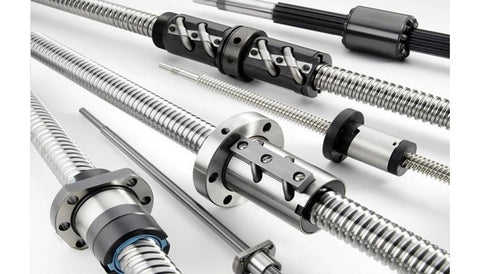
Since FIRGELLI Automations was founded in 2002, we've engineered linear actuators using various leadscrew technologies to match specific application requirements. From cost-effective Acme threads in home automation projects to precision ball screws in industrial actuators, the leadscrew choice directly impacts force capability, speed, duty cycle, and overall system efficiency. This comprehensive guide examines the three primary leadscrew technologies used in modern actuators — Acme leadscrews, ball screws, and planetary roller screws — detailing their mechanical principles, performance characteristics, typical applications, and how to select the right type for your project.
How Leadscrews Work in Linear Actuators
Before diving into specific leadscrew types, it's essential to understand the fundamental operating principle. A leadscrew mechanism consists of a threaded shaft (the screw) and a mating component with internal threads (the nut). When the screw rotates, the nut travels linearly along the screw's length — or conversely, when the nut rotates, the screw moves linearly. In most electric linear actuators, a motor drives the screw while the nut is prevented from rotating, creating linear output motion.
The thread pitch (distance between threads) determines the relationship between rotational and linear motion. A finer pitch produces more force but slower movement for a given motor speed, while a coarser pitch yields faster travel with reduced force output. This mechanical advantage is one reason leadscrews remain prevalent despite the availability of other linear motion technologies like belt drives or rack-and-pinion systems.
The critical performance differentiator between leadscrew types lies in how the screw and nut interface mechanically. Traditional designs use sliding contact between metal surfaces, while advanced designs incorporate rolling elements to dramatically reduce friction. This distinction cascades into differences in efficiency, load capacity, precision, speed capability, and cost.
Acme Leadscrews: Proven Reliability for Cost-Effective Motion
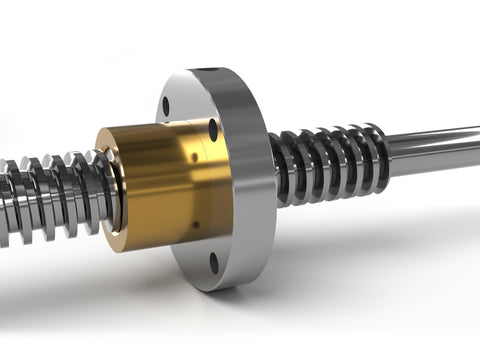
Acme leadscrews represent the most established leadscrew technology, with a design that dates back to the late 19th century. Named after the Acme Thread Company, these leadscrews feature a trapezoidal thread profile with a 29-degree included angle, standardized for interchangeability and ease of manufacturing. The relatively wide, robust thread form allows Acme screws to handle substantial loads while remaining cost-effective to produce.
Mechanical Characteristics of Acme Threads
The trapezoidal thread geometry of Acme leadscrews creates a sliding contact interface between the screw and nut. This direct metal-to-metal contact produces significant friction, which has both advantages and disadvantages. The friction provides inherent braking force — when power is removed, an Acme leadscrew actuator typically holds position without additional braking mechanisms, a property called "self-locking" when the lead angle is sufficiently small.
Typical Acme leadscrew efficiency ranges from 20% to 40%, meaning that 60-80% of input energy is lost to friction and heat. While this sounds inefficient, it's perfectly acceptable for intermittent-duty applications where the actuator operates for short periods. The friction also helps dampen vibration and provides smooth, controlled motion even at very low speeds.
Standard Acme thread sizes range from 1/4" to several inches in diameter, with leads (linear travel per revolution) commonly between 1/8" and 1/2" per revolution. For actuator applications, smaller diameter screws with finer leads are typical, balancing force output against speed and physical package size.
Where Acme Leadscrews Excel
Acme leadscrews dominate applications where moderate speed, modest precision, and cost-effectiveness are priorities. Many FIRGELLI linear actuators utilize Acme screws for residential and light commercial automation projects. Common applications include:
- Home automation systems: TV lifts, bed lifts, and cabinet actuators where speed and efficiency are less critical than cost and reliability
- Agricultural equipment: Positioning systems for implements and controls that operate intermittently
- Medical beds and dental chairs: Height adjustment and positioning mechanisms with low duty cycles
- Solar panel trackers: Positional adjustments that occur slowly throughout the day
- Industrial presses and jacks: Applications requiring high force with controlled, slow movement
The self-locking characteristic makes Acme screws particularly suitable for vertical lifting applications. A TV lift mechanism using an Acme leadscrew won't drop the load if power fails, providing an important safety feature without additional components.
Advantages and Limitations
The primary advantages of Acme leadscrews include low cost, simple design, quiet operation, and self-locking capability. They're also relatively tolerant of contamination — dirt and dust don't disable them as readily as precision ball screw mechanisms. Maintenance is straightforward, typically requiring only periodic lubrication with grease.
However, the limitations are significant for certain applications. The 20-40% efficiency means most input power converts to heat rather than useful work, limiting continuous duty cycles and requiring larger motors for a given force output. The sliding friction also produces wear over time, eventually requiring nut replacement. Speed is limited both by the efficiency losses (which increase with velocity) and the tendency toward thread wear at higher speeds. Finally, backlash — the slight play between screw and nut — can be problematic in applications requiring precise positioning or frequent direction reversals.
Ball Screws: Engineering Precision Through Rolling Elements
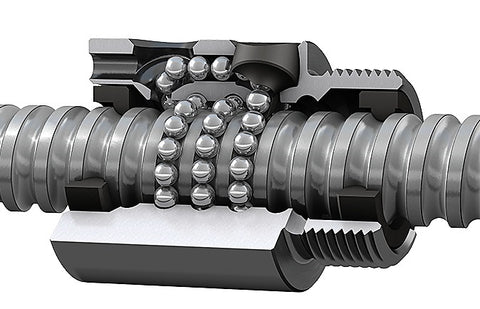
Ball screws represent a fundamental reimagining of leadscrew technology. Instead of sliding contact, ball screws use recirculating ball bearings that roll between precisely ground helical grooves in the screw shaft and the nut. This seemingly simple change transforms performance characteristics, achieving efficiencies of 90% or higher — more than double that of Acme screws.
Ball Screw Design and Operation
A ball screw assembly consists of a precision-ground screw shaft with semi-circular helical grooves, a nut with matching internal grooves, and dozens of hardened steel balls that circulate through the load-bearing path. As the screw rotates, the balls roll through the loaded section between screw and nut, then recirculate through return tubes or channels back to the beginning of the nut, creating a continuous loop.
The rolling contact dramatically reduces friction, with typical efficiency ratings of 90-95%. This means nearly all motor input power converts to useful linear motion rather than heat, enabling continuous-duty operation, smaller motors for equivalent force output, and significantly longer operational life. The precision grinding of both screw and nut achieves positioning accuracy measured in microns, with minimal backlash through preload adjustment.
Ball screws are manufactured to various precision grades, from ground screws for general industrial use (accuracy around ±0.002" per foot) to rolled screws for cost-sensitive applications, to precision-ground aerospace-grade units achieving accuracy of ±0.0001" per foot or better.
Industrial and Precision Applications
The high efficiency and precision of ball screws make them the standard choice for demanding industrial motion control applications. FIRGELLI's industrial actuators often incorporate ball screw mechanisms for applications requiring continuous operation or precise positioning:
- CNC machine tools: Axis drives requiring micron-level positioning accuracy and high repeatability
- Semiconductor manufacturing equipment: Wafer handling and positioning systems with stringent precision requirements
- Medical imaging equipment: CT and MRI gantry positioning systems requiring smooth, precise motion
- Packaging machinery: High-speed, continuous-duty applications where efficiency directly impacts operating costs
- Robotic systems: Multi-axis positioning where precision and repeatability are essential
- Standing desk mechanisms: Height adjustment systems that operate frequently throughout the workday
Ball screws are also the natural choice for high-speed applications. Where an Acme screw might be limited to 2-4 inches per second, a ball screw can readily achieve speeds of 10-20 inches per second or more, depending on the lead and critical speed (the rotational velocity at which the screw shaft becomes dynamically unstable).
Performance Benefits and Design Considerations
The advantages of ball screws are compelling: 90%+ efficiency reduces motor size and heat generation, enabling continuous-duty cycles. Precision grinding achieves positioning accuracy an order of magnitude better than Acme screws. The low friction produces minimal wear, extending service life to millions of cycles. High load capacity comes from distributing force across many ball contact points. And high-speed capability opens applications impossible with sliding-contact designs.
However, ball screws do present challenges. Cost is significantly higher than Acme screws — often three to five times more for the screw assembly alone, before considering the need for more sophisticated sealing and support bearing systems. The precision-ground components are sensitive to contamination; a single particle of grit can damage the raceways, causing premature failure. This sensitivity necessitates bellows or boot seals in many applications, adding cost and complexity.
Ball screws also lack the self-locking property of Acme designs. The low friction means a vertical ball screw actuator will back-drive under load when power is removed, requiring either a brake or continuous motor power for position holding. Finally, ball screws can be noisier than Acme screws, producing a characteristic humming or buzzing as the balls recirculate through the nut — acceptable in industrial settings but potentially objectionable in residential applications.
Planetary Roller Screws: Maximum Performance for Extreme Demands
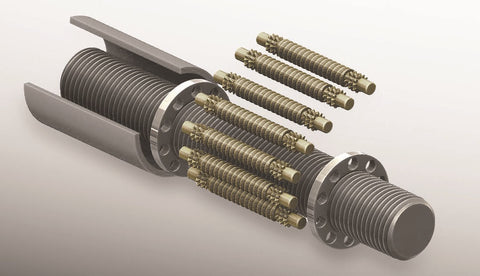
Planetary roller screws represent the apex of leadscrew technology, engineered for applications where standard ball screws reach their performance limits. Instead of ball bearings, planetary roller screws use multiple threaded rollers arranged around the central screw shaft, similar to a planetary gear system. This design distributes loads across vastly more contact points than ball screws, enabling extreme force capacity, high speed, and exceptional longevity.
Advanced Mechanical Design
The planetary roller screw assembly consists of a precision-ground threaded screw shaft, typically five to ten threaded planetary rollers arranged circumferentially around the screw, a nut housing that holds the rollers in position, and a ring gear that synchronizes roller rotation. As the screw rotates, each threaded roller engages both the screw threads and the nut threads, rolling along both surfaces simultaneously while orbiting the screw shaft.
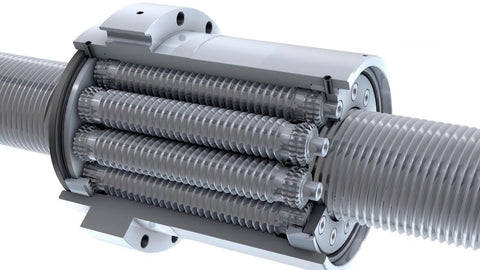
This configuration produces several dramatic advantages over ball screws. Load capacity increases by a factor of three to five because load distributes across multiple large rollers rather than point-contact ball bearings. The line contact between rollers and threads (as opposed to ball contact) provides greater contact area per roller. Efficiency remains high at 85-90%, not quite matching ball screws but far exceeding Acme designs. Most significantly, the robust roller contact enables shock load and dynamic load capabilities far beyond ball screw ratings.
Planetary roller screws are manufactured to exacting tolerances, with precision-ground threads on both screw and rollers. The mechanical advantage — the relationship between force input and force output — can be optimized through the number of thread starts on the screw and rollers, allowing designers to tune performance for specific applications.
Extreme-Performance Applications
Planetary roller screws serve applications where failure is not an option and where the performance envelope exceeds ball screw capabilities. Their use is primarily limited to aerospace, defense, and specialized industrial equipment due to cost and complexity:
- Aircraft primary flight controls: Actuators for ailerons, elevators, and rudders requiring high force, shock resistance, and absolute reliability
- Military vehicle systems: Tank gun stabilization and positioning systems operating in harsh environments
- Space launch systems: Thrust vector control actuators handling extreme dynamic loads
- Nuclear power facilities: Control rod positioning and safety systems where longevity and reliability are paramount
- Heavy industrial presses: Applications requiring hundreds of tons of force with precise position control
- Offshore drilling equipment: Positioning systems exposed to shock loads and harsh environmental conditions
The exceptional shock load capacity makes planetary roller screws uniquely suited for applications with sudden load changes. An aircraft control surface actuator may encounter rapid air load variations during maneuvers; a planetary roller screw handles these dynamic loads without damage that would rapidly degrade ball screw raceways.
When to Specify Planetary Roller Screws
The decision to use planetary roller screws typically comes down to three factors: extreme load requirements, shock/dynamic load conditions, or exceptionally long design life requirements. If your application demands continuous operation for tens of millions of cycles, handles shock loads exceeding 200% of static load, or requires force output beyond ball screw capability in a given package size, planetary roller screws merit consideration.
However, these advantages come at substantial cost — planetary roller screws typically cost five to ten times more than equivalent ball screws, and ten to twenty times more than Acme assemblies. The complexity also demands more sophisticated mounting and support systems. Most importantly, planetary roller screws require precise alignment and preload adjustment during installation, generally necessitating experienced engineering support.
Comparing Leadscrew Technologies: Selection Criteria
Selecting the appropriate leadscrew technology requires balancing multiple performance factors against cost and application requirements. Here's a systematic comparison across key parameters:
Efficiency and Power Requirements
Efficiency directly impacts motor sizing, heat generation, and operating cost. Acme leadscrews at 20-40% efficiency require motors 2-3 times larger than ball screws for equivalent performance. This inefficiency manifests as heat, limiting duty cycle and potentially requiring heat dissipation measures. Ball screws at 90%+ efficiency enable compact motor packages and continuous operation. Planetary roller screws at 85-90% efficiency sacrifice slightly to Acme designs but maintain high performance under load.
For intermittent-duty applications operating a few minutes per day, Acme efficiency is acceptable. For continuous or frequent operation, ball screw efficiency becomes economically compelling despite higher initial cost.
Positioning Accuracy and Backlash
Acme leadscrews typically achieve positioning accuracy of ±0.005" to ±0.020" depending on manufacturing quality, with backlash of 0.005" to 0.020". This is adequate for many automation tasks but insufficient for precision applications. Ball screws achieve ±0.001" to ±0.0001" accuracy depending on grade, with backlash reducible to near-zero through preload. Planetary roller screws match ball screw precision while maintaining accuracy under extreme loads.
Applications requiring precise positioning or frequent direction reversals without lost motion demand ball screw or planetary roller screw technology. If positioning within 0.010" is acceptable and motion is primarily unidirectional, Acme screws suffice.
Speed and Acceleration
Friction limits Acme screw speed to typically 2-6 inches per second, with higher speeds causing excessive heat and wear. Ball screws readily achieve 10-40 inches per second depending on lead and critical speed. Planetary roller screws match ball screw speeds while handling higher dynamic loads during acceleration and deceleration.
High-speed requirements generally preclude Acme technology, pointing toward ball screw or planetary roller screw solutions.
Load Capacity and Service Life
Load capacity depends on screw diameter, material, and thread geometry. Acme screws handle compressive loads well but are limited by friction-induced wear, with service life typically measured in tens of thousands of cycles. Ball screws distribute loads across many balls, achieving millions of cycles of rated load. Planetary roller screws exceed ball screw load capacity by 3-5x and can achieve tens of millions of cycles.
For light loads and infrequent operation, any technology suffices. Heavy continuous loads favor ball screws, while extreme loads or shock conditions require planetary roller screws.
Environmental Considerations
Acme leadscrews tolerate contamination reasonably well; dust and moisture affect performance gradually rather than catastrophically. Ball screws are sensitive to particle contamination and require environmental protection through boots or bellows in dusty or wet conditions. Planetary roller screws are similarly sensitive but can be specified with robust sealing for harsh environments.
Dirty industrial environments may favor Acme designs or require investing in proper sealing systems for ball/roller screws.
Leadscrew Selection in FIRGELLI Actuators
FIRGELLI Automations engineers actuator designs around leadscrew selection matched to application requirements. Our linear actuator product line incorporates Acme leadscrews for cost-effective positioning in home automation, light commercial equipment, and agricultural applications where intermittent duty cycles and moderate precision requirements align with Acme performance characteristics.
For applications requiring higher precision, faster operation, or continuous duty cycles, we offer feedback actuators that often incorporate ball screw mechanisms. The integrated position feedback enables closed-loop control for precise positioning, while the ball screw efficiency supports continuous operation without overheating.
When specifying an actuator for your project, consider these key questions:
- What duty cycle is required — seconds per day, minutes per hour, or continuous operation?
- What positioning accuracy is necessary for the application?
- What speed is required, and how quickly must the actuator accelerate?
- Will the actuator operate in a clean or contaminated environment?
- Is the mounting orientation vertical (requiring self-locking or braking)?
- What is the expected service life in cycles or years?
- How does initial cost compare to operating cost over the product lifetime?
These factors guide leadscrew technology selection and inform the broader actuator specification process.
Maintenance and Service Life Considerations
Leadscrew maintenance requirements vary significantly by technology. Acme leadscrews require periodic lubrication with grease or oil, typically every few thousand cycles or based on visible wear. The lubricant reduces friction and wear, but also attracts contaminants, necessitating cleaning and relubrication. Eventually, the nut wears and requires replacement — a straightforward process but requiring actuator disassembly.
Ball screws require cleaner lubrication, often specialized greases that don't attract particles. Maintenance intervals are longer due to lower wear rates, but contamination poses greater risk. A damaged ball or raceway can cause rapid failure, making environmental protection essential. Properly maintained ball screws in clean environments routinely achieve millions of cycles before requiring replacement.
Planetary roller screws require similar maintenance to ball screws but are more forgiving of marginal lubrication due to the line contact geometry. Their extreme durability means maintenance intervals can extend to major equipment overhauls rather than routine service.
When evaluating total cost of ownership, factor in maintenance labor, downtime for service, and replacement part costs over the expected product lifetime. An Acme screw actuator might cost less initially but require nut replacement every 50,000 cycles, while a ball screw actuator operates maintenance-free for 10 million cycles.
Emerging Leadscrew Technologies and Future Developments
Leadscrew technology continues evolving despite its century-long history. Recent developments include polymer-based nut materials that reduce friction and eliminate lubrication requirements, hybrid designs combining advantages of multiple technologies, and advanced surface treatments that extend service life and reduce friction.
Self-lubricating materials show promise for sealed, maintenance-free actuators in medical and food processing applications where traditional lubrication creates contamination risks. Advanced coatings on ball screw raceways reduce friction while improving corrosion resistance. Additive manufacturing may eventually enable complex roller screw geometries impossible with traditional machining, potentially reducing cost.
For electric actuator manufacturers like FIRGELLI, these developments enable new applications and improved performance in established markets. Our engineering team continuously evaluates emerging technologies for integration into next-generation actuator designs.
Making the Right Leadscrew Choice for Your Application
The leadscrew represents a fundamental design choice in any linear actuator system, with cascading effects on performance, cost, reliability, and service life. Acme leadscrews provide cost-effective motion for intermittent applications where moderate precision and self-locking capability align with requirements. Ball screws enable precision and efficiency for demanding industrial applications requiring continuous operation and accurate positioning. Planetary roller screws serve extreme applications where cost is secondary to ultimate performance and reliability.
Understanding these technologies empowers better actuator selection and system design. Whether you're developing a TV lift mechanism, industrial positioning system, or aerospace actuator, matching leadscrew technology to application requirements optimizes performance and cost-effectiveness.
As electric actuator technology advances, leadscrews remain at the mechanical heart of the system, converting motor rotation into controlled linear motion. The thread you choose truly does "spin the big wheels of innovation" — selecting wisely ensures your project achieves its performance goals within budget and timeline constraints.
Frequently Asked Questions
What is the efficiency difference between Acme and ball screw actuators?
Acme leadscrew actuators typically operate at 20-40% mechanical efficiency due to sliding friction between the screw threads and nut. This means 60-80% of motor input power converts to heat rather than useful linear motion. Ball screw actuators achieve 90-95% efficiency by using recirculating ball bearings that roll rather than slide, dramatically reducing friction. For example, moving a 100-pound load at the same speed might require a 200-watt motor with an Acme screw but only an 80-watt motor with a ball screw. This efficiency difference becomes critical in continuous-duty applications where the power savings in motor sizing and reduced heat generation quickly offset the higher initial cost of ball screw technology.
Do ball screw actuators self-lock like Acme screw actuators?
No, ball screw actuators generally do not self-lock when power is removed. The low friction that makes ball screws efficient also means they will back-drive under load — a vertical ball screw actuator will drop its load when unpowered. Acme leadscrew actuators with sufficiently fine thread pitch do self-lock, holding position without power due to the friction between screw and nut. This self-locking property makes Acme screws advantageous for vertical lifting applications like TV lifts or medical beds where load-holding is a safety requirement. If you need a ball screw actuator that holds position, you must add either a mechanical brake, continuous motor power with closed-loop control using feedback actuators, or a worm gear reducer that provides self-locking at the motor input.
How many cycles can I expect from different leadscrew types?
Service life varies dramatically based on leadscrew type, load, speed, and maintenance. Acme leadscrew actuators typically achieve 50,000 to 200,000 cycles before nut wear requires replacement, with life decreasing under heavier loads or inadequate lubrication. Ball screw actuators in properly maintained environments routinely achieve 5 to 50 million cycles depending on load as a percentage of rated capacity — operating at 50% of rated load extends life significantly compared to 100% rated load operation. Planetary roller screw actuators can achieve 50 to 100 million cycles or more due to their robust load distribution. For context, an actuator cycling once per minute in continuous operation would reach 500,000 cycles in one year, making ball screw technology essential for such demanding duty cycles.
Why are ball screw actuators noisier than Acme screw actuators?
Ball screw actuators produce a characteristic humming or buzzing sound as the steel balls recirculate through the nut assembly. This noise comes from two sources: the balls rolling through the loaded zone between screw and nut create mechanical vibration that transmits through the actuator housing, and the balls entering and exiting the recirculation tubes create impact noise. The frequency and loudness depend on ball diameter, screw rotation speed, and nut design. Acme screw actuators operate more quietly because the sliding contact between screw and nut doesn't generate the same mechanical vibration — the friction actually dampens vibration. For residential applications like TV lifts where noise is objectionable, Acme screw actuators often provide the better user experience despite lower efficiency. Some ball screw designs incorporate noise-reduction features like optimized recirculation paths, but they rarely match Acme silence.
Can I use a ball screw actuator in a vertical orientation?
Yes, but you must address the lack of self-locking to prevent back-driving under load. Vertical ball screw actuators require either a holding brake that engages when power is removed, a self-locking worm gear reducer between the motor and ball screw, or continuous power with position feedback control. The brake approach is common in industrial actuators where fail-safe load holding is required. Some actuator designs integrate an electromagnetic brake into the motor housing that engages when power is removed and releases when powered. Alternatively, always-powered designs use feedback actuators with position sensors and closed-loop control to actively maintain position. A third option is adding a mechanical lock or pin that engages at specific positions, though this limits positioning flexibility. For simple vertical applications without stringent efficiency requirements, Acme screw actuators with their inherent self-locking remain the most straightforward solution.
Can I replace an Acme screw with a ball screw in an existing actuator?
Retrofitting a ball screw into an actuator designed for an Acme screw is generally not practical due to fundamental design differences. Ball screws require precision support bearings at both ends to handle radial and axial loads while maintaining alignment — Acme screws typically use simpler bushing supports. The nut mounting interfaces differ substantially, and ball screw nuts are usually larger diameter than Acme nuts due to the recirculation system. Additionally, the motor sizing and gearing would need reevaluation since the ball screw's higher efficiency means the existing motor might be oversized, while the loss of self-locking requires adding a brake. If your application has outgrown an Acme screw actuator's capabilities, replacing the entire actuator with a ball screw design from FIRGELLI's industrial actuator line is more cost-effective and reliable than attempting a retrofit.


