When you're picking a light source for a material or tuning a detector to a specific band, you need to know the exact photon energy at the wavelength you're interested in. This calculator lets you translate back and forth between wavelength, frequency, and photon energy in electron volts or Joules. It's handy if you're doing spectroscopy work, choosing a semiconductor, or designing a photonic or laser system. The page includes formulas, a worked example for fiber optics, background theory, and an FAQ that gets into the weeds on things like materials, Doppler shift, and de Broglie wavelengths.
What is Wavelength to Energy Conversion?
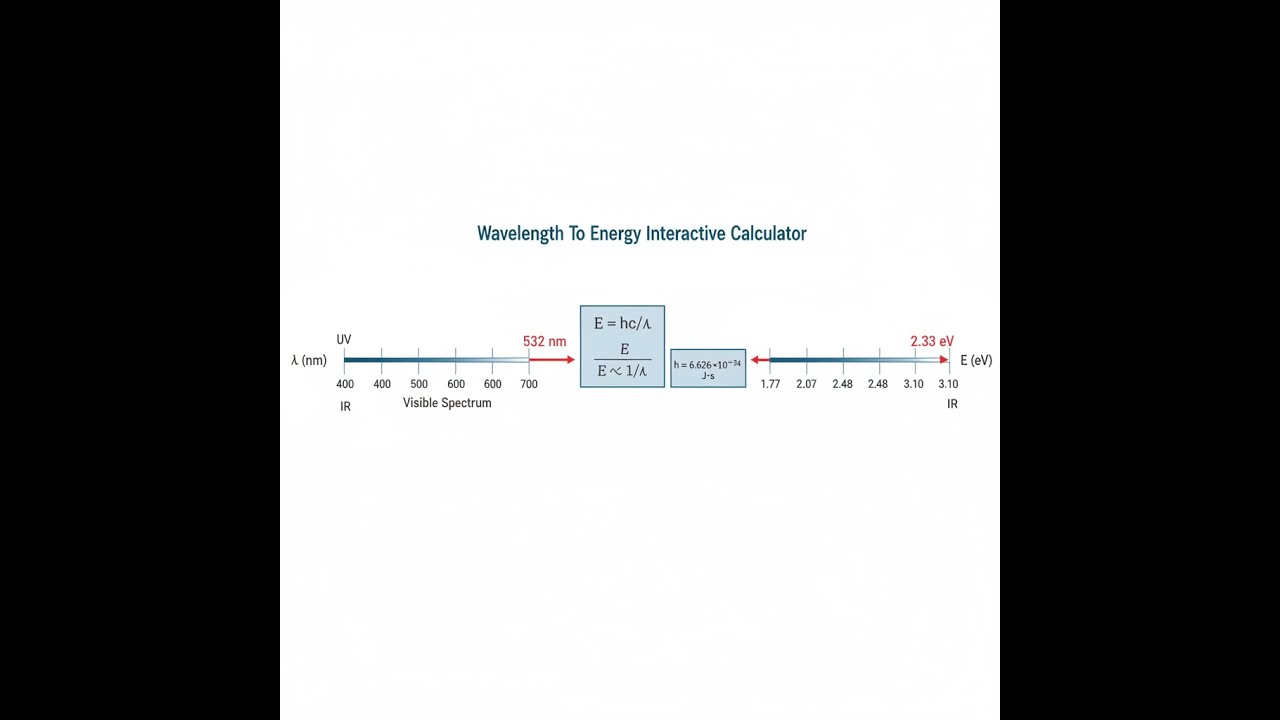
Converting wavelength to energy tells you the energy carried by a single photon at that wavelength. As wavelength goes down, photon energy goes up. This is fixed by the speed of light and Planck’s constant—it's a simple inverse proportionality.
Simple Explanation
Picture light as a wave on a rope: if you cram more waves into the same distance (shorter wavelength), each wave carries more of a hit. UV light has tightly packed waves and can actually break chemical bonds; infrared is more spread out and mostly just heats things up. This calculator just gives you a straight conversion from wavelength to how much energy each photon delivers.
📐 Browse all 1000+ Interactive Calculators
Energy-Wavelength Diagram

Wavelength to Energy Calculator
This calculator is intended for education, concept evaluation, and preliminary design. Results are based on the equations and assumptions described on this page, but cannot account for every real-world load case, tolerance, material property, environmental condition, installation detail, safety factor, code, or regulatory requirement. Verify all inputs, assumptions, units, and results independently before selecting components or using the result in a real application. Safety-critical, structural, medical, lifting, transportation, or regulated applications must be reviewed by a qualified engineer.
Wavelength to Energy Interactive Visualizer
Adjust the wavelength and see how photon energy shifts in real time. Notice how much larger the changes are at the short-wavelength, high-energy end compared to the long end. This is why UV lasers and blue LEDs need more careful engineering for thermal management and material selection.
PHOTON ENERGY
2.25 eV
FREQUENCY
545 THz
SPECTRUM
Visible
FIRGELLI Automations — Interactive Engineering Calculators
Key Equations
Here’s the basic formula you’ll need for photon energy as a function of wavelength:
Photon Energy (Planck-Einstein relation):
E = hf = hc / λ
Energy in electron volts:
E (eV) = 1240 / λ (nm)
Wavelength from energy:
λ = hc / E
Frequency-wavelength relationship:
f = c / λ
Where:
- E = photon energy (J or eV)
- h = Planck's constant = 6.626 × 10⁻³⁴ J·s
- f = frequency (Hz)
- c = speed of light = 2.998 × 10⁸ m/s
- λ = wavelength (m or nm)
- 1 eV = 1.602 × 10⁻¹⁹ J
- 1240 eV·nm = hc (convenient constant for visible light calculations)
How to Use This Calculator
- Pick your calculation mode from the dropdown—choose based on what you know (wavelength, eV, Joules, or frequency).
- Type your value into the right field—wavelength in nm, energy in eV or Joules, or frequency in Hz.
- You can use the Try Example button for a green laser (532 nm) to test the calculator before using your own numbers.
- Click Calculate to get your answer.
Simple Example
Green laser pointer, wavelength = 500 nm.
E = 1240 / 500 = 2.48 eV
In Joules: 2.48 × 1.602 × 10-19 = 3.97 × 10⁻¹⁹ J
Spectral region: Visible light. Photon color: Green.
Theory & Practical Applications
Quantum Nature of Light and the Planck-Einstein Relation
The connection between wavelength and photon energy goes back to the basics of quantum mechanics. Planck introduced the idea of energy quanta in 1900, and Einstein built on it in 1905 with the photoelectric effect, leading to the formula E = hf. Because frequency and wavelength are linked through the speed of light, this means energy and wavelength have an inverse relationship. In other words, as wavelength gets shorter, photon energy goes up.
This matters in practical ways: for example, a 400 nm violet photon carries 3.10 eV, but a 700 nm red photon carries only 1.77 eV, despite the wavelength barely doubling. This isn't linear, so it's easy to miss how quickly photon energy drops. In semiconductors, this is critical because the bandgap sets the minimum photon energy needed for a device to work. Take a silicon photodiode—bandgap 1.12 eV—if the wavelength is longer than about 1107 nm, those photons just pass through; the device does nothing, no matter how bright your source is.
Engineering Applications Across Industries
Semiconductor Device Design: Choosing LED or laser wavelengths to match a semiconductor bandgap always comes back to this calculation. A GaN LED (bandgap about 3.4 eV) gives you UV at 365 nm—good for things like fluorescence and photolithography. On the other end, telecom fiber optics often use 1550 nm (0.80 eV); you need indium gallium arsenide detectors with bandgaps below this value. Sizing things correctly up front avoids spending money on hardware that can’t work by design.
Optical Filter Specification: In spectroscopy and imaging, you often buy or spec filters by wavelength, but what really matters is whether they block or transmit the required energy for your application. For instance, if a notch filter is supposed to block a 532 nm laser, you need to check if it still blocks enough energy when the source wanders by a few nanometers due to heating. The energy shift may seem small, but it can be enough to reduce blocking, especially with sensitive detectors.
Solar Cell Optimization: In solar cell design, splitting up the spectrum based on material bandgap and energy lets you capture more energy efficiently. A triple-junction cell might use GaInP (1.86 eV, 667 nm), GaAs (1.42 eV, 873 nm), and Ge (0.66 eV, 1879 nm), each matched to different parts of the spectrum. You need the energy-wavelength conversion to set up and stack these layers so you don’t leave gaps in collected sunlight.
Medical Laser Systems: For medical laser applications—like treating blood vessels, hair removal, or tattoo removal—the difference in photon energy between two wavelengths can determine how deep you penetrate or what tissue you affect. The 532 nm KTP laser targets hemoglobin, while 1064 nm goes deeper for other work, based directly on the photon energy and its biological effect.
Worked Engineering Example: Optical Communication System Design
Problem: You want to design a fiber optic system around 1310 nm. You’re using a DFB laser and an InGaAs PIN diode with a 0.75 eV bandgap. You need to check if your detector really can pick up this signal, calculate the photon flux needed for -30 dBm sensitivity, and see what happens if the laser temperature goes up 40°C (wavelength drifts by 0.4 nm per °C).
Solution Part 1 - Photon Energy and Detection Verification:
First, calculate the photon energy at 1310 nm:
E = (6.626 × 10⁻³⁴ J·s)(2.998 × 10⁸ m/s) / (1310 × 10-9 m)
E = 1.516 × 10⁻¹⁹ J
In eV: 1.516 × 10⁻¹⁹ J / 1.602 × 10⁻¹⁹ J/eV = 0.946 eV
The detector bandgap is 0.75 eV, so you’ve got margin: 0.946 - 0.75 = 0.196 eV. This also allows for small changes in temperature that can lower the bandgap.
Solution Part 2 - Photon Flux Calculation:
A -30 dBm sensitivity requirement is 1 μW optical power. Photon flux is just power over energy per photon:
Φ = 1.0 × 10⁻⁶ W / 1.516 × 10⁻¹⁹ J = 6.60 × 10¹² photons/second
If your quantum efficiency is 0.85, then electrons per second = 0.85 × 6.60 × 1012 = 5.61 × 10¹². Multiply by the electron charge for photocurrent: 0.899 μA.
Solution Part 3 - Temperature-Induced Wavelength Shift:
Laser drifts by 0.4 nm/°C × 40°C = 16 nm, new wavelength is 1326 nm. Calculating new energy:
E' = (6.626 × 10-34 × 2.998 × 108) / (1326 × 10-9) = 1.498 × 10⁻¹⁹ J = 0.935 eV
So the photon energy drops by 0.011 eV, or about 1.2%. Not a huge shift for the detector, but if you’re in a dense WDM system with tight channel spacing, this much drift could cause serious issues with channel alignment and crosstalk—thermal stabilization may be required.
Non-Obvious Engineering Considerations
A common gotcha is assuming E = hc/λ still holds when you’re inside a material. In materials, wavelength is shorter due to the refractive index, but energy is always based on vacuum wavelength. For engineering, this is crucial in things like grating and photonic crystal designs: use the material wavelength for resonance, but vacuum wavelength for photon energy. Mix these up and you can be off by a large factor, especially in high-index materials.
When you're working with ultrafast laser pulses—say, 10 fs at 800 nm—the bandwidth gets wide (over 100 nm). That spreads the photon energies enough to make nonlinear effects like multi-photon absorption possible, even if your center wavelength says otherwise. Standard single-wavelength calculations don't catch this, so you need to watch for bandwidth effects in such systems.
For more detailed calculations covering other physics and engineering topics, our Engineering Calculator Hub has a full set of tools.
Frequently Asked Questions
▼ Why does shorter wavelength mean higher energy?
▼ What is the 1240 eV·nm constant and when should I use it?
▼ How do I convert between wavelength in air versus wavelength in a material?
▼ Can I use wavelength-to-energy conversion for particles other than photons?
▼ What energy units are most appropriate for different wavelength ranges?
▼ How does Doppler shift affect wavelength-to-energy conversion?
Free Engineering Calculators
Explore our complete library of free engineering and physics calculators.
Browse All Calculators →🔗 Explore More Free Engineering Calculators
About the Author
Robbie Dickson — Chief Engineer & Founder, FIRGELLI Automations
Robbie Dickson brings over two decades of engineering expertise to FIRGELLI Automations. With a distinguished career at Rolls-Royce, BMW, and Ford, he has deep expertise in mechanical systems, actuator technology, and precision engineering.
Video Walkthrough - How to Use This Calculator
Need to implement these calculations?
Explore the precision-engineered motion control solutions used by top engineers.


