Designing a microscope system—or selecting an objective—means confronting a hard physical limit: the Abbe diffraction limit. This boundary determines the smallest distance between 2 point sources that your optics can distinguish as separate, and no amount of lens quality can push past it. Use this Microscope Resolution Abbe Calculator to calculate both lateral and axial resolution limits using wavelength, numerical aperture, and refractive index. Optical engineers, cell biologists, and semiconductor inspection teams rely on these numbers for objective selection, immersion medium choice, and imaging protocol design. This page covers the Abbe and Rayleigh formulas, a worked confocal design example, practical application scenarios, and an FAQ.
What is the Abbe diffraction limit?
The Abbe diffraction limit is the minimum spacing between 2 points in a microscope image that can be seen as separate—set by the wavelength of light and the numerical aperture of the objective. No conventional lens can resolve detail finer than this boundary.
Simple Explanation
Think of it like trying to read two words printed too close together—at some point, no matter how good your eyes are, the letters blur into one. In a microscope, light itself behaves like those letters: it spreads out as it passes through any lens, and that spreading sets a hard floor on how fine a detail you can ever see. A shorter wavelength of light and a wider-angle objective both push that floor lower, giving you sharper images.
📐 Browse all 1000+ Interactive Calculators
Table of Contents
Optical System Diagram

Microscope Resolution Abbe Calculator
How to Use This Calculator
- Select a calculation mode from the dropdown—lateral resolution, axial resolution, required wavelength, required NA, multi-wavelength comparison, or resolution at magnification.
- Enter the wavelength of light in nanometers, the numerical aperture of your objective, and the refractive index of the immersion medium.
- If your mode requires a target resolution or magnification value, enter those in the additional fields that appear.
- Click Calculate to see your result.
Simple Example
Imaging with green light at 550 nm through an oil immersion objective with NA = 1.4:
- Lateral resolution: d = (0.61 × 550) / 1.4 = 239.6 nm
- Axial resolution: z = (2 × 1.518 × 550) / (1.4²) = 848.6 nm
Switch to a 405 nm violet laser with the same objective and lateral resolution drops to ~176 nm—a meaningful improvement without changing any hardware.
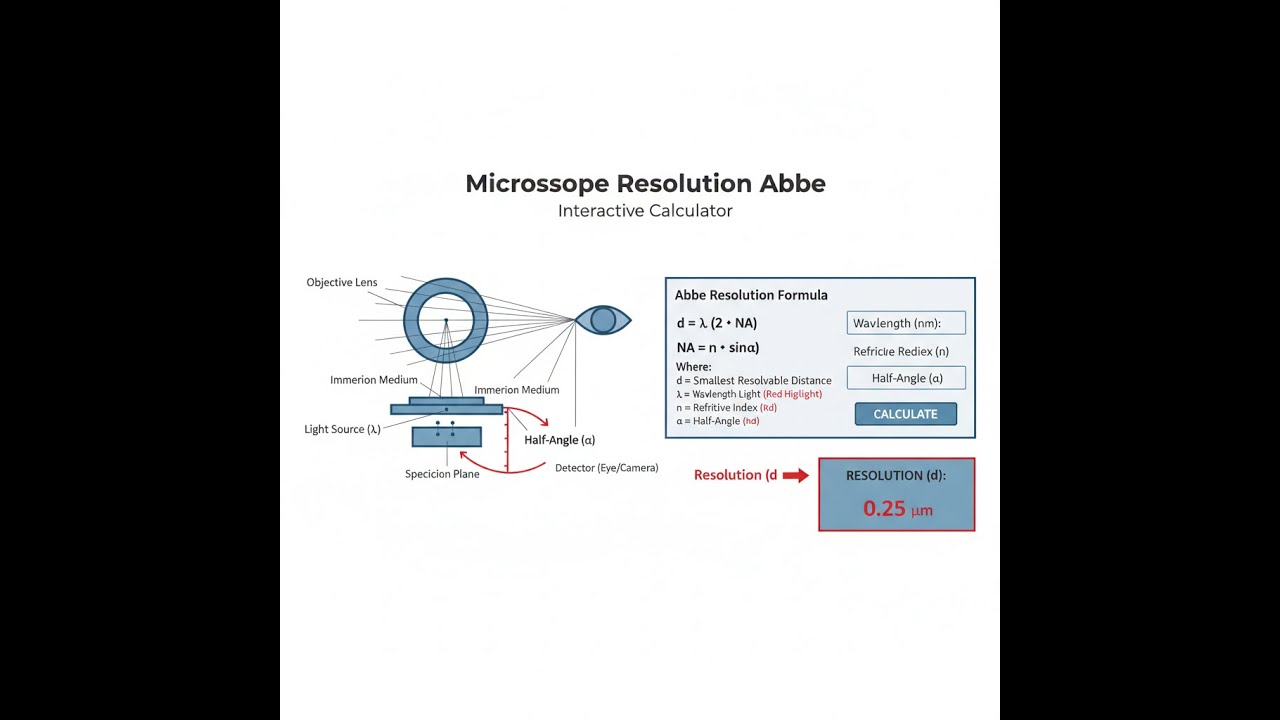
Microscope Resolution Abbe Interactive Calculator
Visualize how wavelength and numerical aperture control the Abbe diffraction limit in real-time. Watch resolution circles shrink as you optimize your microscope parameters for maximum detail.
LATERAL RESOLUTION
336 nm
AXIAL RESOLUTION
1100 nm
RESOLUTION QUALITY
Good
FIRGELLI Automations — Interactive Engineering Calculators
Resolution Equations
Use the formula below to calculate lateral resolution using the Abbe diffraction limit.
Abbe Lateral Resolution (Rayleigh Criterion)
d = 0.61λ / NA
Where:
- d = Minimum resolvable distance (lateral resolution) in nanometers
- λ = Wavelength of light in nanometers
- NA = Numerical aperture (dimensionless, typically 0.1 to 1.6)
- 0.61 = Rayleigh criterion constant for circular apertures
Use the formula below to calculate axial resolution (depth of field).
Axial Resolution (Depth of Field)
z = 2nλ / NA²
Where:
- z = Axial resolution (depth discrimination) in nanometers
- n = Refractive index of immersion medium (1.0 for air, 1.33 for water, 1.518 for oil)
- λ = Wavelength of light in nanometers
- NA = Numerical aperture (dimensionless)
Use the formula below to calculate numerical aperture from the immersion medium and half-angle.
Numerical Aperture Definition
NA = n · sin(α)
Where:
- NA = Numerical aperture
- n = Refractive index of medium between specimen and objective
- α = Half-angle of maximum cone of light entering objective (degrees)
Use the formula below to calculate the Sparrow criterion as an alternative resolution limit.
Sparrow Criterion (Alternative Resolution Limit)
dSparrow = 0.47λ / NA
The Sparrow criterion represents the point where two Airy disks can just barely be distinguished with no dip in intensity between them, providing a slightly tighter resolution limit than the Rayleigh criterion.
Theory & Engineering Applications
Fundamental Diffraction Physics and the Abbe Limit
Ernst Abbe's 1873 formulation of optical resolution fundamentally changed microscopy by establishing that the resolution limit stems not from lens imperfections but from the wave nature of light itself. When coherent light passes through a circular aperture, diffraction creates an Airy disk pattern where the central bright region is surrounded by concentric rings of decreasing intensity. The Rayleigh criterion, which uses the 0.61 factor in Abbe's equation, defines resolution as the minimum separation where the central maximum of one Airy disk coincides with the first minimum of the adjacent disk, producing a 26.3% dip in combined intensity between the two points.
The numerical aperture represents the light-gathering power and resolving ability of an objective lens, defined as the product of the refractive index of the imaging medium and the sine of the half-angle of the maximum cone of light entering the lens. This parameter fundamentally constrains resolution because it determines how many diffracted orders from the specimen can be collected. In confocal microscopy and structured illumination systems, engineers exploit the nonlinear relationship between NA and both lateral and axial resolution—note that axial resolution degrades as the square of NA, creating the characteristic elongation of the point spread function along the optical axis.
Immersion Media and High-NA Objectives
The theoretical maximum NA for dry objectives operating in air (n = 1.0) is approximately 0.95, limited by practical lens geometries and working distances. Oil immersion objectives achieve NA values up to 1.6 by replacing the air gap with immersion oil (n ≈ 1.518), closely matching the refractive index of standard cover glass. This eliminates refraction at the glass-air interface, allowing larger cone angles and capturing higher-order diffracted light that would otherwise undergo total internal reflection. Water immersion objectives (NA up to 1.3) serve as a compromise for live-cell imaging where oil can be toxic or impractical.
A critical but often overlooked limitation involves the cover glass thickness specification. Objectives designed for 0.17mm cover glass (#1.5) experience spherical aberration when used with incorrect thickness, degrading both resolution and contrast. The aberration increases dramatically with NA—a 1.4 NA objective shows significant degradation with just 10 micrometers of deviation from nominal thickness, while a 0.5 NA objective tolerates much larger errors. Modern correction collars on high-NA objectives compensate for this by adjusting internal lens spacing.
Wavelength Selection and Multi-Color Imaging
The linear dependence of resolution on wavelength creates a direct trade-off between resolution and fluorophore selection in fluorescence microscopy. Violet lasers at 405nm provide 26.5% better lateral resolution than red lasers at 640nm when using identical NA objectives. However, shorter wavelengths increase phototoxicity in live cells and often provide poorer penetration depth in thick specimens due to increased scattering. This drives sophisticated microscope designs using sequential imaging with multiple wavelengths, where registration algorithms must account for chromatic aberration and the wavelength-dependent point spread function.
In confocal systems, the effective resolution improves approximately by the square root of two compared to widefield microscopy due to the multiplicative effect of excitation and emission point spread functions. This relationship means a 488nm confocal system achieves resolution comparable to a 345nm widefield system—a wavelength not practical for most applications due to UV absorption by optical materials and severe cellular damage.
Axial Resolution and Three-Dimensional Imaging
The axial resolution equation reveals that depth discrimination is fundamentally worse than lateral resolution, typically by a factor of 2-3 for high-NA objectives. This anisotropic resolution creates elongated point spread functions that complicate three-dimensional reconstruction and quantitative volume measurements. Deconvolution algorithms can partially compensate by using knowledge of the theoretical point spread function to reassign out-of-focus light, but these techniques require careful calibration and fail when noise levels become significant.
The squared dependence of axial resolution on NA means that improvements in NA provide dramatically better depth discrimination—increasing NA from 1.3 to 1.4 improves axial resolution by 16.5%. This nonlinear relationship explains why manufacturers invest heavily in developing ultra-high NA objectives despite the engineering challenges of maintaining field flatness, working distance, and chromatic correction at these extreme parameters.
Worked Engineering Example: Confocal Microscope Design
Problem: A biomedical research laboratory is designing a confocal fluorescence microscope for imaging subcellular structures in fixed tissue sections. The primary fluorophore emits at 520nm (green). The team must determine whether a 1.3 NA water immersion objective or a 1.4 NA oil immersion objective is required to resolve structures with 180nm lateral spacing. Additionally, they need to calculate the axial resolution and determine the optimal pinhole size for the confocal aperture.
Given Data:
- Emission wavelength: λ = 520 nm
- Target lateral resolution: dtarget = 180 nm
- Option A: NA = 1.3 (water immersion, n = 1.33)
- Option B: NA = 1.4 (oil immersion, n = 1.518)
- Confocal improvement factor: √2 ≈ 1.414
Solution - Part 1: Lateral Resolution Calculation
For widefield microscopy using Option A (NA = 1.3):
dA = 0.61λ / NA = (0.61 × 520 nm) / 1.3 = 317.2 nm / 1.3 = 244.0 nm
For confocal microscopy with Option A:
dconfocal,A = 244.0 nm / 1.414 = 172.5 nm
For widefield microscopy using Option B (NA = 1.4):
dB = (0.61 × 520 nm) / 1.4 = 317.2 nm / 1.4 = 226.6 nm
For confocal microscopy with Option B:
dconfocal,B = 226.6 nm / 1.414 = 160.3 nm
Analysis: The 1.3 NA water immersion objective achieves 172.5 nm confocal resolution, which meets the 180 nm requirement with a 4% margin. The 1.4 NA oil objective provides 160.3 nm resolution, exceeding requirements by 11%.
Solution - Part 2: Axial Resolution Calculation
For Option A (water immersion):
zA = 2nλ / NA² = (2 × 1.33 × 520 nm) / (1.3²) = 1383.2 nm / 1.69 = 818.5 nm
For confocal mode:
zconfocal,A = 818.5 nm / 1.414 = 578.9 nm
For Option B (oil immersion):
zB = (2 × 1.518 × 520 nm) / (1.4²) = 1578.7 nm / 1.96 = 805.5 nm
For confocal mode:
zconfocal,B = 805.5 nm / 1.414 = 569.7 nm
Solution - Part 3: Optimal Pinhole Diameter
The optimal confocal pinhole diameter equals 1.0 Airy unit, which corresponds to the diameter of the first Airy disk minimum in the detection path. For Option B (oil, NA = 1.4), assuming a 200mm tube lens focal length and 520nm emission:
Airy disk diameter = 1.22λf / (NA × Mobj) where Mobj is objective magnification (assume 63x):
Airy diameter = (1.22 × 520 nm × 200 mm) / (1.4 × 63) = 127,440 nm·mm / 88.2 = 1445 μm ≈ 31.7 μm at the pinhole plane
Recommendation: Select the 1.4 NA oil immersion objective. While the 1.3 NA water objective technically meets requirements, the oil objective provides superior axial resolution (569.7 nm vs 578.9 nm) and greater margin in lateral resolution. The oil interface also eliminates spherical aberration from refractive index mismatch with the cover glass. Use a pinhole diameter of 30-35 μm (approximately 1.0 Airy units) for optimal optical sectioning while maintaining adequate signal levels.
Beyond the Diffraction Limit: Super-Resolution Techniques
Modern super-resolution microscopy methods circumvent the Abbe limit through various mechanisms. Stimulated emission depletion (STED) microscopy uses a donut-shaped depletion beam to suppress fluorescence everywhere except a sub-diffraction region, effectively shrinking the point spread function. Structured illumination microscopy (SIM) uses patterned illumination to encode high-spatial-frequency information into the passband of the optical system, achieving approximately 2x resolution improvement. Single-molecule localization methods like PALM and STORM achieve 20-30nm resolution by sequentially imaging and precisely localizing individual fluorophores, though at the cost of temporal resolution.
These techniques trade various parameters—acquisition speed, photobleaching, complexity, or applicability to live samples—for improved resolution. Understanding the Abbe limit remains critical even in super-resolution work because it defines the starting point from which these advanced methods build their improvements and constrains fundamental parameters like the photon budget available for localization precision.
Practical Applications
Scenario: Cell Biology Research Lab
Dr. Chen is studying the spatial organization of nuclear pore complexes in human cells using immunofluorescence with a green fluorescent secondary antibody (emission peak 518nm). Previous literature suggests these structures have a ring diameter of approximately 120nm. She needs to determine if her existing 1.3 NA oil immersion objective can resolve individual pore complexes or if she needs to request time on the department's super-resolution microscope. Using this calculator with λ=518nm and NA=1.3, she calculates a lateral resolution of 243nm. Since this exceeds the 120nm feature size by more than 2x, she realizes conventional microscopy will show the pores as diffraction-limited spots without resolving internal structure. The calculator confirms she needs either STED microscopy or a structured illumination approach to visualize the ring architecture, helping her write a more accurate equipment request and experimental timeline.
Scenario: Semiconductor Inspection System Design
Marcus, an optical engineer at a semiconductor metrology company, is designing an automated defect inspection system for 7nm node photomasks. The system must detect particles and pattern defects down to 150nm using a 405nm LED illumination source. He uses this calculator in "Required Numerical Aperture" mode, entering λ=405nm and target resolution of 150nm. The calculator determines he needs NA=1.64, which exceeds the practical limit for conventional objectives. This calculation drives a critical design decision: the team must either switch to deep-UV illumination at 266nm (where NA=1.1 would suffice) or implement a scanning electron microscope approach for this inspection layer. The axial resolution calculation of 327nm also confirms that depth of focus will be extremely shallow, requiring precision focus tracking with piezo stages having sub-100nm position accuracy.
Scenario: Pathology Quality Control
A clinical pathology laboratory is validating a new digital slide scanner for telepathology consultations. The scanner uses a 0.75 NA objective with broadband white light (effective wavelength 550nm for resolution purposes) to image hematoxylin and eosin stained tissue sections. The quality assurance team needs to verify that nuclear detail and cytoplasmic features are adequately resolved for diagnostic interpretation. Using this calculator, they determine the system's lateral resolution is 448nm. They compare this to the "magnification mode" calculation showing that at the scanner's 400x total magnification, the system is slightly under-magnifying (empty magnification would be 750x), meaning fine details are adequately sampled. However, when testing with lymphocyte identification (nuclei approximately 6-8 micrometers), the calculator confirms that nuclear membrane details and chromatin texture at the 300-400nm scale fall right at the resolution limit, explaining why pathologists report subtle differences between physical microscopy and digital review for hematologic specimens.
Frequently Asked Questions
Free Engineering Calculators
Explore our complete library of free engineering and physics calculators.
Browse All Calculators →🔗 Explore More Free Engineering Calculators
About the Author
Robbie Dickson — Chief Engineer & Founder, FIRGELLI Automations
Robbie Dickson brings over two decades of engineering expertise to FIRGELLI Automations. With a distinguished career at Rolls-Royce, BMW, and Ford, he has deep expertise in mechanical systems, actuator technology, and precision engineering.
Need to implement these calculations?
Explore the precision-engineered motion control solutions used by top engineers.


