If you're working with solar sails, optical traps, or laser propulsion setups, you need a clear way to figure out how much force light actually puts on a surface. The calculator below lets you solve for pressure, force, intensity, power, or acceleration using basic quantities: intensity, beam power, area, reflection coefficient, and mass. These numbers matter anywhere momentum from light has a real effect—solar sail propulsion, laser cooling, optical tweezers, or when building a detailed astrophysical model. You'll find the core formulas, step-by-step worked example, and context for when this simple physics actually moves something measurable.
What is radiation pressure?
Radiation pressure is simply the push per unit area from light—or any electromagnetic radiation—when it strikes something. If the surface reflects the light, you'll see more pressure than if it just absorbs it. That's because bouncing light actually reverses its momentum, so more gets transferred to the surface.
Simple Explanation
Picture photons like little rubber balls hitting a wall. If the wall just absorbs them, it gets a nudge. If the wall bounces them back, it gets a bigger nudge—basically double—since the direction flips. That's light hitting a surface: absorption gives a standard push, reflection gives twice that. It's not just theory—solar sails use this as their main source of thrust.
📐 Browse all 1000+ Interactive Calculators
How to Use This Calculator
- Pick a calculation mode—options include pressure from intensity, force from intensity and area, required power from force, etc.
- Put in your needed values (intensity, area, beam power, pressure, etc.—units are shown for each).
- Set the reflection coefficient: 0 for an absorbing surface, 1 for a mirror, or something in between if you're dealing with real materials.
- Hit Calculate to get your result.
Visual Diagram: Radiation Pressure on Surface

Interactive Radiation Pressure Calculator
This calculator is intended for education, concept evaluation, and preliminary design. Results are based on the equations and assumptions described on this page, but cannot account for every real-world load case, tolerance, material property, environmental condition, installation detail, safety factor, code, or regulatory requirement. Verify all inputs, assumptions, units, and results independently before selecting components or using the result in a real application. Safety-critical, structural, medical, lifting, transportation, or regulated applications must be reviewed by a qualified engineer.
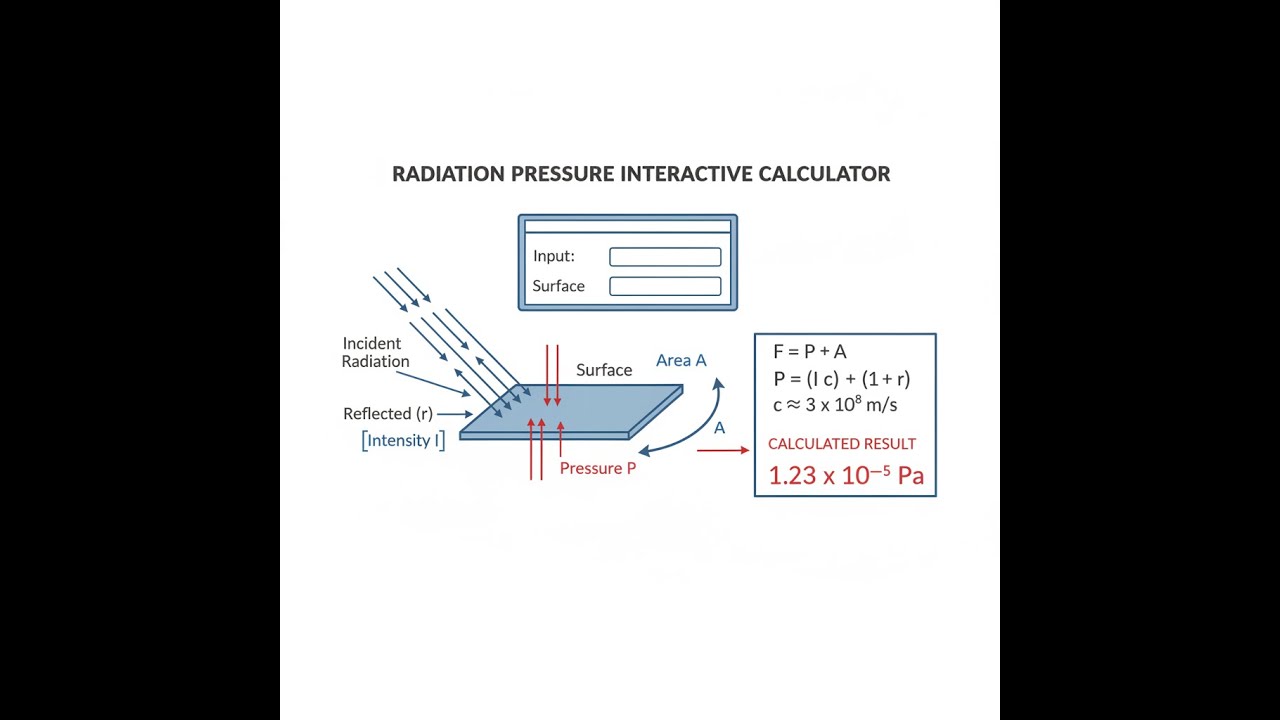
Radiation Pressure Interactive Visualizer
This visualizer lets you see how light transfers momentum to a surface—either through absorption or reflection, and how much that difference matters. Play with intensity, area, and reflection coefficient to see how these simple parameters shift the pressure, force, and acceleration on the fly.
PRESSURE
8.5 µPa
FORCE
85.1 µN
MOMENTUM RATE
85.1 µN
FIRGELLI Automations — Interactive Engineering Calculators
Governing Equations
Here’s the direct formula for radiation pressure based on intensity and the reflection coefficient.
Radiation Pressure (General)
P = (I / c) × (1 + r)
Where:
- P = radiation pressure (Pa = N/m²)
- I = intensity of incident radiation (W/m²)
- c = speed of light in vacuum = 299,792,458 m/s
- r = reflection coefficient (0 = perfect absorption, 1 = perfect reflection)
Radiation Force
F = P × A = (I × A / c) × (1 + r)
Where:
- F = radiation force (N)
- A = illuminated surface area (m²)
Power-Based Formulation
F = (Pbeam / c) × (1 + r)
Where:
- Pbeam = total beam power (W)
- Intensity I = Pbeam / A
Acceleration from Radiation Pressure
a = F / m = (I × A / (m × c)) × (1 + r)
Where:
- a = acceleration (m/s²)
- m = mass of object (kg)
Simple Example
If a 1,000 W/m² light source shines on a surface with a reflection coefficient of 0.5, use P = (I / c) × (1 + r):
P = (1000 / 299,792,458) × (1 + 0.5) = 5.004 × 10⁻⁶ Pa.
Spread over a 2 m² sail, this comes out to a force F = 5.004 × 10⁻⁶ × 2 = 1.001 × 10⁻⁵ N—or about 10 micronewtons.
Theory & Practical Applications
Fundamental Physics of Radiation Pressure
Radiation pressure comes down to the fact that electromagnetic waves carry momentum. The connection to Maxwell’s equations and relativity means this is fundamental physics, but for practical work: each photon carries p = E/c = hν/c. When photons hit something, some momentum gets passed to the surface—as pressure. The (1 + r) factor is because if you only absorb, you get a single impulse, but if you reflect, you get double. Real-world surfaces often sit somewhere in between, with angular and wavelength-dependent behavior; the formula just assumes a direct case.
Unlike gas pressure, which is tied to temperature, radiation pressure is set just by intensity, so temperature doesn’t show up for a fixed beam. But the force is tiny. Solar illumination at Earth's distance is 1361 W/m²—you only get about 9 μPa if the surface is a perfect mirror. That’s one ten-billionth of atmospheric pressure, which is why nobody worried about radiation pressure for practical uses until measurements got sensitive enough.
Non-Obvious Engineering Considerations
The basic (1 + r) formula assumes all reflection is specular—like a mirror—where outgoing light is flipped directly backward. Most surfaces aren’t perfect mirrors: real coatings scatter, show angle dependence, and behave differently by wavelength. If reflection is diffuse (think white paint), the effective push drops to about (1 + 2r/3) because light is scattered over a hemisphere, not just the reverse direction. For solar sail work, this is a major reason why polished film outperforms even very white diffuse coatings.
Another thing to keep in mind: these calculations suppose steady continuous beams and ignore heating. At high laser intensities, more energy turns up as heat than mechanical force; the material may well warp, crack, or even vaporize long before you see the theoretical push. In setups like optical tweezers, gradient forces (from how tightly focused the light is) usually matter more than simple radiation pressure. If you care, you’ll need to move beyond the “intensity only” simplification and look at the whole electromagnetic field distribution.
Solar Sail Propulsion
Solar sails rely on radiation pressure to get anywhere, since there’s no propellant. Take a 10,000 m² aluminum-coated Mylar sail, mass about 100 kg, reflectivity around 0.88—at Earth's orbit, you’ll calculate: F = (1361 W/m² × 10,000 m² / 3×10⁸ m/s) × (1 + 0.88) = 0.085 N. So, acceleration a = 0.085 N / 100 kg = 8.5×10⁻⁴ m/s². That's tiny, but with no fuel to run out, it keeps building up speed. After a year, this gets you to Δv ≈ 26,800 m/s. If you go further from the sun (say, Mars), power per area drops by r⁻², so acceleration drops quickly, but get closer (like 0.2 AU) and things can ramp up dramatically. The IKAROS probe proved the numbers aren’t far off from theory—actual acceleration matched predictions within a percent or two, aside from some side effects like initial drag and control system inefficiencies.
Laser Cooling and Optical Trapping
Laser cooling uses these tiny photon kicks to slow atoms down. A sodium atom exposed to a 589 nm laser absorbs photons; with each one, it gets a momentum nudged by Δp = E/c. Fire off 10⁷ photons per second, and you can bring atoms to a standstill over just a millimeter. Similar logic holds for optical tweezers: a 100 mW laser focused to a micron scale will give about 3 pN to a polystyrene bead. That's enough to move cells or even individual DNA strands. But in most of these systems, the trap’s “stiffness”—how much it resists displacement—runs around 10⁻⁵ N/m, suitable for nanometer precision but not more.
Astrophysical Implications
In astronomy, tiny particles near stars are heavily affected by radiation pressure. For example, micron-size dust near a solar-type star gets about 10⁻¹⁴ N of force, enough to accelerate a grain by 10 m/s²—which dwarfs the local solar gravity. This “blowout” process sweeps out the smallest particles on timescales of years. For massive stars (20+ solar masses), radiation pressure near the surface can overcome gravity, leading to constant mass loss as strong stellar winds. In those situations, the ratio of radiation pressure to gas pressure (β) can exceed 1, which makes for very different star behavior compared to the sun.
Worked Example: Laser Acceleration of a Microparticle
Problem: Take a polystyrene ball (diameter 2.8 µm, density 1050 kg/m³), hit it with a 120 mW 532 nm laser whose beam diameter just matches the ball, assuming it absorbs all the light (r = 0), and it’s in vacuum. What are the (a) radiation pressure, (b) force, (c) acceleration, and (d) velocity after 5 seconds?
Solution:
(a) Radiation Pressure:
Area A = π(1.4×10⁻⁶)² = 6.158×10⁻¹² m²
Intensity I = 0.120 W / 6.158×10⁻¹² m² = 1.948×10¹⁰ W/m²
Pressure for r = 0: P = I/c = 6.50×10¹ Pa = 65.0 Pa
(b) Radiation Force:
F = P × A = 65.0 Pa × 6.158×10⁻¹² m² = 4.003×10⁻¹⁰ N = 0.400 nN
Check: F = Power / c = 0.120 / 2.998×10⁸ = 4.003×10⁻¹⁰ N — matches up.
(c) Initial Acceleration:
Volume V = (4/3)π(1.4×10⁻⁶)³ = 1.150×10⁻¹⁷ m³
Mass m = 1050 × 1.15×10⁻¹⁷ = 1.207×10⁻¹⁴ kg
a = F / m = 0.400 nN / 1.207×10⁻¹⁴ kg = 3.316×10⁴ m/s² = 33,160 m/s²
(d) After 5 Seconds:
Velocity: v = a × t = 3.32×10⁴ × 5 = 1.66×10⁵ m/s = 165.8 km/s
Distance: x = ½ a t² = 0.5 × 3.32×10⁴ × 25 = 4.145×10⁵ m = 414.5 km
Analysis: The calculated acceleration is huge for such a small mass and tightly focused beam, leading to very high speeds in just seconds. In reality, though, the particle would overheat and degrade quickly at this intensity. This kind of simple calculation is good for a first estimate, but actual laser micropropulsion or optical trapping systems run at much lower intensities—or use pulsed light to avoid melting the target.
Precision Metrology and Calibration Standards
Radiation pressure’s direct link to constants like c means you can use it to calibrate tiny force sensors. National measurement labs use lasers and highly reflective mirrors to create traceable forces in the micro- to nanonewton range. For most setups, uncertainties are limited by how well you know reflectivity and the beam’s geometry, not the beam power itself. In cavity optomechanics, high-finesse mirrors boost circulating power so far that milliwatt lasers can apply tens of nanonewtons of force, enough to move mirrors by nanometers. This allows extremely sensitive detection of displacement and even touches topics like gravitational wave detection or quantum-limited measurements.
Frequently Asked Questions
Free Engineering Calculators
Explore our complete library of free engineering and physics calculators.
Browse All Calculators →🔗 Explore More Free Engineering Calculators
About the Author
Robbie Dickson — Chief Engineer & Founder, FIRGELLI Automations
Robbie Dickson brings over two decades of engineering expertise to FIRGELLI Automations. With a distinguished career at Rolls-Royce, BMW, and Ford, he has deep expertise in mechanical systems, actuator technology, and precision engineering.
Need to implement these calculations?
Explore the precision-engineered motion control solutions used by top engineers.


