If you need to plan out solar panel layouts, crop cycles, or even schedule a film shoot outside, you can't just guess when the sun will clear the horizon. For serious work, you want sunrise and sunset times accurate to within a couple of minutes — at your exact location and for a specific date. The Sunrise Interactive Calculator below runs the full astronomy, letting you figure out sunrise, sunset, solar noon, the day length, and twilight windows, all from your latitude, longitude, date, and UTC offset. Details like this are essential for things like agriculture (timing fieldwork or irrigation), solar system design (when your panels actually start making useful power), construction scheduling, or nailing lighting windows for photography or film. Below, you'll find the raw calculation method, a worked-through example based on a real-world rooftop solar install, and answers to common questions about accuracy, polar regions, and atmospheric influences.
What is sunrise time calculation?
To calculate a sunrise time, you’re figuring out exactly when the sun first appears above your local horizon on a given date, given your coordinates. This isn’t just a matter of looking at a clock—it takes into account latitude, longitude, Earth’s orbit, and the way light bends as it moves through the planet’s atmosphere.
Simple Explanation
Here’s the quick version: the Earth is tilted and spinning around the sun at an angle, so sunrise happens at a different clock time every day and changes with your position on the globe. This calculator crunches the numbers — you put in where and when, and it tells you when the sun rises, sets, and how many real daylight hours you get at that spot.
📐 Browse all 1000+ Interactive Calculators
Diagram

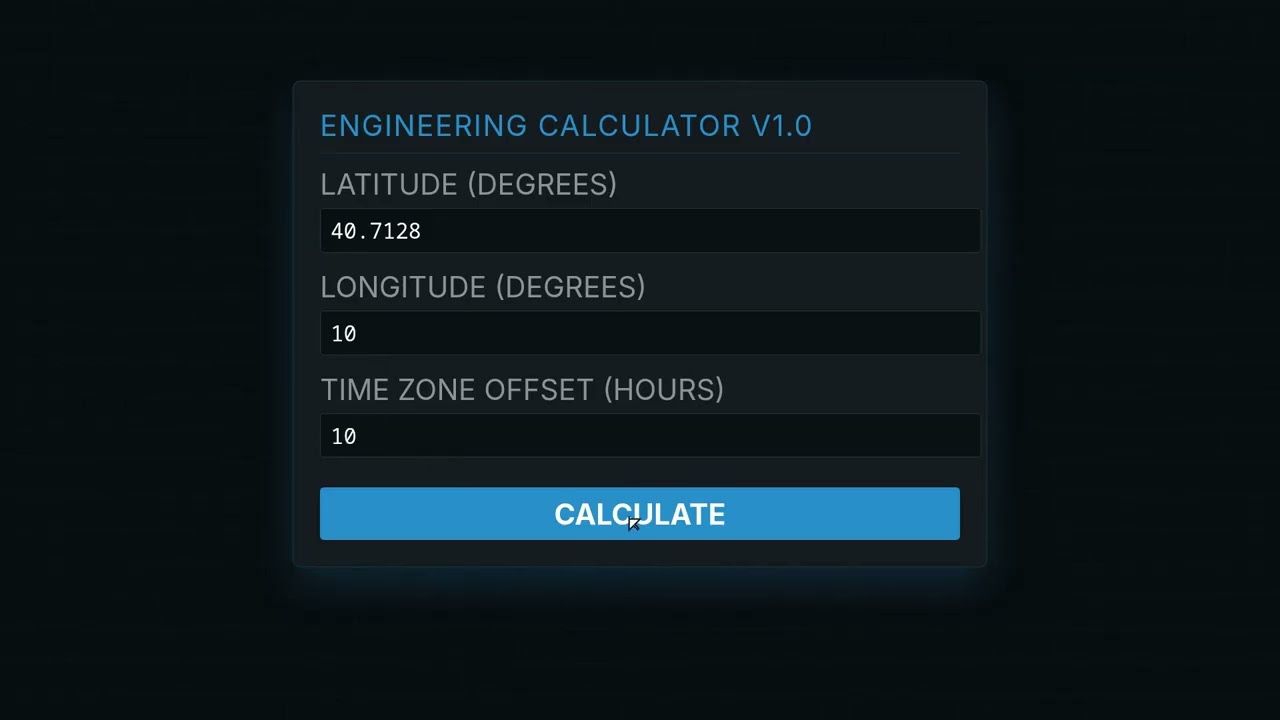
How to Use This Calculator
- Select your calculation mode — sunrise, sunset, both, daylight duration, solar noon, or twilight times.
- Enter your latitude (positive for north, negative for south) and longitude (positive for east, negative for west).
- Select your date and enter your UTC time zone offset (e.g., −5 for Eastern Standard Time).
- Click Calculate to see your result.
Sunrise Calculator
This calculator is intended for education, concept evaluation, and preliminary design. Results are based on the equations and assumptions described on this page, but cannot account for every real-world load case, tolerance, material property, environmental condition, installation detail, safety factor, code, or regulatory requirement. Verify all inputs, assumptions, units, and results independently before selecting components or using the result in a real application. Safety-critical, structural, medical, lifting, transportation, or regulated applications must be reviewed by a qualified engineer.
Sunrise Interactive Calculator
Calculate precise sunrise and sunset times for any location and date using astronomical formulas. Visualize the sun's path, twilight phases, and daylight duration with real-time solar position tracking.
SUNRISE
05:25
SUNSET
20:30
DAYLIGHT
15.1h
FIRGELLI Automations — Interactive Engineering Calculators
Equations
Here’s the breakdown if you want to get hands-on and calculate local sunrise or sunset from first principles. Each step is based on how Earth's position and tilt affects what you see at the horizon.
Julian Day Number:
JD = d + ⌊(153m + 2)/5⌋ + 365y + ⌊y/4⌋ − ⌊y/100⌋ + ⌊y/400⌋ − 32045
where: JD = Julian Day, d = day of month, m = adjusted month, y = adjusted year
Solar Mean Anomaly:
M = (357.5291° + 0.98560028° × n*) mod 360°
where: M = mean anomaly (degrees), n* = days since J2000.0 adjusted for longitude
Equation of Center:
C = 1.9148° sin(M) + 0.0200° sin(2M) + 0.0003° sin(3M)
where: C = equation of center correction (degrees)
Solar Declination:
sin(—) = sin(λ) × sin(23.44°)
where: δ = solar declination (radians), λ = ecliptic longitude (radians), 23.44° = Earth's axial tilt
Hour Angle for Sunrise/Sunset:
cos(H0) = [sin(−0.833°) − sin(φ)sin(δ)] / [cos(φ)cos(δ)]
where: H0 = hour angle at sunrise/sunset (degrees), φ = observer latitude (radians), −0.833° = atmospheric refraction correction
Sunrise and Sunset Times:
Jrise = Jtransit − H0/360°
Jset = Jtransit + H0/360°
where: Jtransit = Julian Day of solar noon, Jrise = Julian Day of sunrise, Jset = Julian Day of sunset
Solar Transit (Solar Noon):
Jtransit = 2451545.0 + n* + 0.0053 sin(M) − 0.0069 sin(2λ)
where: 2451545.0 = J2000.0 epoch, 0.0053 and 0.0069 = equation of time correction coefficients
Simple Example
Location: New York City (latitude 40.71°N, longitude −74.01°W), June 21, 2024, UTC−5.
- Solar declination: +23.44° (summer solstice maximum)
- Hour angle H₀: ~113°
- Sunrise: approximately 05:25 AM EST
- Solar noon: approximately 12:57 PM EST
- Sunset: approximately 20:30 PM EST — daylight duration: ~15 hours 5 minutes
Theory & Practical Applications
Celestial Mechanics of Solar Position
To figure out sunrise and sunset, you're really working out when the center of the Sun crosses your local horizon. The snag is, the Sun's path is tracked in the “ecliptic” system, your horizon is in the “horizontal” system, and converting between them requires some steps — mostly involving right ascension and declination (think longitude and latitude, but celestial).
Julian Day Number is just a way to count days continuously and skip complications with leap years and calendars. Everything in solar calculations uses J2000.0 (that’s noon UTC, January 1, 2000, Julian Day 2451545.0) as the baseline. For your actual location, you adjust by subtracting your longitude in days, since noon happens “earlier” the further east you go.
The mean anomaly M is a measure of where Earth is in its orbit, increasing nearly 1 degree per day. The “equation of center” (C) tweaks this for the elliptical orbit, so you don’t get the same apparent Sun speed all year. This offset accounts for why solar noon drifts back and forth by several minutes over the calendar year (the so-called “equation of time”).
Atmospheric Refraction and Geometric Corrections
By default, these calculations use a solar elevation of −0.833°, not exactly zero, for the horizon crossing. That value comes from two things: light bends as it enters the thicker air near the horizon, making the Sun “lift” by about −0.57°, and the Sun's disk is about half a degree across, so you get first light when the top of the disk just peeks up, not when the center arrives. These details shift the observable sunrise 2-3 minutes earlier and sunset later compared to a pure geometric model.
The catch here is the standard −0.833° correction assumes a mild climate at sea level. Colder, denser air can bend the Sun higher—sometimes adding several minutes to sunrise at very cold or high-pressure sites—while high-altitude sites see less bending. Unless you run the numbers with your site’s temperature and air pressure, standard refraction gives you results within about 2 minutes for most uses, but it’s not universal.
The hour angle H₀ tells you how far, in degrees, the Sun travels to reach the horizon that day. If the math spits out an hour angle that results in cos(H₀) > 1, the Sun never rises—all-day darkness (polar night). If cos(H₀) < −1, the Sun never sets (midnight sun). Getting into these edge-case regimes usually means you’re operating above the Arctic or Antarctic circles, or close, around the solstices.
Twilight Categories and Light Availability
Civil twilight is when the Sun is between 0° and 6° below the horizon. It’s light enough outside to see and work without additional lamps. Nautical twilight (6° to 12° under) was historically used by sailors to see both the horizon and stars for navigation. Astronomical twilight (12° to 18° under) roughly marks when the sky is truly dark. For solar panels, civil twilight defines the rough bounds for usable energy — panels start doing anything meaningful once the Sun is a few degrees up, since irradiance is very low until then.
In construction, daylight hours frame when crews and equipment can run safely without extra lights. Take a bridge job in Seattle, June 21: sunrise 5:11 AM, sunset 9:11 PM, so nearly 16 daylight hours — two full shifts. Come December 21, light drops to 8.5 hours; then, artificial lighting and other workarounds come into play, and pour schedules typically change, since concrete behaves differently in cold or darkness.
Agricultural Applications and Growing Seasons
Certain crops (soybeans, rice, chrysanthemums) are sensitive to day length; it cues flowering. Soybeans, for example, are grouped (MG 000 to MG X) to match specific latitudes. Planting a variety designed for north into the deep south can trigger early flowering and cut your yield. Knowing the actual daylight hours lets you plan planting dates and pick the right cultivar for your fields, instead of relying on charts made for another climate.
Greenhouses rely on this as well — daylight hours dictate when to supplement light. Say you're running a tomato operation in Amsterdam: in January, you’ll only get 7.9 daylight hours naturally, but tomatoes need more. Programming supplemental lighting to start at civil twilight and run only as long as needed saves energy; precise calculations here trim operating costs compared to a one-size-fits-all lighting schedule.
Photography and Cinematography Planning
You get “golden hour” (warm, soft light and long shadows) when the Sun is low, within 6° of the horizon. Pros use calculated sunrise times not just for travel planning, but to arrive with enough advantage to unpack and catch that brief window. Civil and blue hour are similar — they make a big difference for how photos look, but only last 20–40 minutes depending on where and when you are. If you want matching scenes across shooting days for a film, you need to know not just when sunset happens, but at what minute the lighting matches a previous shot; it changes a few minutes each day. Crew call sheets benefit from pre-calculated solar times — it keeps expensive production on schedule.
Worked Example: Solar Panel Installation Feasibility
Problem: You're assessing installing solar panels on a commercial roof in Portland, Oregon (45.5231°N, −122.6765°W). There's a 3.2 m high penthouse standing about 8.7 m north of where the panels would go, and you want to know how early in the day the array will actually clear the penthouse shadow — especially during the darkest time of year (winter solstice, Dec 21).
Part A: Calculate sunrise, solar noon, and sunset for December 21, 2024
Given data:
- Latitude φ = 45.5231°N
- Longitude λ = −122.6765°W
- Date: December 21, 2024 (winter solstice)
- Time zone: UTC−8 (Pacific Standard Time)
Step 1: Use the Julian Day formula for this date.
Step 2: Work out days since J2000.0, adjust for longitude.
Step 3: Find solar mean anomaly (M).
Step 4 & 5: Account for orbital corrections and sun's ecliptic longitude.
Step 6: Solar declination will be nearly −23.45° (the max winter value).
Step 7: Plug numbers into the hour angle formula.
Step 8: Compute solar noon.
Step 9: Find sunrise and sunset as time of day using the hour angle.
Step 10: Convert to local clock time using UTC offset. You should get close to:
Sunrise ≈ 7:59 AM PST
Solar noon ≈ 12:19 PM PST
Sunset ≈ 4:40 PM PST
Daylight duration just under 9 hours.
Part B: Calculate minimum solar elevation to clear penthouse shadow
Given:
- Penthouse height h = 3.2 m
- Distance d = 8.7 m
Find the angle: tan(α) = h/d = 3.2/8.7 → α ≈ arctan(0.3678) ≈ 20.2°
The sun needs to reach at least this height before light clears the shadow.
At winter solstice local noon, sun elevation = 90° – |latitude – declination| = 21°. There's only about 0.8° margin at noon; much of the morning and late afternoon, panels are shaded. The upshot: until roughly 11:30 AM and after 1:00 PM, winter production is lost to this shadow, cutting daily yield by around 35–40%. Summer performance will be much better, but the overall economics are right on the edge. You'd likely want to relocate the panel string or consider a taller mounting if you want reliable winter yield.
FAQ
Free Engineering Calculators
Explore our complete library of free engineering and physics calculators.
Browse All Calculators →🔗 Explore More Free Engineering Calculators
About the Author
Robbie Dickson — Chief Engineer & Founder, FIRGELLI Automations
Robbie Dickson brings over two decades of engineering expertise to FIRGELLI Automations. With a distinguished career at Rolls-Royce, BMW, and Ford, he has deep expertise in mechanical systems, actuator technology, and precision engineering.
📹 Video Walkthrough — How to Use This Calculator
📹 Video Walkthrough — How to Use This Calculator
Need to implement these calculations?
Explore the precision-engineered motion control solutions used by top engineers.


