Picture this: it's a beautiful summer afternoon, the kids are splashing in the pool, and you're trying to catch the big game while keeping an eye on them. Or perhaps you're hosting a backyard barbecue and want to create an entertainment hub on your patio. The challenge? How do you enjoy outdoor television viewing without compromising your equipment or your peace of mind?
🎥 Video — What are the top 2 ways to watch TV outside - Using an Outdoor TV Lift Cabinet might just be the best option.
Outdoor entertainment spaces have become increasingly popular as homeowners seek to extend their living areas beyond the four walls of their homes. But integrating technology like televisions into these spaces presents unique challenges: weather protection, security concerns, and aesthetic considerations all come into play. While some solutions exist, not all are created equal, and choosing the wrong approach can lead to damaged equipment, theft, or an eyesore that detracts from your outdoor oasis.
In this comprehensive guide, we'll explore the two primary methods for watching TV outdoors—permanent outdoor installations and automated outdoor TV lift cabinets—examining their advantages, limitations, and practical considerations to help you make the best choice for your outdoor entertainment needs.
The Fundamental Challenges of Outdoor TV Installations
Before diving into solutions, it's essential to understand what makes outdoor television installations different from their indoor counterparts. These challenges influence every aspect of your decision-making process.
Moisture and Weather Protection
Television electronics and moisture are natural enemies. Even if you mount a standard TV under a covered patio, you're still exposing it to humidity, temperature fluctuations, and potential water intrusion. Morning dew, afternoon rain showers, and even rising ground moisture can all compromise electronic components over time. Standard consumer televisions lack the sealed enclosures and weatherproofing necessary to withstand these conditions, leading to shortened lifespans, screen damage, and complete component failure.
The problem isn't just direct water contact—it's also condensation that forms when temperatures drop at night, moisture carried by wind-driven rain, and the cumulative effect of constant exposure to outdoor humidity levels that can be 2-3 times higher than indoor environments.
Security and Theft Concerns
An expensive television mounted permanently on an outdoor wall or placed on a cabinet becomes an obvious target for theft. Unlike indoor installations where your home's security system provides protection, outdoor TVs are often in areas with easy access points: side yards with low fences, patios visible from the street, or pool areas that open to alleyways. Even with security cameras, a determined thief can remove a wall-mounted TV in minutes with basic tools.
The visibility factor compounds this problem—a high-end outdoor TV essentially advertises valuable electronics to anyone passing by or scoping out potential targets in your neighborhood.
Sun Glare and Visibility Issues
Outdoor viewing means contending with natural sunlight, which can make even bright screens difficult to see during peak daylight hours. Standard televisions typically produce 250-350 nits of brightness, adequate for indoor viewing but woefully insufficient for outdoor use where 700-1000 nits may be necessary for comfortable viewing in shaded areas, and even more for direct sunlight conditions.
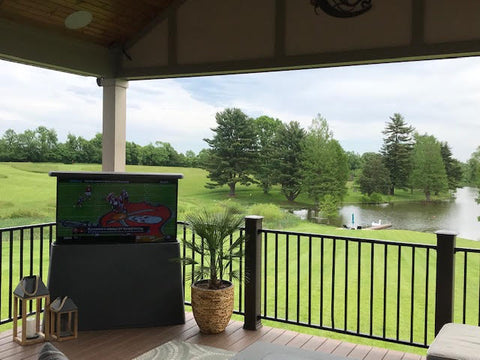
Option One: Dedicated Outdoor Televisions
The first approach to outdoor TV viewing involves purchasing a television specifically engineered for outdoor use. These specialized displays address weather protection through industrial-grade construction but come with their own set of trade-offs.
How Outdoor TVs Differ from Standard Models
Outdoor televisions feature sealed, weatherproof enclosures typically rated to IP65 or higher standards, meaning they're protected against dust ingress and water jets from any direction. They incorporate anti-glare screens with significantly higher brightness ratings (often 700-1500 nits) to combat sunlight, and their internal components are rated for wider temperature ranges—typically -40°F to 122°F compared to standard TVs' 50°F to 95°F operating range.
These units also include reinforced screens to resist impacts from debris, insects, or accidental contact, and they often feature corrosion-resistant materials for mounting hardware and connection ports.
Advantages of Permanent Outdoor TVs
The primary benefit is simplicity: mount it once, and it's always ready for viewing. There's no setup time, no mechanisms to maintain, and no need to deploy the TV before each use. For high-traffic outdoor entertainment areas where the TV gets daily use, this convenience factor can be significant.
Outdoor TVs also offer superior brightness and viewing angles compared to standard televisions, making them genuinely usable in various lighting conditions. The weatherproofing is comprehensive and manufacturer-backed, providing peace of mind about rain, snow, and humidity exposure.
Limitations and Cost Considerations
The most significant drawback is cost. Outdoor-rated televisions typically cost 2-4 times more than comparable indoor models. A 55-inch outdoor TV can easily run $2,500-$4,000 or more, compared to $500-$800 for a similar-sized indoor TV. This premium reflects the specialized engineering, weatherproof construction, and higher brightness displays.
Security remains an unresolved issue with permanently installed outdoor TVs. Even with protective covers, the presence of an expensive television is obvious, making theft a persistent concern. Installing additional security measures like protective cages or advanced alarm systems adds further cost and complexity.
Additionally, permanent outdoor installations lack flexibility. Once mounted, relocating the TV requires additional mounting hardware and potentially running new electrical and signal cables. Seasonal changes in sun position may also create viewing difficulties that weren't apparent during initial installation.
Option Two: Outdoor TV Lift Cabinets with Built-In Automation
The second approach combines weather protection, security, and convenience through an automated system that conceals the television when not in use and deploys it on demand. This solution represents a more sophisticated approach to outdoor entertainment.
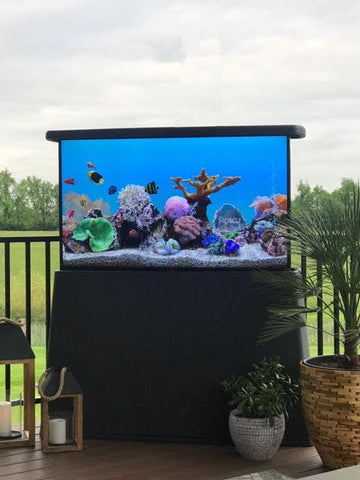
How Outdoor TV Lift Cabinets Work
An outdoor TV lift cabinet is an integrated system combining weatherproof storage with an automated tv lift mechanism. The cabinet houses a standard television on a motorized platform controlled by a remote control, allowing the TV to rise from concealment at the press of a button and retract when viewing is complete.
The lift mechanism typically uses industrial-grade linear actuators—the same motion control technology used in automotive, aerospace, and medical applications. These actuators provide smooth, reliable vertical motion with precise positioning and sufficient force to lift television weights up to 100 pounds, depending on the mechanism specifications.
Weatherproof Construction Details
Quality outdoor TV lift cabinets feature several layers of weather protection. The cabinet body is constructed from high-density polyethylene or similar weather-resistant materials designed to withstand UV exposure, temperature extremes, and moisture without cracking, fading, or degrading. Many models incorporate a granite or stone-like aesthetic that blends naturally with typical outdoor furniture while providing structural durability.
The lid design is critical—it features an overhanging profile that channels water away from the cabinet body, preventing water intrusion even during heavy rain or snow accumulation. When closed, the cabinet creates a sealed environment that protects the television from all weather elements, essentially creating an indoor environment within an outdoor structure.
Internal drainage systems in well-designed cabinets ensure that any moisture that does enter through cable routing holes or minor gaps can escape without pooling around electronic components. This attention to detail extends the lifespan of both the television and the lift mechanism significantly.
Security Through Concealment
The most elegant aspect of a TV lift cabinet is its security-through-obscurity approach. When retracted, the cabinet appears to be ordinary outdoor furniture—there's no indication that it contains valuable electronics. This dramatically reduces theft risk because potential thieves simply don't know there's anything worth taking.
Even if someone suspects the cabinet contains a TV, accessing it requires multiple steps: having the remote control to activate the lift mechanism, opening the cabinet while the TV is raised, and then removing mounting hardware with tools. This multi-layered security approach makes opportunistic theft virtually impossible and deters even determined thieves who would need significant time and tools to succeed—time they don't have in most residential settings.
The system can also integrate with home automation security systems, allowing you to monitor the cabinet's status and receive alerts if it's opened or if the lift is activated when you're away.
Integrated Safety Features
Outdoor TV lift cabinets incorporate important safety mechanisms, particularly crucial in households with children. The magnetic coupling between the cabinet lid and the lift mechanism provides a critical safety function: if the lid encounters resistance while closing (such as a child's hands on the cabinet edge), the magnetic connection disengages, allowing the lid to stop while the lift mechanism continues safely downward.
This prevents pinching injuries and equipment damage while maintaining sufficient magnetic strength during normal operation to resist wind loads and prevent accidental lid separation when the TV is raised. Additional safety features typically include soft-start and soft-stop motion profiles that prevent sudden movements, and obstacle detection in some advanced models that stops the lift if unexpected resistance is encountered.
Flexibility and Portability
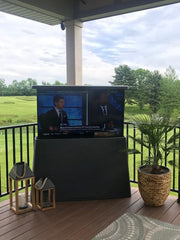
Unlike permanent wall installations, outdoor TV lift cabinets offer remarkable flexibility. The self-contained design means you can relocate the cabinet anywhere on your patio or deck without new mounting hardware or running additional cables. This is particularly valuable for seasonal use—easily move the cabinet to different entertainment zones depending on sun position, shade availability, or where your outdoor activities are focused.
For homeowners who winter in different locations, the cabinet can be stored in a garage or shed during off-seasons, protecting the investment from extreme weather when it won't be used. This portability also adds value when you move homes—unlike a custom outdoor TV installation that stays with the property, you can take the entire cabinet system with you.
Standard TV Compatibility and Cost Savings
Because the cabinet provides complete weather protection, you can use a standard indoor television rather than an expensive outdoor-rated model. This represents substantial cost savings—typically $1,500-$3,000 on the television alone. A cabinet with a quality lift mechanism and a standard 50-inch TV often costs less than an outdoor-rated TV of similar size, while providing superior security and flexibility.
Standard TVs also offer better picture quality and feature sets for the money. You get access to the latest smart TV features, streaming capabilities, and display technologies without paying the outdoor TV premium. The only requirement is selecting a TV size compatible with the cabinet's internal dimensions—typically accommodating screens up to 50-55 inches depending on the specific cabinet model.
Technical Specifications and Selection Criteria
When evaluating outdoor TV lift cabinets, several technical factors influence performance and suitability for your application.
Lift Mechanism Specifications
The heart of any TV lift cabinet is its actuator system. Quality systems use linear actuators rated for the load requirements with adequate safety margins. For a 50-pound television, the actuator should have a minimum load rating of 75-100 pounds to ensure smooth operation and longevity.
Stroke length determines how far the TV can rise above the cabinet—typically 20-30 inches for most applications. Speed ratings usually range from 0.5 to 1.5 inches per second; slower speeds provide smoother, quieter operation, while faster speeds reduce deployment time. Consider your priorities: entertaining guests might favor speed, while peaceful backyard relaxation might prioritize quiet operation.
The actuator's duty cycle—how frequently it can operate without overheating—should match your usage patterns. For occasional use (1-2 cycles per day), most systems are more than adequate. Frequent use environments might require industrial actuators with higher duty cycle ratings.
Control Systems and Integration
Basic systems include a simple remote control with up/down functionality. More sophisticated setups integrate with home automation systems, allowing control through smartphone apps, voice assistants, or programmable scenes that might deploy the TV automatically at certain times or when you activate "pool party mode" on your smart home system.
A quality control box should include thermal protection to prevent motor damage, smooth acceleration/deceleration profiles for refined motion, and memory positioning that returns the TV to the exact same height each time. Some systems offer customizable height presets, useful if different family members prefer different viewing positions.
Power Requirements and Installation
Most TV lift cabinets require standard 120V AC power through a weatherproof outdoor outlet. The power supply converts household current to the DC voltage used by the actuators—typically 12V or 24V systems. Ensure your installation location has access to a GFCI-protected outlet as required by electrical codes for outdoor applications.
Power consumption during operation is generally modest—50-150 watts depending on TV size and actuator specifications—with minimal standby power draw. Annual electricity costs are negligible, even with frequent use.
Comparing the Two Approaches: Which Solution Fits Your Needs?
The choice between a permanent outdoor TV and a lift cabinet depends on your specific situation, priorities, and usage patterns.
When Outdoor TVs Make Sense
A dedicated outdoor television is the right choice if you have a covered outdoor space with excellent security (gated, alarmed, or under constant video surveillance), need maximum brightness for direct sunlight viewing, want the simplest possible solution with no moving parts, or plan to use the TV multiple times daily year-round. Commercial applications like restaurant patios or resort pool areas often favor permanent installations for their durability and low-maintenance operation.
When TV Lift Cabinets Excel
An outdoor TV lift cabinet is superior when security is a concern (open yards, visible from public areas, vacation properties), you want to use a standard TV to save costs, weather protection without the outdoor TV premium is important, you value flexibility to move the setup around your outdoor space, or aesthetics matter—preferring the TV to disappear when not in use. Residential applications, especially in suburban or urban settings, typically benefit most from the cabinet approach.
Total Cost Comparison
Initial investment for a 50-inch setup breaks down approximately as follows:
- Outdoor TV approach: $2,500-$4,000 (outdoor TV) + $200-$500 (mounting hardware and installation) + ongoing security costs = $2,700-$4,500 total
- TV lift cabinet approach: $1,500-$2,500 (cabinet with lift mechanism) + $500-$800 (standard 50-inch TV) + minimal installation = $2,000-$3,300 total
Long-term costs favor the cabinet approach as well—standard TV replacement is less expensive than outdoor TV replacement when components eventually fail, and the cabinet itself can last decades with minimal maintenance.
Installation and Maintenance Considerations
Both solutions require some installation planning, but the complexity differs significantly.
Installing an Outdoor TV
Permanent outdoor TV installation requires secure mounting to structural elements (not just siding), running weatherproof electrical and signal cables through walls or conduit, ensuring proper drainage behind the TV to prevent water accumulation, and potentially adding protective covers or awnings for enhanced weather protection. Professional installation is often recommended, adding $200-$500 to the project cost.
Setting Up a TV Lift Cabinet
TV lift cabinet installation is substantially simpler: place the cabinet in your desired location, plug into a GFCI-protected outdoor outlet, mount the TV to the lift mechanism using standard mounting brackets, route cables through designated openings, and perform initial testing. Most homeowners can complete the setup in 1-2 hours with basic tools. The modular nature means no permanent modifications to your home structure.
Ongoing Maintenance
Both solutions require periodic maintenance. Outdoor TVs need screen cleaning to remove dust and debris, inspection of seals and weatherproofing, and verification that drain holes remain clear. TV lift cabinets require similar TV maintenance plus occasional inspection of the lift mechanism, cleaning debris from the cabinet interior, verifying smooth operation of the actuators, and lubricating moving parts according to manufacturer recommendations (typically annually).
The actuator mechanisms in quality TV lift systems are engineered for thousands of cycles—comparable to the lifetime of linear actuators used in industrial applications. With proper maintenance, these systems can provide decades of reliable service.
Conclusion
Creating an outdoor entertainment space with television viewing capability requires balancing multiple factors: weather protection, security, cost, convenience, and aesthetics. While dedicated outdoor televisions offer simplicity and maximum brightness, outdoor TV lift cabinets provide a more comprehensive solution for most residential applications. The ability to use standard TVs, eliminate security concerns through concealment, gain flexibility in placement, and achieve these benefits at a lower total cost makes TV lift cabinets the superior choice for homeowners seeking to enhance their outdoor living spaces.
The sophisticated engineering behind modern tv lifts—leveraging proven motion control technology from industrial applications—ensures reliable, safe operation for years of outdoor entertainment. Whether you're watching the game while the kids play in the pool, hosting movie nights under the stars, or simply enjoying your morning coffee with the news, an automated outdoor TV lift cabinet delivers the perfect blend of protection, security, and convenience.
Frequently Asked Questions
Can I use any TV in an outdoor lift cabinet?
Yes, you can use any standard indoor television in an outdoor lift cabinet, provided it fits within the cabinet's dimensional specifications (typically up to 50-55 inches depending on the cabinet model). The cabinet provides complete weather protection, eliminating the need for expensive outdoor-rated TVs. However, verify the TV's weight is within the lift mechanism's load capacity—most systems handle up to 75-100 pounds. Smart TVs with built-in streaming capabilities work perfectly, and you'll maintain access to all modern features without the outdoor TV premium.
How long does it take for the TV to rise and retract from the cabinet?
Deployment time depends on the linear actuator specifications and stroke length. Most outdoor TV lift cabinets complete the full cycle in 20-45 seconds. Systems with faster actuators (1.0-1.5 inches per second) deploy more quickly but may be slightly noisier, while slower systems (0.5-0.8 inches per second) operate more quietly with smoother motion. The deployment time is generally not a practical limitation—it's fast enough to avoid frustration while being slow enough to ensure safe, controlled motion.
What happens if it rains while the TV is up and I'm not home?
This is a valid concern, and different solutions exist. Basic systems require you to manually retract the TV, so you should check weather forecasts and retract before leaving. However, many outdoor TV lift cabinets can integrate with smart home systems and weather monitoring services to automatically retract when rain is detected or predicted. Some advanced setups include rain sensors that trigger automatic retraction. Additionally, most cabinets provide some overhead protection even when raised, offering short-term protection during unexpected brief showers—though prolonged exposure should be avoided.
How much does an outdoor TV lift cabinet weigh, and can I move it easily?
A typical outdoor TV lift cabinet weighs 80-150 pounds empty (without the TV), depending on size and construction materials. While this is substantial, the cabinets are designed with portability in mind—most feature smooth bottom surfaces or built-in caster mounts that allow two people to move them across a patio or deck relatively easily. Some models include integrated handles or wheels for enhanced portability. The weight provides stability against wind when the TV is raised while still allowing repositioning as needed. For frequent moves, consider adding furniture sliders or dolly wheels to make relocation even easier.
Do outdoor TV lift cabinets require special electrical installation?
Outdoor TV lift cabinets plug into standard 120V AC household outlets, but the outlet must be GFCI-protected and rated for outdoor use per electrical codes. Most patios and decks already have such outlets for other equipment. The cabinet's power supply converts household current to the low-voltage DC used by the lift actuators. No special electrical work is typically required beyond ensuring you have an accessible outdoor outlet—though if you need to add one, hire a licensed electrician to ensure code compliance and safety. Total power draw is modest, comparable to running a desktop computer, so there are no concerns about overloading typical outdoor circuits.
How do I connect cable TV, streaming devices, or gaming consoles to a TV in a lift cabinet?
Cable management is straightforward with outdoor TV lift cabinets. Most cabinets include designated cable routing channels that allow HDMI cables, power cords, and other connections to run from external devices into the cabinet interior. You can keep streaming devices, cable boxes, or gaming consoles inside the cabinet alongside the TV—the enclosed space protects them from weather just like the television. For optimal convenience, consider using wireless streaming devices to minimize cable runs, or keep all source devices inside the cabinet and use a single HDMI cable to switch between inputs. The cabinet interior typically provides adequate ventilation for electronic devices, though you should avoid stacking multiple heat-generating components without airflow.


