Order too much and your money sits in product, using up warehouse space. Order too little and you'll run out of stock, which means delays, rushed shipments, and unhappy customers. This Economic Order Quantity calculator finds the order size that tends to keep your total inventory costs down, using your estimates for annual demand, cost per order, and cost to hold each unit per year. EOQ is practical in manufacturing, supply chains, and retail—anywhere you’re making regular decisions about when and how much product to order. You’ll find the formula, a step-by-step example, detailed explanation, and some common questions further down the page.
What is Economic Order Quantity?
Economic Order Quantity (EOQ) is the ideal number of units to order at a time so that your total inventory costs — what you spend placing orders plus what you spend storing stock — are as low as possible.
Simple Explanation
Think of it like buying groceries. If you shop once a year, you'd need a massive freezer and a huge upfront spend. If you shop every day, you waste time and pay for gas constantly. EOQ finds the sweet spot — the order size where those 2 costs balance out and your total spend is lowest. The formula handles the math so you don't have to guess.
📐 Browse all 1000+ Interactive Calculators
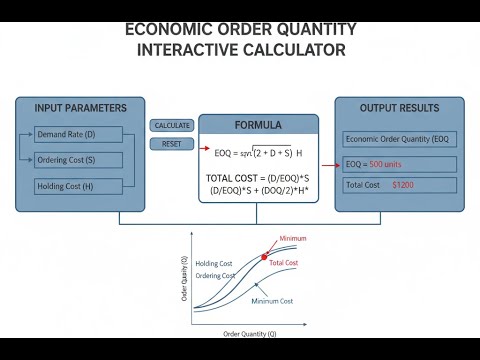
System Diagram

Economic Order Quantity Calculator
How to Use This Calculator
- Select a calculation mode from the dropdown — for most users, start with "Calculate Economic Order Quantity (EOQ)".
- Enter your Annual Demand (D) in units per year, Ordering Cost (S) in dollars per order, and Holding Cost (H) in dollars per unit per year.
- If your selected mode requires additional inputs (such as lead time or a known EOQ value), enter those in the fields that appear.
- Click Calculate to see your result.
This calculator is intended for education, concept evaluation, and preliminary design. Results are based on the equations and assumptions described on this page, but cannot account for every real-world load case, tolerance, material property, environmental condition, installation detail, safety factor, code, or regulatory requirement. Verify all inputs, assumptions, units, and results independently before selecting components or using the result in a real application. Safety-critical, structural, medical, lifting, transportation, or regulated applications must be reviewed by a qualified engineer.
Economic Order Quantity Interactive Visualizer
Watch how ordering costs and holding costs balance to find the optimal Economic Order Quantity. Adjust demand, ordering cost, and holding cost to see how EOQ changes and total inventory costs minimize at the sweet spot.
OPTIMAL EOQ
283 units
ORDERS/YEAR
7.1
TOTAL COST
$1,414
FIRGELLI Automations — Interactive Engineering Calculators
Equations & Variables
Use the formula below to calculate Economic Order Quantity.
Economic Order Quantity
Q* = √[(2DS) / H]
Use the formula below to calculate Total Annual Inventory Cost.
Total Annual Inventory Cost
TC = (D/Q)S + (Q/2)H
Use the formula below to calculate the Reorder Point.
Reorder Point
ROP = d × L
Number of Orders per Year
N = D / Q*
Time Between Orders (Cycle Time)
T = 365 / N (days)
Variable Definitions
| Variable | Description | Units |
|---|---|---|
| Q* | Economic Order Quantity (optimal order size) | units |
| D | Annual demand | units/year |
| S | Ordering cost (fixed cost per order) | $/order |
| H | Annual holding cost per unit | $/unit/year |
| TC | Total annual inventory cost | $/year |
| ROP | Reorder point (inventory level to trigger new order) | units |
| d | Daily demand rate (D/365) | units/day |
| L | Lead time (time from order to delivery) | days |
| N | Number of orders per year | orders/year |
| T | Time between orders (cycle time) | days |
Simple Example
Annual demand (D) = 1,000 units. Ordering cost (S) = $50 per order. Holding cost (H) = $2 per unit per year.
Q* = √[(2 × 1,000 × 50) / 2] = √50,000 = 224 units per order.
Number of orders per year: 1,000 / 224 = 4.5 orders. Time between orders: 365 / 4.5 = 81 days. Total annual inventory cost: $447.
Theory & Engineering Applications
The Economic Order Quantity model, developed by Ford W. Harris in 1913 and popularized by R.H. Wilson, represents one of the foundational concepts in operations research and supply chain management. This mathematical optimization technique balances two competing cost drivers: the fixed costs associated with placing orders and the variable costs of holding inventory over time. While simple in formulation, the EOQ model reveals profound insights about inventory dynamics that remain relevant across modern manufacturing, distribution, and retail operations.
Fundamental Cost Trade-offs
The genius of the EOQ model lies in its recognition that ordering costs and holding costs move in opposite directions as order quantity changes. When organizations place many small orders, they minimize inventory holding costs—less capital tied up in stock, reduced warehouse space requirements, lower insurance premiums, and decreased obsolescence risk. However, frequent ordering dramatically increases procurement costs through administrative overhead, shipping charges, receiving labor, quality inspection time, and purchase order processing expenses that remain relatively constant regardless of order size.
Conversely, placing large infrequent orders reduces the per-unit ordering cost by amortizing fixed expenses across more units. A company ordering 10,000 units once per year pays the ordering cost once, while ordering 100 units 100 times per year multiplies that fixed cost by 100. Yet large orders create substantial holding costs through warehouse space utilization, inventory insurance at 1-3% of inventory value annually, capital opportunity costs typically calculated at the company's weighted average cost of capital (8-15% for most manufacturers), physical deterioration, technological obsolescence, and shrinkage from theft or damage.
The EOQ formula identifies the precise order quantity where these opposing cost curves intersect, minimizing total inventory cost. Mathematically, this occurs where ordering cost per year equals holding cost per year: (D/Q*)S = (Q*/2)H. This equilibrium condition, derived through calculus by setting the derivative of total cost to zero, produces the square root relationship that defines optimal order quantity.
Holding Cost Components and Practical Estimation
Accurately estimating holding costs proves more challenging than most inventory management textbooks acknowledge. The annual holding cost H encompasses multiple components, each requiring separate quantification. Capital cost represents the largest component for most organizations—the return the company could earn by investing cash elsewhere rather than holding inventory. For a manufacturer with a 12% weighted average cost of capital and a $75 unit cost item, capital cost alone contributes $9.00 per unit per year to holding costs.
Warehouse space costs depend heavily on facility type and geographic location, ranging from $4-8 per square foot annually for basic distribution space in secondary markets to $15-25 per square foot in major metropolitan logistics hubs. A pallet occupying 48 square feet in a $10/sq ft warehouse incurs $480 annual space cost. If that pallet holds 50 units, space cost adds $9.60 per unit per year. Insurance typically ranges from 1-3% of inventory value annually, while obsolescence risk varies dramatically by industry—perhaps 2-5% for stable products like fasteners or pipes, but 15-30% for electronics or fashion items with rapid product lifecycles.
Temperature-controlled storage adds substantial costs. Refrigerated warehouse space costs $20-35 per square foot annually, while frozen storage reaches $35-50 per square foot. Pharmaceutical products requiring validated cold chain management can incur holding costs exceeding 40% of product value annually. These environmental requirements fundamentally alter EOQ calculations, often driving companies toward smaller, more frequent orders despite higher per-order costs.
Ordering Cost Decomposition and Hidden Expenses
While holding costs prove difficult to estimate, ordering costs contain equally subtle components often overlooked in simplified analyses. Purchase order processing costs include requisition preparation, supplier selection and price negotiation, purchase order creation and approval routing, order transmission, acknowledgment verification, and documentation filing. A comprehensive Aberdeen Group study found average purchase order processing costs ranging from $53 for companies with automated e-procurement systems to $506 for organizations relying on manual paper-based processes.
Receiving costs add further expense through dock scheduling, unloading labor, pallet movement to staging areas, quantity verification counting, quality inspection sampling, inventory system updates, and discrepancy resolution when shipments don't match orders. Complex products requiring detailed inspection protocols or hazardous materials demanding special handling procedures can multiply receiving costs by factors of 3-5 compared to standard commodities.
Transportation costs per order vary with shipping method, order size, and distance. LTL (less than truckload) shipments cost $0.50-2.00 per mile depending on freight class and weight, while dedicated truckload shipping provides economies of scale at $1.50-2.50 per mile for loads exceeding 10,000-15,000 pounds. Small parcel shipping through carriers like UPS or FedEx follows complex dimensional weight algorithms and zone-based pricing that can make frequent small shipments prohibitively expensive for dense, heavy items.
Worked Example: Industrial Bearing Manufacturer
Consider Precision Components Inc., a mid-sized bearing manufacturer in Cleveland, Ohio, managing inventory for their most popular product: a sealed ball bearing used in automotive transmissions. The engineering team must determine optimal ordering quantities for the steel balls that form the bearing's rolling elements, purchased from a specialty supplier in Pennsylvania.
Given parameters:
- Annual demand: D = 847,500 steel balls (based on production schedule of 94,167 bearing units, each requiring 9 balls)
- Unit cost: C = $0.73 per steel ball (negotiated contract price)
- Ordering cost: S = $187 per purchase order (including $62 administrative cost, $48 receiving labor, $37 quality inspection, $40 transportation)
- Capital cost: 11.5% of inventory value (company WACC)
- Warehouse space: $7.20 per square foot annually, with steel balls occupying 0.032 square feet per 1,000 units
- Insurance and taxes: 2.1% of inventory value annually
- Obsolescence/damage: 1.3% of inventory value annually (steel balls are stable but subject to rust if improperly stored)
Step 1: Calculate total annual holding cost per unit
Capital cost contribution: $0.73 × 0.115 = $0.08395 per unit per year
Storage cost contribution: $7.20 per sq ft × 0.000032 sq ft per unit = $0.0002304 per unit per year
Insurance and taxes: $0.73 × 0.021 = $0.01533 per unit per year
Obsolescence and damage: $0.73 × 0.013 = $0.00949 per unit per year
Total holding cost: H = $0.08395 + $0.00023 + $0.01533 + $0.00949 = $0.1090 per unit per year (14.9% of unit cost)
Step 2: Calculate Economic Order Quantity
Q* = √[(2 × 847,500 × $187) / $0.1090]
Q* = √[316,725,000 / 0.1090]
Q* = √2,905,045,872
Q* = 53,898 steel balls per order
Step 3: Calculate derived metrics
Number of orders per year: N = 847,500 / 53,898 = 15.72 orders/year
Time between orders: T = 365 / 15.72 = 23.2 days
Average inventory level: Q*/2 = 53,898 / 2 = 26,949 units
Annual ordering cost: (847,500 / 53,898) × $187 = $2,939
Annual holding cost: (53,898 / 2) × $0.1090 = $2,938
Total annual inventory cost: TC = $2,939 + $2,938 = $5,877
Step 4: Calculate reorder point (assuming 12-day lead time)
Daily demand: d = 847,500 / 365 = 2,322 units/day
Reorder point: ROP = 2,322 × 12 = 27,864 units
Analysis and practical implications:
The EOQ calculation reveals that Precision Components should place orders for approximately 53,900 steel balls every 23 days. Notice that at the optimal order quantity, annual ordering costs ($2,939) essentially equal annual holding costs ($2,938) - this balance is the defining characteristic of the EOQ solution and validates the calculation.
The reorder point of 27,864 units slightly exceeds the average inventory level of 26,949 units, indicating that new orders will arrive before inventory depletes to the average level. This makes sense given the 12-day lead time relative to the 23-day order cycle—inventory will fluctuate between approximately 80,800 units (immediately after receiving a new order: 26,900 remaining + 53,900 new) and 26,900 units (just before the next order arrives).
From a cash flow perspective, the average inventory investment equals 26,949 units × $0.73 = $19,673. This capital commitment must be weighed against the inventory cost savings. If Precision Components instead ordered monthly (12 times per year), order quantity would increase to 70,625 units, raising holding costs to $3,849 while reducing ordering costs to $2,244, for a total cost of $6,093—$216 higher annually than the EOQ approach.
Model Limitations and Extensions
The basic EOQ model operates under several assumptions that rarely hold perfectly in practice, creating opportunities for model refinement. The assumption of constant, predictable demand ignores seasonal fluctuations, trend growth, and demand uncertainty. Automotive bearing demand, for instance, follows automotive production cycles with summer peaks and winter troughs. Safety stock calculations and time-series forecasting methods address this limitation by adding buffer inventory proportional to demand variability and lead time uncertainty.
The model assumes instantaneous replenishment—the entire order quantity arrives simultaneously. For manufacturers producing items internally rather than purchasing them, the Economic Production Quantity (EPQ) model modifies the EOQ formula to account for gradual inventory accumulation during production runs. The EPQ formula becomes Q* = √[(2DS) / (H(1 - d/p))] where d represents daily demand rate and p represents daily production rate.
Quantity discounts violate the constant unit price assumption. When suppliers offer price breaks at specific order quantities, total cost must include purchase price: TC = (D/Q)S + (Q/2)H + DC. The optimal order quantity may shift to a discount breakpoint even if it exceeds the calculated EOQ, provided the purchase price savings offset increased holding costs. Evaluating quantity discounts requires calculating total cost at each breakpoint and comparing against the EOQ solution.
Storage capacity constraints may prevent ordering the full EOQ quantity. A warehouse with limited refrigerated space or a retail store with fixed shelf space must respect these physical limits. Constrained optimization techniques using Lagrange multipliers determine the optimal order quantity subject to storage constraints, typically resulting in more frequent orders than the unconstrained EOQ would suggest.
Multiple product interactions create additional complexity. Products competing for the same limited warehouse space or requiring coordinated ordering from a single supplier benefit from joint replenishment models that determine optimal order quantities and ordering intervals across product portfolios. These extensions minimize system-wide costs rather than optimizing individual items in isolation.
Integration with Modern Supply Chain Systems
Contemporary supply chain management increasingly integrates EOQ principles within larger optimization frameworks. Enterprise Resource Planning (ERP) systems like SAP and Oracle embed EOQ calculations within material requirements planning (MRP) modules, automatically adjusting order quantities based on current cost parameters, demand forecasts, and supplier lead times. Advanced planning systems extend basic EOQ logic with constraint-based optimization considering production capacity, transportation economies, and inventory budget limitations simultaneously.
Vendor-managed inventory (VMI) arrangements shift ordering responsibility to suppliers who monitor customer inventory levels and automatically replenish stock according to agreed parameters. VMI systems often use modified EOQ models where the supplier optimizes total supply chain costs rather than individual party costs, potentially benefiting both parties through reduced bullwhip effect and better demand visibility. A bearing supplier implementing VMI for Precision Components might adjust delivery frequency based on their production schedule efficiency rather than pure EOQ optimization.
Just-in-time (JIT) and lean manufacturing philosophies challenge the fundamental EOQ premise that holding inventory provides value. JIT practitioners argue that inventory hides problems—quality defects, machine unreliability, supplier inconsistency—and that organizations should attack root causes rather than buffer against them with inventory. In practice, successful JIT implementations reduce both setup times (lowering S) and lead times (reducing safety stock requirements), which naturally drives EOQ calculations toward smaller, more frequent orders without abandoning the underlying cost minimization logic.
For more insights into optimizing manufacturing and industrial systems, explore additional resources in the engineering calculator library.
Practical Applications
Scenario: Electronics Retailer Managing Component Inventory
Maria runs procurement for a regional electronics retailer with seventeen stores across the Southeast. She's responsible for ordering USB-C charging cables—one of their highest volume accessories with annual demand of 43,200 units across all locations. Her supplier charges $4.75 per cable with a $215 flat rate per delivery covering transportation and receiving processing. The company's finance team has calculated holding costs at $0.89 per unit per year (18.7% of product cost) accounting for warehouse space, capital tied up in inventory, and the risk that cables become obsolete when new charging standards emerge. Using the EOQ calculator, Maria determines an optimal order quantity of 3,180 cables, meaning she should place orders approximately every 27 days. This replaces her previous practice of monthly ordering based on intuition, reducing her annual inventory costs from $5,847 to $5,652—a savings of $195 that compounds across the hundreds of SKUs she manages, ultimately improving the company's bottom line by over $35,000 annually.
Scenario: Food Service Distributor Optimizing Frozen Inventory
James, operations manager for a food service distributor, faces a challenging inventory decision for frozen french fries—a staple product with steady demand of 28,600 cases annually but expensive storage requirements due to freezer space limitations and high energy costs. His supplier is located 340 miles away, making each delivery expensive at $380 per order including freight and temperature-controlled receiving procedures. The frozen storage costs are substantial: $3.47 per case per year covering freezer space ($18 per square foot annually), capital costs, insurance, and the real risk of freezer failures causing total product loss. Using the EOQ calculator's reorder point mode with a 9-day lead time, James calculates an optimal order of 2,449 cases with a reorder point of 704 cases. This approach tells him exactly when to call his supplier—when freezer inventory hits 704 cases, he needs to place an order that will arrive just as he's working through the last of his stock. The mathematical precision prevents both costly stockouts that would force him to make emergency rush deliveries to restaurant clients and excessive inventory that ties up valuable freezer space he could use for higher-margin specialty items.
Scenario: Medical Device Manufacturer Balancing Quality and Costs
Dr. Patricia Chen, supply chain director for a medical device manufacturer, must carefully manage inventory for specialized titanium screws used in orthopedic implants. Unlike commodity parts, these components require extensive incoming quality inspection—radiographic testing, dimensional verification, and material certification review—making each order expensive at $1,840 per batch including the quality assurance protocol that FDA regulations mandate. Annual demand is relatively modest at 12,400 screws, with each screw costing $127 and holding costs reaching $31.75 per unit annually due to the high capital cost and climate-controlled clean room storage requirements. When Patricia uses the EOQ calculator, she discovers the optimal order quantity is 1,085 screws, meaning roughly 11.4 orders per year or one every 32 days. However, she notices something important: at 1,100 screws per order (adjusting slightly for package quantities), her total annual cost is only $6 higher than the theoretical optimum. This insight proves valuable during negotiations with her supplier, who offers a 2.5% price reduction if she commits to quarterly orders of 3,100 screws. Patricia uses the calculator's total cost mode to verify that even though quarterly ordering isn't the mathematical EOQ optimum, the price discount of $3.18 per screw ($39,370 annual savings) far exceeds the increased holding costs of $18,830, delivering net savings of $20,540 annually while maintaining the stringent quality standards her FDA-regulated production demands.
Frequently Asked Questions
Why does the EOQ formula produce ordering costs that exactly equal holding costs? +
How should I handle seasonal demand fluctuations in EOQ calculations? +
Should I include purchase price in the total cost calculation when comparing different order quantities? +
How do I accurately determine the holding cost percentage for my specific situation? +
What happens if I can't order exactly the EOQ quantity due to supplier minimum order requirements or package sizes? +
How does lead time variability affect my reorder point, and should I add safety stock? +
Free Engineering Calculators
Explore our complete library of free engineering and physics calculators.
Browse All Calculators →🔗 Explore More Free Engineering Calculators
About the Author
Robbie Dickson — Chief Engineer & Founder, FIRGELLI Automations
Robbie Dickson brings over two decades of engineering expertise to FIRGELLI Automations. With a distinguished career at Rolls-Royce, BMW, and Ford, he has deep expertise in mechanical systems, actuator technology, and precision engineering.
Video Walkthrough - How to Use This Calculator
Need to implement these calculations?
Explore the precision-engineered motion control solutions used by top engineers.


