Stockouts usually come down to two culprits: unpredictable demand and suppliers who take longer than expected to deliver. If you try to eyeball your buffer inventory, you’ll either waste money or risk running dry. The Safety Stock Statistical Calculator here works out buffer inventory using the actual numbers that matter—the service level you want, how wild your demand is, and how much lead time can swing. This isn’t just theoretical. It’s useful anywhere a stockout will cost you time or customers, whether you’re on a factory floor, filling shelves, or running a distribution center. Below you’ll find the working equations, an example run-through, where the statistics really matter, and a detailed FAQ.
What is Safety Stock?
Safety stock is the extra inventory you hold to cover for unexpected surges in demand or for late supplier deliveries—anything above what you’d expect to need while waiting for an order to arrive. It’s meant to stop production or sales from grinding to a halt when things don’t go according to plan.
Simple Explanation
Safety stock is your backup—like keeping a spare tire in the trunk. Most days, you won’t need it, but it saves you when you hit a rough patch: demand pops up higher than average, or your order gets stuck somewhere. The rougher or more uncertain things get (either demand or delivery), the more backup you’ll need, plain and simple.
📐 Browse all 1000+ Interactive Calculators
How to Use This Calculator
- Pick your calculation: Basic Safety Stock, Variable Lead Time, Reorder Point, or a reverse calculation.
- Put in your numbers—average demand, demand’s standard deviation, average lead time, and service level (or the number you’re solving for).
- If you’re using Variable Lead Time, add the standard deviation for lead time too.
- Hit Calculate to see the answer.
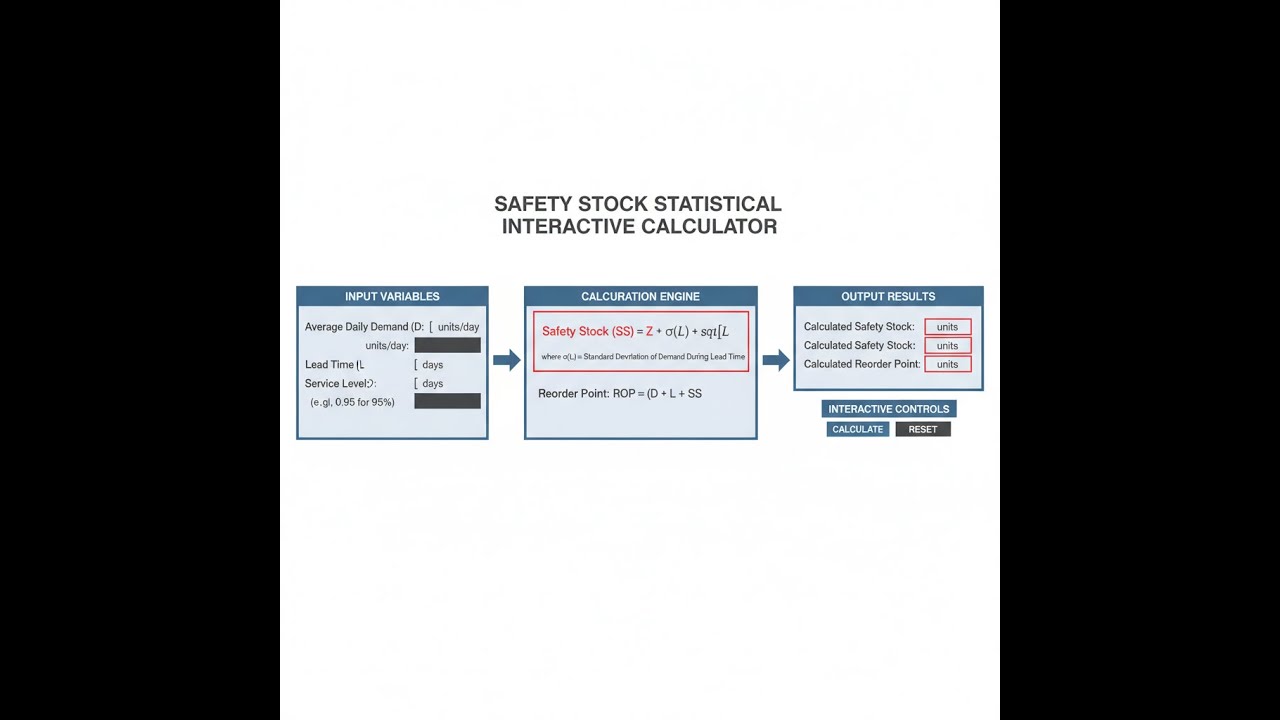
Diagram

Safety Stock Statistical Calculator
This calculator is intended for education, concept evaluation, and preliminary design. Results are based on the equations and assumptions described on this page, but cannot account for every real-world load case, tolerance, material property, environmental condition, installation detail, safety factor, code, or regulatory requirement. Verify all inputs, assumptions, units, and results independently before selecting components or using the result in a real application. Safety-critical, structural, medical, lifting, transportation, or regulated applications must be reviewed by a qualified engineer.
Safety Stock Statistical Interactive Calculator
Calculate optimal buffer inventory levels using service level targets, demand standard deviation, and lead time variability. Visualize how demand uncertainty and supplier delays impact your required safety stock buffer.
SAFETY STOCK
65 units
Z-SCORE
1.645
REORDER POINT
765 units
STOCKOUT RISK
5.0%
FIRGELLI Automations — Interactive Engineering Calculators
Equations & Formulas
Below is the standard approach for safety stock when lead time doesn't swing.
Basic Safety Stock (Constant Lead Time)
SS = Z × σD × √LT
Where:
SS = Safety Stock (units)
Z = Z-score corresponding to desired service level (dimensionless)
σD = Standard deviation of demand (units per period)
LT = Lead time (periods)
When both your demand and your lead time bounce around, use this one instead.
Variable Demand and Variable Lead Time
SS = Z × √(LTavg × σD2 + Davg2 × σLT2)
Where:
Z = Z-score for service level (dimensionless)
LTavg = Average lead time (periods)
σD = Standard deviation of demand (units per period)
Davg = Average demand (units per period)
σLT = Standard deviation of lead time (periods)
If you want the reorder point, base it on average demand, lead time, and the calculated safety stock:
Reorder Point
ROP = (Davg × LTavg) + SS
Where:
ROP = Reorder Point (units)
Davg = Average demand (units per period)
LTavg = Average lead time (periods)
SS = Safety Stock (units)
Standard deviation during the lead time isn't always obvious—here’s how you figure it out:
Standard Deviation During Lead Time
σLT = σD × √LT
Where:
σLT = Standard deviation during lead time (units)
σD = Standard deviation of daily demand (units per period)
LT = Lead time (periods)
Simple Example
Average daily demand: 100 units
Standard deviation of demand: 20 units/day
Average lead time: 7 days
Target service level: 95% → Z-score = 1.645
σ during lead time = 20 × √7 = 52.92 units
Safety Stock = 1.645 × 52.92 = 87.06 units
Theory & Engineering Applications
Safety stock is your working buffer against uncertainty—an extra layer above what you’d expect to go through during lead time. It’s not based on gut feeling; the idea is to handle real-life swings in usage and delays. Older, deterministic approaches assume you know exactly what you’ll need and when. That rarely happens. Using these statistical methods, you’re actually putting a number on your risk rather than guessing, which makes sense when stakes are high or you’ve been burned by guesswork in the past.
Fundamental Statistical Principles
Safety stock formulas generally assume that total demand over your lead time behaves like a normal distribution. That assumption can be off for niche or highly variable items, but it holds up decently for high-volume parts where randomness averages out. Z-score isn’t just math jargon—it tells you how far you’re padding above average demand for the service level you want. For example, a 95% service level means carrying enough inventory to cover average demand plus another 1.645 standard deviations’ worth of surprises. That leaves roughly a 5% chance you’ll run out.
Be aware: ‘standard deviation of demand’ tells you how much your day-to-day usage jumps around, not how far off your forecasts are. Many make the mistake of building forecast error into their safety stock calculation, which ends up double-counting uncertainty. You’ll get more inventory than you need and pay for it. If you find a chronic gap between forecast and reality, use that to fix your forecasting method, not as a reason to keep stockpiling.
Variable Lead Time Complexity
When lead time itself is unpredictable, you need a formula that can handle both moving targets: demand and delivery. The total variance during lead time is the sum of two things: how much demand varies, multiplied by average lead time, and how much lead time varies, scaled up by average demand squared. This means that if your demand number is high, even moderate swings in lead time create huge uncertainty and can swamp the effect of variable demand. For example, a big manufacturer using 10,000 units a day and seeing swings of just a day or two in lead time is in a much riskier position than a small supplier with slow-moving stock, even if delivery uncertainty is the same.
These formulas assume demand and lead time don’t influence each other—often not the case. When things get busy, suppliers can slip behind, so spikes in demand and delays actually happen together. If you see that in your business, you’ll need to adjust: bump up your safety stock by a quarter or so over the calculated number (plus or minus), or run some historical simulations if you need to be more exact. There’s no perfect one-size-fits-all math for correlation without more advanced modelling.
Service Level Interpretation and Cost Trade-offs
‘Service level’ means different things depending on who’s asking. Most formulas here target the chance of a stockout per cycle, but your boss might care more about the percentage of actual orders you can fill from stock. These aren't always the same—especially when you’re dealing with items that don’t move much but have unpredictable spikes. The disconnect can lead to the wrong stocking policy if you’re not careful.
The sweet spot for service level is where the cost of carrying more inventory equals the cost of running out. In the real world, that’s a slog to calculate, since runout costs depend on lost sales, angry customers, extra shipping, and so on—and these costs are hard to pin down. Most companies pick some global targets (e.g. 95% for important items) and move on. Better practice is to break stock into categories (fast movers, slow movers, high value, etc.) and tune service levels to what actually makes sense for each.
Practical Calculation Example: Medical Device Distribution
Here’s a relatable scenario. Say you oversee inventory for surgical staplers. You see average daily demand of 87 units (standard deviation: 23). Your supplier usually takes 42 days, but it can swing by 6 days. Targeting a 98% service level, find the Z-score: it’s 2.054. Calculate combined variance: (42 × 23²) + (87² × 6²). That’s (42 × 529) + (7569 × 36) = 22,218 + 272,484 = 294,702. The standard deviation during lead time is the square root: 542.87 units. Multiply by Z: safety stock is about 1,115 units. Your reorder point becomes average demand during lead time (87 × 42 = 3,654 units) plus safety stock, so 4,769 units. Notice how the lead time variation (supplier’s side) dominates most of the total uncertainty—if you can reduce that, your safety stock requirements drop fast. For example, halving the lead time swing almost cuts required safety stock by 35%.
Advanced Considerations in Modern Supply Chains
Classic formulas assume average demand and its swings aren’t shifting. In practice, demand can trend up, crash, or whipsaw seasonally—think new product launches or holiday surges. If you use an old average and variance for something that’s growing, you’ll get stockouts. If the product is dying off, you’ll be loaded up with dead inventory. To tackle this, keep your safety stock stats current: for fast-changing products, use shorter history windows, and update frequently. For steady products, longer time frames will do.
When you hold stock in more than one location—like a warehouse and a bunch of stores—blindly adding safety stock everywhere quickly stacks up. Multi-echelon inventory models handle this by pooling risk: holding more at a central spot and less elsewhere, cutting down on total buffer but still covering uncertainty across the network. This only works if your locations actually share risk (they pull from the same central supply and demand isn’t perfectly synchronized at the edges). For a more hands-on approach to tuning safety stock for your own setup, see our engineering calculator library.
Practical Applications
Scenario: Automotive Parts Supplier During Supply Chain Disruption
Marcus runs logistics for an automotive parts supplier. His main fastener vendor in China used to deliver like clockwork—21 days average, 3 days standard deviation. Now, containers show up anywhere from 18 to 35 days. His daily fastener need (mean: 4,200, standard deviation: 680) means the warehouse needs to hold a lot more buffer: 8,347 units now, up from 5,462 before the delays. This number helps Marcus plan warehouse space realistically and negotiate supply chain pricing. He can also show sales and purchasing just how expensive it is to ignore lead time swings, backing up his case for a backup domestic supplier even if they’re 8% more expensive per part.
Scenario: Pharmaceutical Distribution Service Level Optimization
Dr. Anita Patel manages oncology drug inventory. One key medicine costs $12,400 per vial, and parking it on a shelf isn’t cheap. Even with tight inventory (99.5% service level requiring 287 vials in stock), it ties up $3.56 million. After running the numbers, dropping to a 98% service level drops required stock to 198 vials—frees $1.1 million, and the cost of stockouts is less than $6,000 a year with quick shipping or alternative drugs. Reducing safety stock slightly with a clear view of real stockout costs amounts to real money saved, without meaningfully affecting patient care.
Scenario: E-commerce Retailer Seasonal Inventory Planning
Jennifer handles inventory for an online retailer. A desk organizer usually sells 340 daily (σ = 52) with a 14-day supplier lead time. During peak season, sales spike to 890 units/day and daily swings go up to 267. The reorder point jumps from 2,180 to 17,321 units during this period. If Jennifer simply scaled orders by expected demand, she’d be caught short—because demand volatility and lead time both scale up. She builds a bigger buffer before the rush, which keeps the supply chain moving and cuts expensive last-minute shipments. After the season, the savings are plain in the numbers.
Frequently Asked Questions
Free Engineering Calculators
Explore our complete library of free engineering and physics calculators.
Browse All Calculators →🔗 Explore More Free Engineering Calculators
About the Author
Robbie Dickson — Chief Engineer & Founder, FIRGELLI Automations
Robbie Dickson brings over two decades of engineering expertise to FIRGELLI Automations. With a distinguished career at Rolls-Royce, BMW, and Ford, he has deep expertise in mechanical systems, actuator technology, and precision engineering.
Video Walkthrough - How to Use This Calculator
Need to implement these calculations?
Explore the precision-engineered motion control solutions used by top engineers.


