If you can't find the exact inductance you need off-the-shelf, or you need to increase current handling, running inductors in parallel is a practical solution. The Parallel Inductors Calculator on this page lets you quickly check what total inductance you'll get when you parallel different values, or work backwards to find what value you need to hit a target. You can also estimate quality factor if you know the ESR and switching frequency. This kind of calculation shows up in power electronics, RF design work, or any multiphase converter. You'll find worked equations, a step-by-step practical buck converter example, discussion on magnetic coupling and high-frequency effects, and an FAQ with common issues covered.
What is parallel inductance?
Put simply: parallel inductance is the total inductance when two or more inductors connect across the same pair of circuit nodes. The combined inductance always comes out less than the smallest inductor—because there are more paths for current to change, so overall opposition drops.
Simple Explanation
Picture inductors as narrow pipes that resist water flow. If you add a second pipe alongside the first, water flows with less restriction—the combined "resistance" goes down. Parallel inductors are no different: each extra path lets current change easier, so total inductance drops. Keep adding them in parallel, and the total value keeps shrinking.
📐 Browse all 1000+ Interactive Calculators
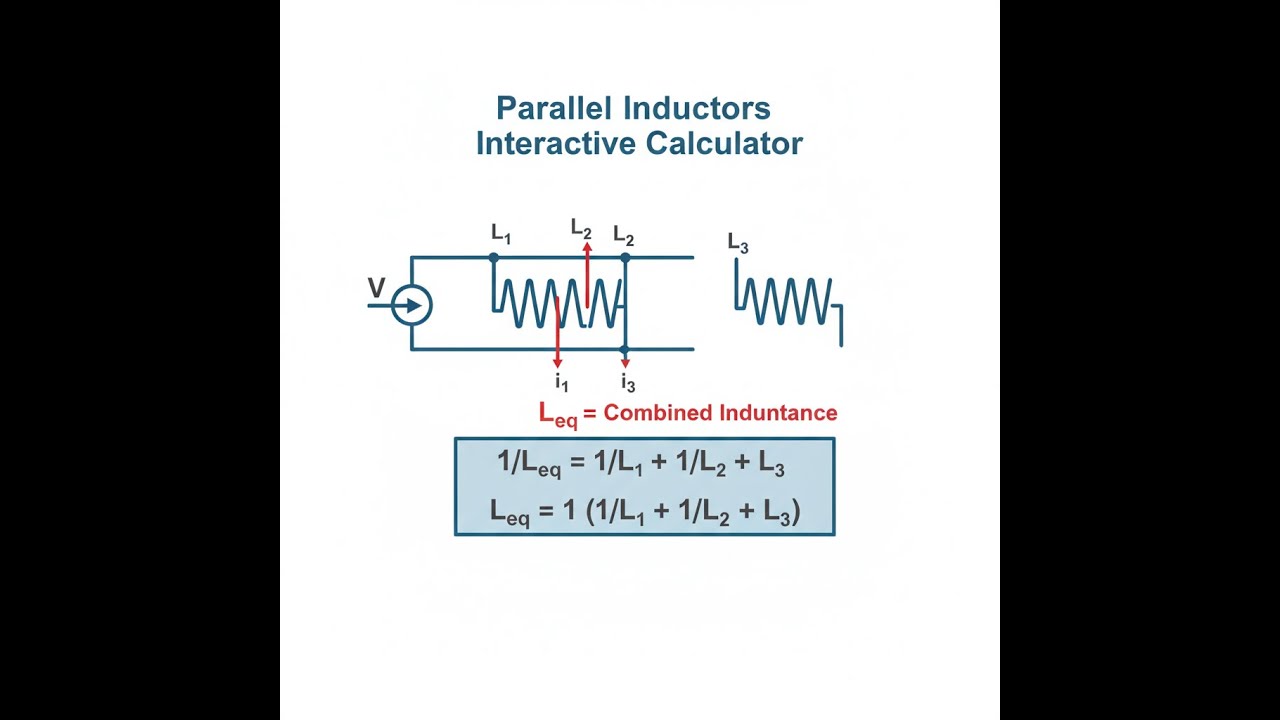
Circuit Diagram: Parallel Inductors

Parallel Inductors Calculator
This calculator is intended for education, concept evaluation, and preliminary design. Results are based on the equations and assumptions described on this page, but cannot account for every real-world load case, tolerance, material property, environmental condition, installation detail, safety factor, code, or regulatory requirement. Verify all inputs, assumptions, units, and results independently before selecting components or using the result in a real application. Safety-critical, structural, medical, lifting, transportation, or regulated applications must be reviewed by a qualified engineer.
How to Use This Calculator
- Choose what you're solving for—equivalent value, missing inductor value, or quality factor—from the dropdown menu.
- Enter inductor values in mH. For Q-factor, add ESR (ohms) and frequency (kHz).
- If you want to see the process before entering values, use Try Example to fill in a worked case.
- Press Calculate and review your result.
Parallel Inductors Interactive Visualizer
This visualization shows how putting inductors in parallel drops the total inductance as you provide multiple current paths. Adjust each value and supply current to see how current splits and how Leq responds.
EQUIVALENT L
18.8 mH
I₁ CURRENT
7.5 A
I₂ CURRENT
12.5 A
FIRGELLI Automations — Interactive Engineering Calculators
Governing Equations
Here's what you use for two parallel inductors:
Two Inductors in Parallel
1/Leq = 1/L1 + 1/L2
Leq = (L1 × L2) / (L1 + L2)
Where:
- Leq = Equivalent inductance (H, mH, μH)
- L1, L2 = Individual inductances (same units)
N Inductors in Parallel (General Form)
Use this for more than two:
1/Leq = 1/L1 + 1/L2 + 1/L3 + ... + 1/Ln
For N identical inductors: Leq = L / N
Quality Factor and Reactance
For AC calculations:
XL = 2πfL = ωL
Q = XL / RESR = ωL / RESR
Where:
- XL = Inductive reactance (Ω)
- f = Frequency (Hz)
- ω = Angular frequency = 2πf (rad/s)
- L = Inductance (H)
- Q = Quality factor (dimensionless)
- RESR = Equivalent series resistance (Ω)
Simple Example
Take two inductors: L₁ = 10 mH, L₂ = 15 mH in parallel.
Leq = (10 × 15) / (10 + 15) = 150 / 25 = 6 mH
No matter what, the answer ends up lower than both original values if you're connecting in parallel.
Theory & Practical Applications
Fundamental Physics of Parallel Inductance
Parallel inductors share the same voltage but each carries its own current. The sum of their effects leads to a situation where reciprocal values add together—not direct sums like with resistors. This comes straight out of how Faraday's law and circuit current/voltage rules work: the voltage across each parallel branch is identical, but current divides according to the inductance and how fast current is changing (v = L di/dt).
But—and this gets overlooked often—the classic reciprocal formula only holds if the inductors’ fields don’t interact. If there’s mutual inductance (shared flux), calculation changes to Leq = (L₁L₂ - M²)/(L₁ + L₂ - 2M). Practical rule: keep parallel inductors spaced well apart or at 90° angles if you want the simple calculation to match real measurements. Mutual coupling can easily shift the result by 15–30% and mess with filter response.
High-Frequency Behavior and Parasitic Effects
No inductor is ideal. Parasitic capacitance, skin effect, and proximity effect all matter, especially at higher frequencies. Above a certain self-resonant frequency (SRF), the inductor acts more like a capacitor. In parallel, SRF usually goes up, which is actually useful in RF work, but as you get near SRF, calculated inductance values lose validity and circuit behavior gets odd due to phase shifts. Skin effect means AC resistance rises with frequency, so Q drops. For matched inductors, Q goes down evenly. With mismatched types or wire sizes in parallel, current can split unevenly at high frequencies—something you can exploit in filter design, or something that can cause overheating if not expected. Sometimes, mixing an air-core and a ferrite-core in parallel lets you get good DC inductance and better high-frequency filtering in one circuit. But you’ll need to model it to know what you’ll get.
Practical Applications in Power Electronics
Parallel inductors show up everywhere in multiphase DC-DC converters. Put N identical inductors on N out-of-phase switching legs, and you get output ripple inductance divided by N. This lets you handle fast load transients or meet tight output ripple specs without huge, slow inductors or massive output capacitors. Example: use six 1 μH inductors in a 6-phase output, and di/dt performance is like you used a single 167 nH inductor—hard to find as a part. It costs you board space and parts count, so it only makes sense when your regulator needs that much speed or current.
In noise filtering, parallel inductors help create notches or broadband EMI blocks. One trick is to parallel a differential-mode choke with a common-mode choke. This way, the circuit gets fast transient response on the wanted signals, but still blocks high-frequency noise.
Magnetic Core Considerations
If you parallel ferrite or powder-core inductors, pay attention to core saturation. Once one saturates, its inductance drops, shifting more current to the others—sometimes triggering a domino effect. The safe approach is to use inductors that all saturate at about the same point, or pick core types (like iron powder) with softer onset of saturation rather than sudden collapse. Temperature matters as well. Ferrite inductors tend to increase in inductance as they heat up, which causes them to steal less current, automatically balancing load. Air cores change less, so with big parallel banks, you sometimes need extra means to keep currents balanced if temperature or tolerances drift.
Worked Example: Multiphase Buck Converter Design
Scenario: You need an output filter for a four-phase synchronous buck providing 12V at 50A steady (80A peak); input is 48V at 300kHz; you want no more than 20% ripple per phase. See how the math works:
Step 1: Current per phase
Iphase = 50A / 4 = 12.5A average phase
Ripple is ΔIphase = 0.20 × 12.5A = 2.5A
Step 2: Duty cycle
D = Vout/Vin = 12V / 48V = 0.25
Step 3: Needed inductance per phase
L = Vout(1-D) / (fsw × ΔI)
L = 12V × (1-0.25) / (300,000 × 2.5A)
L = 9V / 750,000 = 12 μH per leg
Step 4: Equivalent Output Inductance
With 4 identical: Leq = 12 μH / 4 = 3 μH
Step 5: Output Ripple
Output ripple is less than the per-phase value because the phases are timed 90° apart. For four phases, ripple drops by a factor of about 4: ΔIout ≈ 2.5A / 4 = 0.625A. That's just over 1% of full load—well under many specs, and shows the appeal of multiphase.
Step 6: Core Sizing and Saturation Check
Pick iron-powder toroids rated for at least 15A—preferably with a 20% margin for peaks. For the 13.75A per winding needed here, that's around 92% of the rating. Use datasheets for AL value and saturation current; e.g., T106-26 core (AL ≈ 100nH/turn²), so N ≈ sqrt(12,000nH / 100nH) ≈ 11 turns.
Step 7: ESR and Q
At 300kHz, estimate 0.040Ω ESR. XL = 2π × 300,000 × 12e-6 = 22.6Ω.
Q = 22.6Ω / 0.040Ω = 565.
Summary: Four 12 μH leg inductors in parallel = 3 μH total, lets you run a smaller output cap for the same low ripple. This is why multiphase and parallel arrangements show up in VRMs and high-current DC-DC design.
Design Trade-offs and Limitations
Parallel inductors make sense for current handling, special values, or if your regulator is multiphase. Downsides: PCB layout gets complex (low-resistance traces everywhere), and if one inductor runs hotter than the rest, imbalance can set in. Temperatures outdoors or in vehicles can push specs ±15%, so if the application is rugged or safety-critical, you need to account for drift and imbalance. Most of the time, it's cheaper and simpler to use one big inductor if you have the space, unless you have a special need for the parallel configuration.
Frequently Asked Questions
Free Engineering Calculators
Explore our complete library of free engineering and physics calculators.
Browse All Calculators →🔗 Explore More Free Engineering Calculators
- Resistor Color Code Calculator
- I2C Pull-Up Resistor Calculator
- I2C/SPI Bus Speed & Pull-up Resistor Sizing
- Capacitor Charge Discharge Calculator — RC Circuit
- Eirp Calculator
- Internal Resistance Calculator
- Noise Figure Calculator
- Voltage Divider Calculator — Output Voltage from Two Resistors
- Ohm's Law Calculator — V I R P
- Transformer Turns Ratio Calculator
About the Author
Robbie Dickson — Chief Engineer & Founder, FIRGELLI Automations
Robbie Dickson brings over two decades of engineering expertise to FIRGELLI Automations. With a distinguished career at Rolls-Royce, BMW, and Ford, he has deep expertise in mechanical systems, actuator technology, and precision engineering.
Video Walkthrough - How to Use This Calculator
Need to implement these calculations?
Explore the precision-engineered motion control solutions used by top engineers.


