If you’re building an optical system, you can’t afford to get wavelength, frequency, or photon energy wrong—they’re tightly linked, and a small error carries through to the rest of your design. This Frequency of Light Interactive Calculator will give you those relationships directly, whether your starting point is wavelength, frequency, or energy, and you can factor in different propagation media. This is practical for anything from fiber optic comms to spectroscopy or laser layout, where even a 0.01 nm miscalculation can knock a DWDM channel completely out of spec. Scroll down for the base equations, a step-by-step DWDM example, theory on duality and dispersion, and a FAQ covering real technical questions.
What is the frequency of light?
Frequency is simply how many wave cycles hit a given point each second. Raising frequency shortens wavelength and boosts the energy of each photon. For visible light, the range is about 430 to 770 THz.
Simple Explanation
Picture light like ripples on a pond. Frequency is how many ripples pass a fixed spot per second. Wavelength is the distance from one ripple crest to the next. In any material, the speed of light is fixed—if you increase the frequency, the wavelength drops. Photon energy is basically how much energy each "ripple" carries, and it goes up directly with frequency.
📐 Browse all 1000+ Interactive Calculators
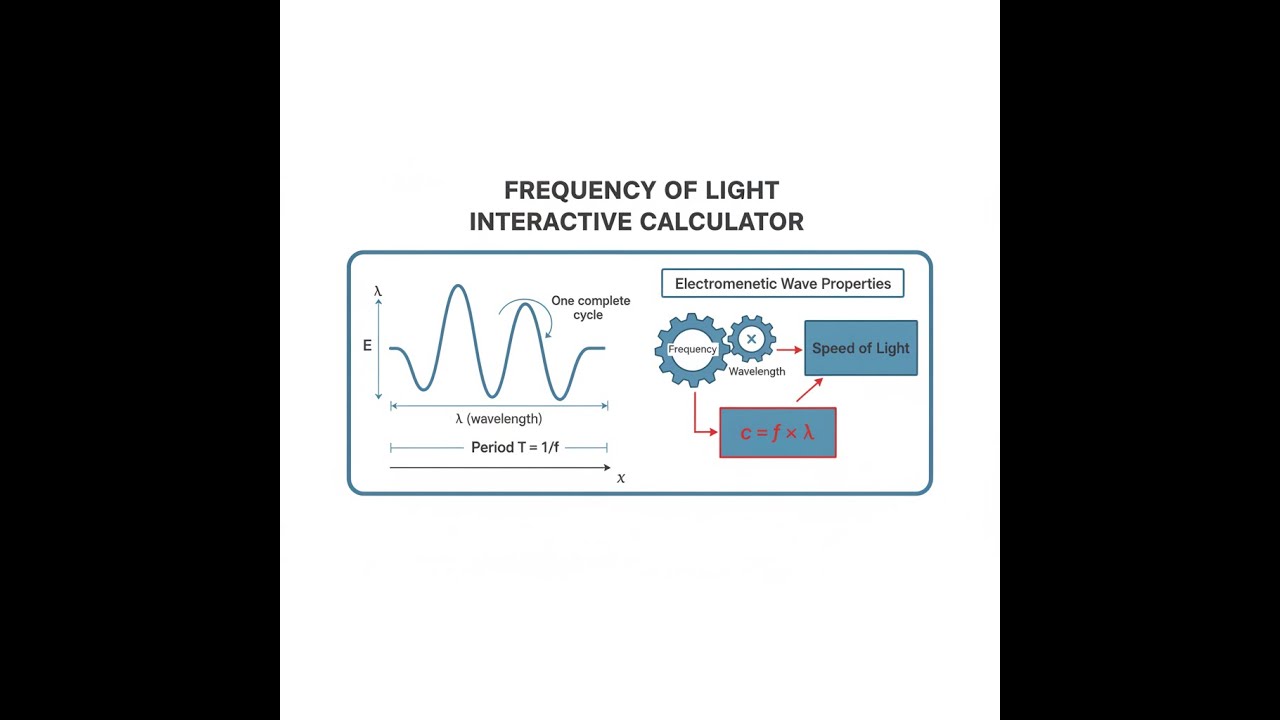
Electromagnetic Wave Diagram

How to Use This Calculator
- Pick what you want to solve for—frequency, wavelength, or energy—and what you already know.
- Enter your known value: wavelength (metres), frequency (Hz), or photon energy (J or eV).
- Choose the medium (vacuum, water, glass, diamond, or enter a custom refractive index).
- Click Calculate to get your result.
Frequency of Light Calculator
This calculator is intended for education, concept evaluation, and preliminary design. Results are based on the equations and assumptions described on this page, but cannot account for every real-world load case, tolerance, material property, environmental condition, installation detail, safety factor, code, or regulatory requirement. Verify all inputs, assumptions, units, and results independently before selecting components or using the result in a real application. Safety-critical, structural, medical, lifting, transportation, or regulated applications must be reviewed by a qualified engineer.
Frequency of Light Interactive Visualizer
This tool lets you see how wavelength, frequency, and photon energy all tie together. Adjust the parameters and see how the wave changes in different media—frequency never shifts at a boundary, but wavelength does.
FREQUENCY
545 THz
ENERGY
2.25 eV
IN MEDIUM
550 nm
FIRGELLI Automations — Interactive Engineering Calculators
Governing Equations
Use these formulas to tie frequency, wavelength, and photon energy together. Any one lets you work out the rest.
Fundamental Wave Equation
c = f × λ
Where:
- c = speed of light in vacuum = 2.998 × 10⁸ m/s
- f = frequency of the electromagnetic wave (Hz)
- λ = wavelength in vacuum (m)
Photon Energy
E = h × f = (h × c) / λ
Where:
- E = photon energy (J or eV)
- h = Planck's constant = 6.626 × 10⁻³⁴ J·s
- f = frequency (Hz)
- λ = wavelength (m)
Wave Propagation in Media
v = c / n = f × λmedium
λmedium = λvacuum / n
Where:
- v = wave speed in the medium (m/s)
- n = refractive index of the medium (dimensionless, n ≥ 1)
- λmedium = wavelength in the medium (m)
- λvacuum = wavelength in vacuum (m)
Note: Frequency stays constant when light crosses into a new medium—only wavelength and speed change.
Simple Example
Take green light with a wavelength of 550 nm (5.5 × 10⁻⁷ m) in vacuum.
- Frequency: f = c / λ = 2.998 × 10⁸ / 5.5 × 10⁻⁷ = 5.45 × 10¹⁴ Hz (545 THz)
- Photon energy: E = hf = 6.626 × 10⁻³⁴ × 5.45 × 10¹⁴ = 3.61 × 10⁻¹⁹ J (2.25 eV)
- In glass (n = 1.52): the wavelength drops to 550 / 1.52 = 362 nm; frequency stays at 545 THz.
Theory & Practical Applications
Electromagnetic Wave Nature and the Wave-Particle Duality
Light acts both like a wave and a particle, depending on what you measure. For most engineering work, the wave model (from Maxwell’s equations) handles things well—oscillating electric and magnetic fields, with frequency setting visible colors (about 430–770 THz) and energy. When you need to track individual packets, like in quantum effects or detector shot noise, the photon model (E = hf) comes into play.
A major point, often missed in basic texts: frequency doesn’t change when light enters a new material, but the wavelength shrinks by the refractive index. If you don’t account for this, your optical resonators, waveguide spacings, or Bragg structures in integrated photonics may end up off by a large margin. For example, a cavity that’s resonant at 1550 nm in vacuum becomes resonant at 1550 nm / 3.48 = 445 nm in silicon, so you have to scale all internal dimensions accordingly for correct operation.
Frequency-Dependent Phenomena in Real Systems
Dispersion—that is, how refractive index varies with frequency—is a real headache for high-rate optical data links. For example, in standard telecom fiber, you get about 17 ps of dispersion per nanometer of spectral width per kilometer at 1550 nm. For 100 Gbps data with about 0.8 nm spectral width sent over 80 km, that’s pulse spreading of over 1 ns. When your bit period is only 10 ps, you quickly get errors unless you add dispersion compensation.
The way materials absorb light also depends strongly on frequency. For instance, tissue is fairly transparent at 700–900 nm (“optical window,” useful for deep imaging), but UV-C around 200–280 nm gets stopped within microns (which is why UV-C can sterilize but doesn’t penetrate skin). The same frequency dependence shows up in every real photonics application: deep UV is used for germicidal lamps, while near-IR penetrates tissue for therapy.
Worked Engineering Example: Laser Diode Specification
A telecom engineer needs a laser diode that will operate at a precise DWDM channel—let’s say 193.1 THz—with frequency drift held within ±1.25 GHz across the full temperature range.
Part A: Find the center wavelength in vacuum
With c = f × λ, solve for λ:
λ₀ = c / f = (2.99792458 × 10⁸ m/s) / (193.1 × 10¹² Hz) = 1.55234 × 10⁻⁶ m = 1552.34 nm
This falls right in the C-band, as expected for long-haul fiber work.
Part B: Allowable wavelength drift
Given Δf = ±1.25 GHz, what’s Δλ? Differentiate c = fλ:
c = fλ → 0 = f(dλ) + λ(df) → dλ/df = -λ/f
So, Δλ ≈ -(λ/f) × Δf
Plug in: Δλ = -(1.55234 × 10⁻⁶ m / 193.1 × 10¹² Hz) × (±1.25 × 10⁹ Hz) = ∓1.004 × 10⁻¹¹ m = ∓0.01004 nm
This tells you the wavelength must stay within ±0.01 nm. Frequency and wavelength always move in opposite directions—a drift upward in f means a drift downward in λ.
Part C: Photon energy and output power
Photon energy at this frequency is:
E = hf = (6.62607015 × 10⁻³⁴) × (193.1 × 10¹²) = 1.2793 × 10⁻¹⁹ J
In electronvolts: E = 1.2793 × 10⁻¹⁹ / 1.602176634 × 10⁻¹⁹ = 0.7985 eV
If you need 10 mW optical output:
Photon rate = Power / Energy per photon = (10 × 10⁻³) / (1.2793 × 10⁻¹⁹) ≈ 7.82 × 10¹⁶ photons/second
Massive photon numbers like this mean you can usually treat bulk photonics problems with wave equations, not quantum mechanics—quantum effects are negligible in most practical calculations.
Part D: Wavelength inside the fiber core
If the fiber’s index is 1.4682 at 1552.34 nm:
λ_fiber = λ₀ / n = 1552.34 nm / 1.4682 = 1057.05 nm
This significant shrink impacts things like mode cutoffs and mode-field diameters, which all rely on the real wavelength in the medium, not the vacuum number. If you’re matching waveguides or integrated chips, you have to use λ in medium.
Applications Across Industries
Optical Communications: 1550 nm (193.1 THz) is the backbone for long-haul fiber because attenuation is low and amplifiers are available. Channels are spaced tightly—just 0.4 nm apart in DWDM—and the system only works if your frequency and drift are tightly controlled.
Medical Phototherapy: Penetration depth and mechanisms change with frequency. Shorter blue light can treat jaundice near the skin, while red and near-IR go deeper for stimulation therapy. What you pick depends on your target tissue and absorption profile.
Semiconductor Manufacturing: High photon energies in EUV let you pattern sub-7 nm features, but you can’t use ordinary optics. Everything absorbs in this region, so you have to use specialized mirrors and do the whole job in vacuum.
Spectroscopic Analysis: Atomic transitions are frequency-precise—if you want to cool sodium atoms, you need lasers locked within a few MHz of the 589 nm doublet. The precision in frequency, not just wavelength, is what sets the resolution limit.
Radio Astronomy: The 21-cm hydrogen line at 1420.4 MHz maps cosmic hydrogen. The photon energy is tiny, so you use large antenna arrays relying on coherence rather than photon counting—single photons aren’t practical at these frequencies.
Non-Ideal Behaviors and Engineering Limitations
Every real source has a linewidth. For a 1550 nm DFB laser, the intrinsic linewidth may be 100 kHz, but in practice, it’s broader due to temperature and current noise—often in the MHz range without active stabilization. Linewidth matters for coherent systems or dense channel packing.
Group velocity (how the pulse envelope moves) doesn’t always match phase velocity (carrier wave) in dispersive materials. In fiber, dispersion sets a limit: pulses stretch out beyond their bit period after just a few kilometers at high data rates—engineers have to compensate for this, or ISI (intersymbol interference) becomes unacceptable.
For more optics and wave problems, check out the full engineering calculator library.
Frequently Asked Questions
▼ Why does frequency remain constant while wavelength changes when light enters a different medium?
▼ How does the photon energy equation relate to the threshold current in laser diodes?
▼ What limits the accuracy of frequency measurements in real optical systems?
▼ Why do different spectral regions require fundamentally different detection technologies?
▼ How do dispersion effects become more severe at higher data rates even though frequency remains constant?
▼ What physical mechanism causes the refractive index to vary with frequency?
Free Engineering Calculators
Explore our complete library of free engineering and physics calculators.
Browse All Calculators →🔗 Explore More Free Engineering Calculators
About the Author
Robbie Dickson — Chief Engineer & Founder, FIRGELLI Automations
Robbie Dickson brings over two decades of engineering expertise to FIRGELLI Automations. With a distinguished career at Rolls-Royce, BMW, and Ford, he has deep expertise in mechanical systems, actuator technology, and precision engineering.
Video Walkthrough - How to Use This Calculator
Need to implement these calculations?
Explore the precision-engineered motion control solutions used by top engineers.


