If you pick the wrong soil compressibility model for a foundation, it’s easy for costs and settlements to spiral—often because preconsolidation pressure wasn’t properly identified. This Casagrande calculator helps you pin down σ'p, OCR, compression indices, and settlement using actual oedometer data. When you get σ'p right, you can make sound calls in foundation design, embankment work, and forensic geotechnical jobs. Below, you’ll find the full Casagrande method, formulas, a worked example, and straight answers to common questions engineers run into in practice.
What is Preconsolidation Pressure?
Preconsolidation pressure is the highest effective stress a soil has seen in its life. It guides you on whether a new load will compress a soil noticeably or just a little—overconsolidated soil behaves much stiffer than normally consolidated soil.
Simple Explanation
Picture a sponge that’s been squeezed once as hard as it ever could be, then released. As long as you squeeze it again with less force than before, it doesn’t change much—it’s already close-packed. Soil’s similar: if you push past its old stress record, it becomes much softer and compacts faster. Casagrande’s method lets you find this break point using routine lab data.
📐 Browse all 1000+ Interactive Calculators
Table of Contents
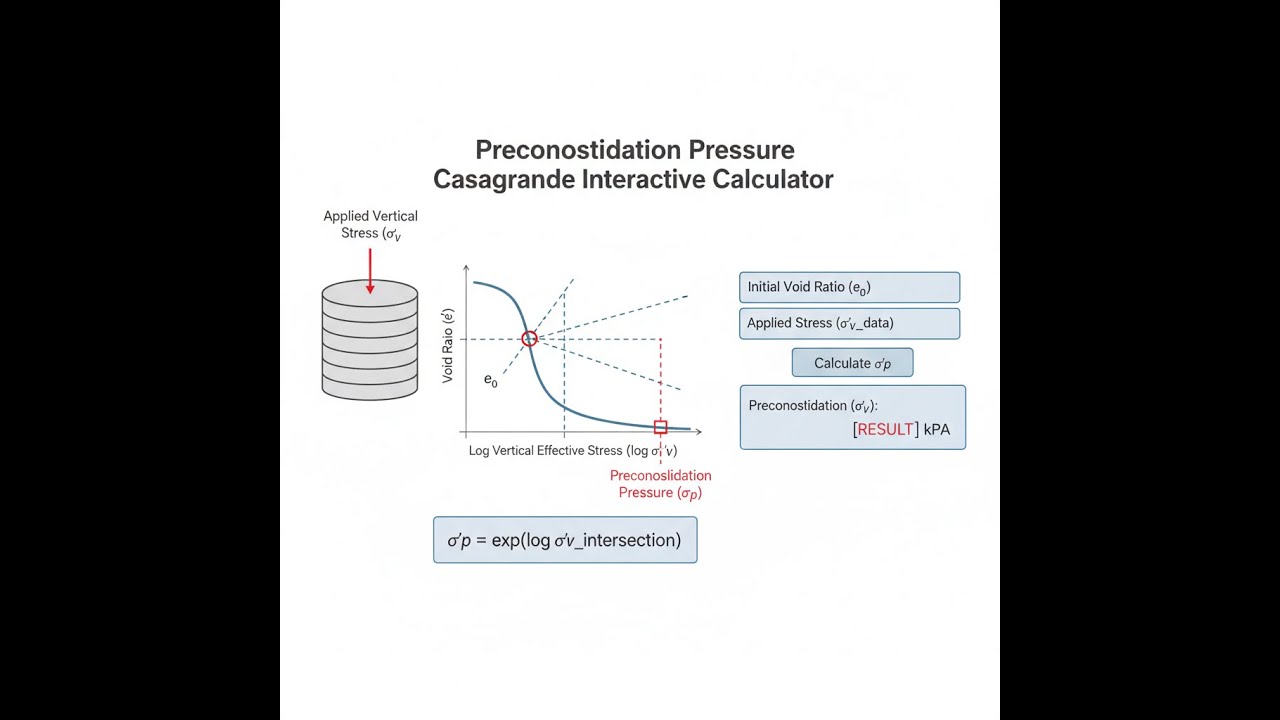
Casagrande Construction Diagram

How to Use This Calculator
- Choose which calculation you want from the dropdown (preconsolidation pressure, OCR, void ratio, Cc, Cr, or settlement).
- Enter void ratio (e) and matching effective stress values (σ', in kPa) from your oedometer data at the relevant points on the curve.
- If you’re estimating settlement, enter layer thickness, initial void ratio, and both compression indices too.
- Click Calculate—your answer will appear below.
Preconsolidation Pressure Calculator
This calculator is intended for education, concept evaluation, and preliminary design. Results are based on the equations and assumptions described on this page, but cannot account for every real-world load case, tolerance, material property, environmental condition, installation detail, safety factor, code, or regulatory requirement. Verify all inputs, assumptions, units, and results independently before selecting components or using the result in a real application. Safety-critical, structural, medical, lifting, transportation, or regulated applications must be reviewed by a qualified engineer.
Preconsolidation Pressure Casagrande Interactive Visualizer
Visualize the Casagrande graphical construction method to determine preconsolidation pressure from oedometer test data. Adjust void ratio points to see how the bisector construction identifies the maximum past stress threshold.
PRECONSOLIDATION
245 kPa
OCR
2.04
COMP. INDEX
0.31
FIRGELLI Automations — Interactive Engineering Calculators
Fundamental Equations
These are the working formulas for preconsolidation pressure by the Casagrande method.
Casagrande Construction Method
σ'p = σ'intersection
Where:
σ'p = Preconsolidation pressure (kPa or psf)
σ'intersection = Stress at intersection of bisector line and virgin compression line (kPa or psf)
Overconsolidation Ratio
OCR = σ'p / σ'0
Where:
OCR = Overconsolidation ratio (dimensionless)
σ'p = Preconsolidation pressure (kPa)
σ'0 = Current vertical effective stress (kPa)
Compression Index
Cc = (e1 - e2) / log10(σ'2 / σ'1)
Where:
Cc = Compression index (dimensionless)
e1, e2 = Void ratios at stress levels σ'1 and σ'2
σ'1, σ'2 = Effective stress levels on virgin compression line (kPa)
Recompression Index
Cr = (e1 - e2) / log10(σ'2 / σ'1)
Where:
Cr = Recompression index (dimensionless)
e1, e2 = Void ratios on recompression curve
Typically Cr ≈ 0.1 to 0.2 × Cc for most clays
Settlement of Overconsolidated Soil
If σ'0 + Δσ' ≤ σ'p:
S = (Cr H / (1 + e0)) × log10((σ'0 + Δσ') / σ'0)
If σ'0 + Δσ' > σ'p:
S = (Cr H / (1 + e0)) × log10(σ'p / σ'0) + (Cc H / (1 + e0)) × log10((σ'0 + Δσ') / σ'p)
Where:
S = Settlement (m or ft)
H = Initial thickness of compressible layer (m or ft)
e0 = Initial void ratio (dimensionless)
Δσ' = Increase in effective stress due to loading (kPa or psf)
Simple Example
At maximum curvature: e0 = 0.850 at σ' = 150 kPa. At virgin compression: e1 = 0.750 at σ' = 400 kPa.
Virgin slope = (0.750 − 0.850) / (log₁₀(400) − log₁₀(150)) = −0.100 / 0.426 = −0.235. Bisector slope = −0.235 / 2 = −0.117. Casagrande’s procedure gives σ'p ≈ 245 kPa. OCR = 245 / 150 = 1.63 — so, moderately overconsolidated.
Theory & Engineering Applications
Historical Development and Physical Significance
Casagrande’s method from 1936 gave engineers a graphic technique for finding the maximum past stress in a soil sample: preconsolidation pressure (σ'p). This value separates stiff, mildly compressible behavior (recompression) from the more yielding, permanent compression you get past that threshold (virgin compression). You can’t measure σ'p directly; instead, you infer it from the lab curve—so the Casagrande approach relies on interpretation, not just measurement.
Hitting a stress higher than σ'p damages the particle structure: grains shift, rotate, and pack denser; structure is permanently changed. The e-log(σ') curve shows this as a break between a flat recompression slope and a much steeper virgin compression line. The critical jump in compressibility marks the soil’s stress memory boundary.
The Casagrande Construction Procedure
The approach uses an e-log(σ') lab curve and boils down to three things: 1) Find the curve’s point of maximum curvature—the transition from stiff response to softer compression. Sometimes it’s obvious, sometimes it isn’t, especially if overconsolidation is low. 2) Draw a horizontal and a tangent at this point, then bisect the angle between them. 3) Extend the virgin compression line backward to lower stress. Where this line meets your bisector is the estimated preconsolidation pressure. This is a practical geometric trick for separating two types of soil behavior on a graph, not some perfect science. The construction assumes a straight virgin line in e-log(σ') space—which does the job well for everyday clays and silts, but can mislead you for highly plastic or very high-stress soils. If your sample is disturbed or the transition is faint, don’t expect high precision regardless of the method or software.
Overconsolidation Mechanisms and Their Engineering Implications
Soils end up overconsolidated for several reasons, and it matters to engineering. The usual cause is erosional unloading: material removed by glaciers, rivers, or excavators. Take a clay now at the surface that once sat beneath thick glacial ice—the clay’s stress memory (σ'p) can be several times modern overburden. These clays, common in certain northern climates, act much stiffer than their present depth suggests.
Desiccation is another path—near the surface, seasonal drying creates high effective stresses via suction. You wind up with a hard, stiff crust across the top few meters; underneath, the clay can be much softer. It's easy for light structures to bear on this crust and then see sudden settlement if the crust fails.
Chemical cementation and aging can also stiffen a clay beyond what overburden alone would predict. These are “structural” effects—particle bonding, not just packing. Regardless of the mechanism, the Casagrande method detects only the change in compressibility, not the cause.
Compression and Recompression Indices: Fundamental Compressibility Parameters
The compression index (Cc) controls settlement along the virgin line. For most clays, Cc sits between 0.15 and 0.50, with higher values for softer or high-plasticity soils. Shortcuts like Cc ≈ 0.009(LL - 10) exist, but real projects should get Cc from tests. Cc has a direct, linear effect on predicted settlement—double Cc, double the settlement.
The recompression index (Cr) governs settlement for load increments within the overconsolidated zone and is usually just 5%–20% of Cc. This is why overconsolidated clays hardly settle if you stay under σ'p. Once you cross it, settlement jumps fast. For variable loads (e.g., warehouses with heavy spots), some areas may slip into virgin compression while others don’t, causing differential settlement.
The upshot: settlement in overconsolidated soils is usually modest and predictable up to σ'p. But let your stress rise just above that, and it can increase sharply, so it pays to check every location against this threshold—not just average values.
Worked Example: Shopping Center Foundation Analysis
Problem Statement: A shopping center near Chicago loads a 4.2 m clay layer with 95 kPa. Lab consolidation tests used high-quality samples. Glacial till is at depth, and the region was covered by ice during glaciation. Groundwater table is 1.5 m from the surface.
Given Laboratory Data from Consolidation Test:
- Maximum curvature: e0 = 0.927 at σ' = 147 kPa
- Virgin line point: e1 = 0.783 at σ' = 425 kPa
- Recompression: e changes 0.952 → 0.921 as σ' goes 85 → 235 kPa
- Initial in-situ void ratio: ei = 0.895
- Unit weight above water table: γ = 18.3 kN/m³
- Saturated unit weight: γsat = 19.7 kN/m³
- Clay layer depth: 2.0 to 6.2 m below ground
Step 1: Find Preconsolidation Pressure
Slope, virgin line: (0.783 - 0.927) / (log₁₀(425) - log₁₀(147)) = -0.144 / 0.461 = -0.312. Bisector: -0.312 / 2 = -0.156. Build both equations and set their e-values equal to find σ'p; you’ll get log(σ'p) = 2.526, so σ'p = 336 kPa.
Step 2: Calculate In-Situ Effective Stress at Mid-Depth
Mid-depth of clay = (2.0 + 6.2) / 2 = 4.1 m
Overburden: σ = 18.3×1.5 + 19.7×(4.1−1.5) = 27.45 + 51.22 = 78.67 kPa
Pore pressure: u = 9.81×(4.1−1.5) = 25.51 kPa
Effective stress: σ'0 = 78.67-25.51 = 53.16 kPa
Step 3: Calculate OCR
OCR = 336 / 53.16 = 6.32
This is high, fitting the site’s glacial history. The clay once held much more load than now.
Step 4: Compression Indices
Compression: (0.927 - 0.783)/(log₁₀(425)-log₁₀(147)) = 0.144 / 0.461 = 0.312
Recompression: (0.952-0.921)/(log₁₀(235)-log₁₀(85)) = 0.031/0.442 = 0.070
Cr / Cc = 0.070 / 0.312 ≈ 0.22 — typical for many clays.
Step 5: Final Effective Stress with Loading
Δσ' = 95 kPa; So σ'f = 53.16 + 95 = 148.16 kPa. Since σ'f well below σ'p, all settlement is along the stiff recompression curve.
Step 6: Settlement
S = (0.070×4.2)/(1+0.895) × log₁₀(148.16/53.16) = 0.294/1.895 × 0.445 ≈ 0.069 m = 69 mm
Step 7: Margin to Virgin Compression
σ'p - σ'f = 336 - 148.16 = 187.84 kPa; this is extra capacity before you risk large settlement.
Comparison to Normally Consolidated Clay:
If OCR = 1, whole loading causes virgin compression. SNC = (0.312 × 4.2)/1.895 × log₁₀(148.16/53.16) = 0.691×0.445 = 0.308 m = 308 mm. Thanks to the high OCR, settlement is cut by more than 75%; real-world, this lets you avoid deep foundations or soil improvement in many cases.
For more, see the engineering calculator library.
Alternative Methods and Comparison
Casagrande’s construction is the industry workhorse, but alternatives exist. Schmertmann’s method and Pacheco Silva’s construction tweak the geometry: some users get slightly more repeatable results with them, especially if the curve has a gradual transition. In practice, most of these methods agree within 10–20% for typical soils—well inside the noise added by sample handling and soil variability. Every method is an engineer’s best estimate, not an absolute, so double-checking with multiple samples and methods is standard procedure if the project is risk-sensitive. Trying to be too precise—say, by reporting σ'p to three decimals—just hides the true limits of the test and interpretation.
Practical Applications
Scenario: Foundation Design for Medical Center Expansion
A hospital addition in Minneapolis is planned over a stiff clay layer. The lab void ratio curve shows maximum curvature at 0.843 and 178 kPa; the virgin compression line stretches to 520 kPa. The Casagrande calculator gives σ'p = 267 kPa and OCR = 2.9 (current stress 92 kPa). This supports a five-story design with just 47 mm settlement on a 135 kPa load—within the 75 mm project limit. If you skip the overconsolidation check and assume the soil is normally consolidated, you could overestimate settlement and push the project into much more costly foundation work unnecessarily.
Scenario: Embankment Construction Over Soft Clay
For an approach embankment in Louisiana over 6 m of soft clay, Casagrande analysis reveals almost no overconsolidation (σ'p = 58 kPa, current σ' = 54 kPa, OCR = 1.07). An 85 kPa embankment load pushes the soil far past σ'p. The calculator shows settlement will be over half a meter. The practical fix: preload the site with a temporary surcharge that forces the clay to preconsolidate before building the embankment, reducing long-term settlement and future maintenance.
Scenario: Forensic Investigation of Excessive Settlement
A warehouse floor in service settles much more than estimated. The design assumed OCR = 3.5 from local geology, but didn’t actually use the Casagrande method on lab data. Forensic review shows, by Casagrande construction, σ'p was really 112 kPa and OCR just 2.0. Worse, the design load actually pushed stresses past σ'p, causing virgin compression where only recompression had been assumed. Settlement was badly underestimated. A more careful σ'p determination at the start would have changed the design and avoided expensive post-construction repairs.
Frequently Asked Questions
Why does the Casagrande method require plotting void ratio versus LOG of stress rather than arithmetic stress? +
How accurate is the Casagrande method, and what factors affect the reliability of preconsolidation pressure determination? +
What does it mean when calculated OCR is less than 1.0, and how should engineers respond? +
Why is the recompression index typically 1/5 to 1/10 of the compression index, and what controls this ratio? +
Can preconsolidation pressure vary with depth within a single clay layer, and how does this affect foundation design? +
How does the Casagrande method apply to organic soils and highly compressible peats? +
Free Engineering Calculators
Explore our complete library of free engineering and physics calculators.
Browse All Calculators →🔗 Explore More Free Engineering Calculators
About the Author
Robbie Dickson — Chief Engineer & Founder, FIRGELLI Automations
Robbie Dickson brings over two decades of engineering expertise to FIRGELLI Automations. With a distinguished career at Rolls-Royce, BMW, and Ford, he has deep expertise in mechanical systems, actuator technology, and precision engineering.
Video Walkthrough - How to Use This Calculator
Need to implement these calculations?
Explore the precision-engineered motion control solutions used by top engineers.


