
You want to automate a gate, chute, vent, cover, or implement on farm equipment. The actuator has to survive dust, vibration, weather, and bad geometry. Agriculture linear actuators work well when you size force, stroke, speed, duty cycle, IP rating, and control method before you drill brackets.
What are agriculture linear actuators?
Agriculture linear actuators are electric actuators used on farm equipment to push, pull, lift, tilt, open, close, or adjust a mechanical part. They turn motor rotation into straight-line motion.
What is the simple explanation?
A farm actuator replaces your hand, a linkage, or a small hydraulic cylinder in jobs that need controlled motion. It can open a chute, move a seed door, lift a cover, adjust a deflector, or position a vent.
Use the formula below when the actuator pushes a hinged chute or cover.
F = (W × D) ÷ (A × sin(θ))
The calculator assumes the center of gravity sits roughly halfway along the lid, hatch, or cover. If the load is heavier at one end, use the real balance point instead.
The angle θ in the formula represents the angle between the actuator shaft and the chute or cover at the position you are sizing — usually the closed position, where the lever arm is shortest and force demand peaks. This differs from the calculator's separate "target open angle" input, which controls geometry and stroke estimation.
When should you use electric actuators on farm equipment?
Use electric actuators when the job needs clean, simple, controlled motion and the force sits within the actuator's rating. They make sense when hydraulic pumps, hoses, valves, and leaks add more trouble than value.
Typical farm uses include hopper gates, seed doors, grain chute diverters, ventilation louvers, sprayer boom adjustments, livestock feeder doors, equipment covers, and small implement adjustments.
FIRGELLI explains the core actuator terms in our linear actuators guide. That page covers dynamic load, static load, side loading, speed, duty cycle, limit switches, and IP ratings.
How does a farm actuator actually fail?
Most failures start with geometry or environment. The actuator stalls because the mount angle gives it no leverage. The rod sees side load because the gate lacks a guide. The wiring fails because the connector sits where water and dirt collect.
Fix those 3 things first. Then choose force.
How do you size force for a hinged chute or cover?
Use the same lever math you would use for a boat hatch or hinged lid:
F = (W × D) ÷ (A × sin(θ))
Then add a safety factor. Farm equipment rarely lives in clean lab conditions. Dust, mud, old hinges, crop buildup, vibration, and weather all steal force.
What should the calculator inputs be?
Use the full chute or cover length. The calculator estimates the center of gravity at half that length, which works for a first-pass estimate on a uniform hinged flap.
The chute starts closed at 0°. You choose the target open angle, usually around 45° to 90° depending on the equipment.
How do you use this calculator?
- Measure the chute, cover, or lifting flap weight.
- Measure from the hinge to the center of gravity.
- Measure from the hinge to the actuator mount point.
- Click Calculate to see your result.
What is a simple example?
A 75 lb chute has its center of gravity 24 inches from the hinge. You mount the actuator 30 inches from the hinge at a 35° starting angle.
F = (75 × 24) ÷ (30 × sin(35°))
F = 1,800 ÷ 17.21 ≈ 104.6 lbs
Add 1.75× safety factor:
Fsafe = 104.6 × 1.75 ≈ 183 lbs
So you would not pick a 100 lb actuator. You would pick above 183 lbs, then check stroke, speed, duty cycle, IP rating, mounting, and control.
Can we calculate a real farm chute door?
Let’s size a grain chute door that lifts upward around a horizontal hinge.
- Door weight: 95 lbs
- Length from hinge: 20 inches
- Hinge to actuator mount: 32 inches
- Starting angle: 28°
- Safety factor: 2× because the door sees dust and crop buildup
F = (95 × 20) ÷ (32 × sin(28°))
F = 1,900 ÷ 15.02 ≈ 126.5 lbs
Fsafe = 126.5 × 2 ≈ 253 lbs
This system needs an actuator rated above 253 lbs in that geometry. You can reduce that requirement by moving the actuator mount farther from the hinge or improving the starting angle.
How do you choose stroke?
Mock up the motion before ordering. Stroke depends on the closed length, open angle, hinge position, and bracket locations.
Do not guess stroke from gate size. Draw the hinge, closed position, open position, actuator base mount, and actuator rod mount. The distance change between closed and open gives you the required stroke.
What speed should farm equipment use?
Use enough speed to make the equipment practical, but not so much that it slams, throws material, or creates a pinch hazard. Faster usually means less force for the same actuator family.
For gates, covers, and chutes, controlled motion usually beats fast motion.
What about dust, water, and IP rating?
Farm equipment sees dust, rain, washdown, fertilizer, crop debris, and vibration. Choose an actuator with an enclosure rating that matches the real location, not the best day the machine will ever see. IP ratings follow IEC 60529, which defines the two-digit code for protection against solids and liquids.
Also protect the wiring. A sealed actuator body does not help much if the connector sits open under a wet hopper.
Should you use feedback control?
Use feedback when the actuator needs to stop at positions, synchronize with another actuator, report position, or work with a controller like the FCB-2 actuator controller.
Do not use feedback just to make a simple gate open and close. For basic extend/retract motion, a regular switch may make more sense.
Recommended FIRGELLI setup
Which FIRGELLI actuators fit farm equipment?
Farm equipment punishes weak actuator choices. Dust, vibration, weather, and awkward geometry all add load. Start with a serious actuator, then choose whether you need feedback control or simple switch control.

Industrial Actuators
Use the Industrial Actuators collection for heavy-duty farm and equipment applications. These actuators can be specified with optional feedback wiring when the system needs position-aware control.
View Industrial Actuators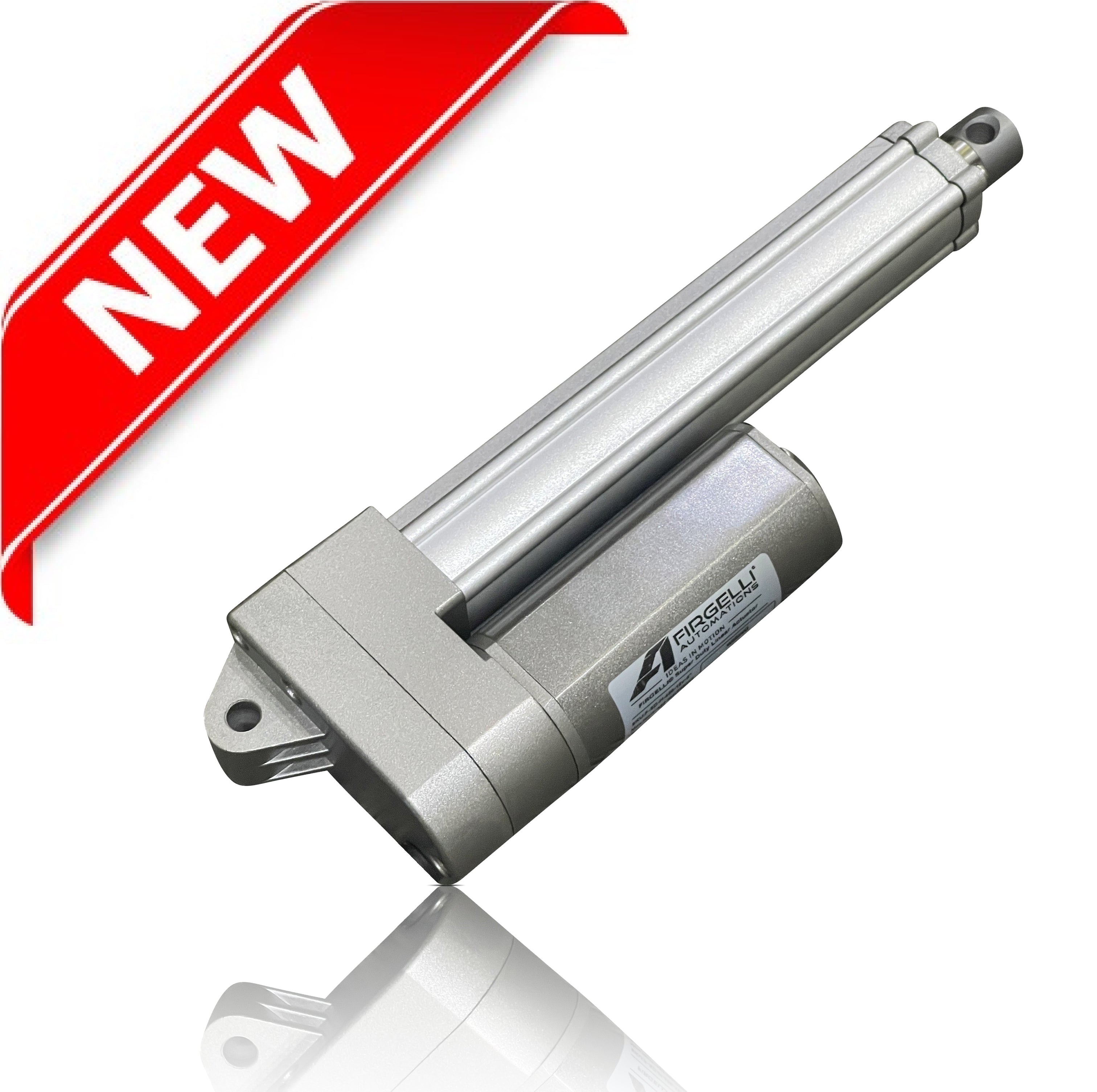
Super Duty Electric Linear Actuator
Use this when you need stroke, force, and speed options in a strong actuator platform. Built-in feedback can work with the FCB-2, but you can still use a regular switch for basic extend/retract control.
View Super Duty Actuators
Utility Linear Actuator
Use this for smaller farm automation jobs where compact size, low weight, and quiet motion matter. Feedback works with the FCB-2, but simple switch control still works when feedback is not needed.
View Utility ActuatorsFeedback gives you better control, but it stays optional. For a simple grain chute, vent, or small door, a 2-wire toggle switch or another option from the FIRGELLI switches collection may be all you need.
What trade-offs matter most?
What should you check before ordering?
- Load weight
- Hinge location
- Center of gravity
- Actuator mount distance
- Starting angle
- Required stroke
- Speed requirement
- Duty cycle
- IP rating and wiring protection
- Control method
- Side-load support
How should you test the actuator before trusting it?
A prototype that works once proves the idea, not the design. Run these checks with the real chute, cover, or gate before you put it in the field.
- Cycle test with real load. Run at least 50 full extend and retract cycles with the actual chute, gate, or cover attached. Watch for stalling near the start of motion, where torque demand peaks.
- Test at the hard part of travel. Measure current draw or listen for motor strain at the worst angle, not at mid-stroke where the lever arm is easiest.
- Side-load check. With power off, try to push the rod sideways at the mount. If it deflects, the load needs a guide. The actuator should not act as the hinge.
- Wet and dusty cycle. If the equipment runs outdoors, hose the connector and bracket area, then run a cycle. Check for water in the connector or actuator body afterward.
- Verify limit behavior. Confirm the actuator stops cleanly at both ends without slamming. Adjust mounting geometry or use a controller if motion is too abrupt.
Frequently Asked Questions
Can electric actuators replace hydraulics on farm equipment?
Yes, when the force, speed, duty cycle, and environment fit the actuator. Electric actuators work well for gates, covers, chutes, vents, and adjustment mechanisms. Hydraulics still make sense when the job needs very high force or continuous heavy-duty cycling.
Do agriculture actuators need feedback?
No. Feedback helps when you need position control, synchronization, custom limits, or FCB-2 control. A simple chute or door can use a 2-wire actuator with a rocker or toggle switch if it only needs full extend and full retract motion.
What causes actuator failure on farm equipment?
Bad geometry, side loading, water ingress, poor wiring protection, overload, and excessive duty cycle cause most failures. The actuator should push and pull along its shaft. Hinges, slides, and brackets should carry the side loads.
What safety factor should I use for farm equipment?
Use at least 1.5x for clean light-duty mechanisms. Use 1.75x or 2x for exposed equipment, dusty gates, older hinges, gaskets, or unknown friction. Safety factor does not fix bad geometry, but it gives the actuator room for real-world conditions.


