When you’re working out the resolution for an optical system—whether it’s a telescope, microscope, or a camera—the real limit usually isn’t your sensor or your glass. It’s diffraction. This calculator gives you the numbers on angular resolution, aperture size, and linear resolution at distance, all based on wavelength and aperture diameter. If your goal is to see fine detail—like in astronomy, semiconductor inspection, or surveillance—it pays to actually check what you’ll be able to resolve before making design choices. The rest of this page walks through the Rayleigh formula, real-world examples, the physical basis, and typical questions engineers run into.
What is the Rayleigh criterion?
The Rayleigh criterion lets you calculate the minimum angle where two small light sources stop being distinguishable with your optics—set purely by diffraction at the aperture, not by flaws in your hardware. This is the hard cutoff below which you just get a blur, no matter how good your lens or sensor is.
Simple Explanation
If you aim two flashlights at you from the far end of a football field, at some range their beams will overlap until you can’t tell they’re two sources. The Rayleigh criterion is the rule for where that blending happens. You get sharper resolution with a bigger lens and/or a shorter wavelength. That’s the core idea.
📐 Browse all 1000+ Interactive Calculators
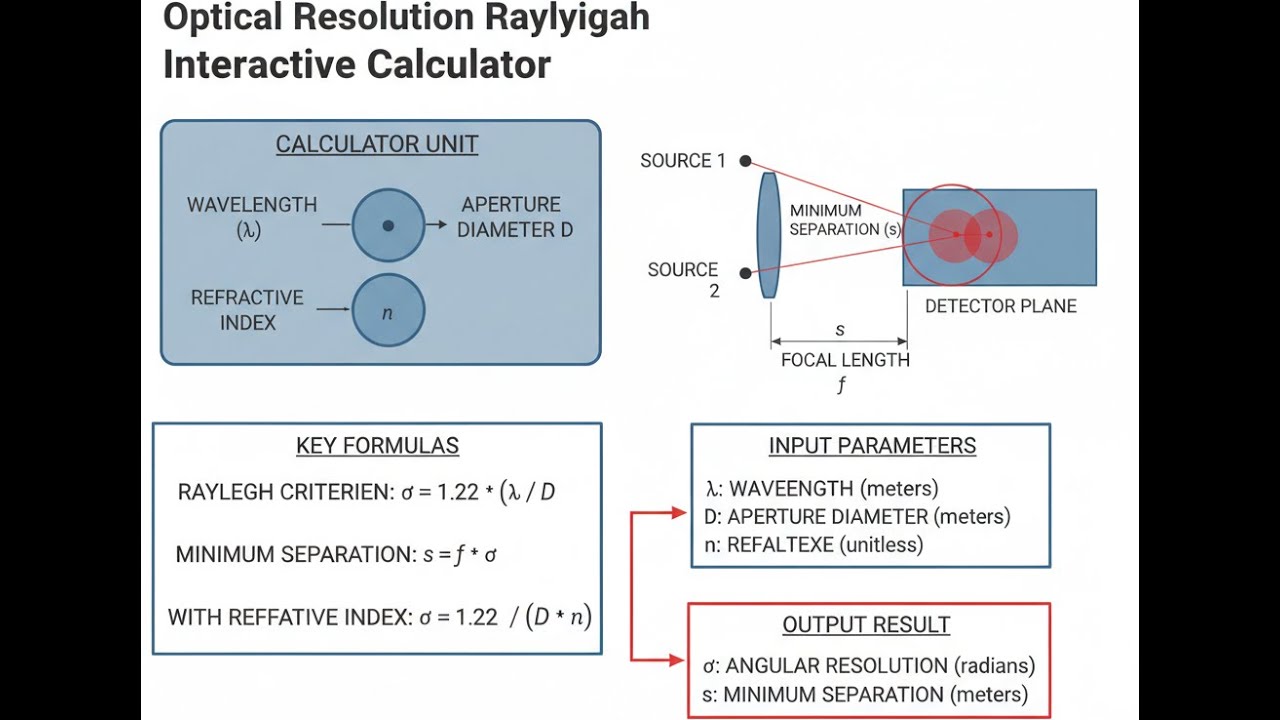
Optical Resolution Diagram

Interactive Rayleigh Resolution Calculator
How to Use This Calculator
This calculator is intended for education, concept evaluation, and preliminary design. Results are based on the equations and assumptions described on this page, but cannot account for every real-world load case, tolerance, material property, environmental condition, installation detail, safety factor, code, or regulatory requirement. Verify all inputs, assumptions, units, and results independently before selecting components or using the result in a real application. Safety-critical, structural, medical, lifting, transportation, or regulated applications must be reviewed by a qualified engineer.
- Pick which type of result you want: angular resolution, required aperture, linear resolution, or another option.
- Put in your wavelength (in nanometers) and your aperture diameter (in millimeters), or the target resolution for the mode you’ve chosen.
- Hit Calculate. You’ll get your answer immediately.
Optical Resolution Rayleigh Interactive Visualizer
See how aperture size and wavelength determine the fundamental resolution limit of optical systems. Watch the Airy disk pattern and angular resolution change in real-time as you adjust parameters.
Angular Resolution
1.38"
Linear Resolution
6.7 mm
Resolving Power
149k
FIRGELLI Automations — Interactive Engineering Calculators
Rayleigh Criterion Equations
Here are the formulas you’ll use for angular resolution, linear resolution, minimum aperture for a given result, and maximum separation at distance.
Angular Resolution (Rayleigh Criterion)
θ = 1.22 × λ / D
θ = angular resolution (radians)
λ = wavelength of light (meters)
D = aperture diameter (meters)
1.22 = constant derived from the first zero of the Bessel function J₁
Use the formula below to calculate linear resolution at a known distance.
Linear Resolution at Distance
d = θ × L
d = minimum resolvable linear separation (meters)
θ = angular resolution (radians)
L = distance to object (meters)
Use the formula below to calculate the minimum aperture diameter needed to hit a target resolution.
Required Aperture for Target Resolution
D = 1.22 × λ / θ
D = required aperture diameter (meters)
λ = wavelength of light (meters)
θ = desired angular resolution (radians)
Use the formula below to calculate the maximum distance at which two objects can be resolved.
Maximum Distance to Resolve Objects
Lmax = s / θ
Lmax = maximum distance (meters)
s = physical separation between objects (meters)
θ = angular resolution (radians)
Use the formula below to calculate resolving power for a given aperture and wavelength.
Resolving Power
R = D / (1.22 × λ)
R = resolving power (dimensionless)
D = aperture diameter (meters)
λ = wavelength of light (meters)
Simple Example
Example: For 550 nm light and a 100 mm aperture, plug into θ = 1.22 × 550×10⁻⁹ / 0.1 and you get 6.71×10⁻⁶ radians, or 1.384 arcseconds. If you’re viewing something 1000 m away, your minimum feature size (linear resolution) will be about 6.71 mm. You can’t distinguish anything smaller than that.
Theory & Engineering Applications
Rayleigh’s limit is the result of how light behaves as a wave—once it passes through a round aperture, it spreads out and creates an Airy disk with a central spot and faint rings. Rayleigh’s original rule was that you can say two points are resolved when one Airy disk’s center lines up with the first dark ring of the other, which gives around a 26% intensity dip between them—enough for a human to notice there are two peaks instead of one.
Physical Origins of the Diffraction Limit
The 1.22 in Rayleigh’s equation isn’t arbitrary; it comes from where the first zero lands in the Bessel function describing diffraction through a circle (x = 3.8317). When you convert this to angular units for a circular aperture, the factor becomes 1.22. Rectangular apertures have a different structure and don’t use the 1.22 correction. Each aperture shape changes how light spreads and what your “diffraction pattern” looks like—rings for circles, cross-shapes for rectangles.
Rayleigh’s rule assumes you’re using normal light sources (not lasers or phase-locked), and that you’re only limited by diffraction; in practice, misalignment, glass imperfections, atmospheric turbulence, and manufacturing errors can all make the real-world resolution much worse. This is why telescopes with large mirrors still don't always reach their theoretical limits unless the conditions are extremely stable—or you use adaptive optics to iron out the atmospheric wobble in ground-based systems.
Wavelength Dependence and Multi-Spectral Systems
Shorter wavelengths give sharper resolution—if your microscope uses blue (400 nm) instead of red (700 nm), you get about 37% better detail. That’s the main reason behind using UV or even electron beams when you need to spot extremely tiny things. But go to radio wavelengths and the story flips: to match the detail, your aperture has to get unrealistically big. That’s why radio astronomers use multiple dishes spread over long distances to synthesize a larger "virtual" aperture—otherwise, their resolution would be extremely poor at those long wavelengths.
Designing for a wide spectrum means trade-offs. A telescope made for visible light (~550 nm) will blur out infrared objects unless you scale the aperture proportionally. Space projects like the James Webb use a large mirror so their longer-wavelength images still retain usable detail, even though the numbers aren’t as good as what you’d get at visible wavelengths on the same size glass in space.
Engineering Trade-offs in Optical Design
If you want higher resolution, the answer is a bigger aperture, but larger optics come with real hurdles. Mirrors and lenses get heavy fast, need better support, and their surfaces have to be polished extremely accurately—within about λ/20. For a large mirror, that means holding the entire shape within nanometers of perfect across meters of span. You also run into weight scaling quickly—double the diameter, and the mass more than octuples for the same thickness. That’s why big mirrors are segmented: making a single enormous, flawless slab just stops being practical after a certain point.
Increasing the aperture can shrink your field of view if you don’t change your design. If you want both a wide scene and high resolution, you’ll have to stitch smaller images together or add extra corrector lenses, which adds cost and complexity. The lesson: you’re always trading off between coverage, sharpness, price, and physical size—pick your compromises early.
Microscopy and Near-Field Techniques
Microscopes use numerical aperture (NA = n·sin(α)) because the cone of light and the refractive index of the medium affect how much detail you get—especially when the working distance is short. For Rayleigh-limited microscopy, the smallest detail resolvable goes as d = 0.61λ/NA. Using oil (n ~ 1.515) and pushing NA near 1.4, visible light microscopes can hit about 200 nm resolution. If you need more, you won’t get it with normal lenses—instead, super-resolution tricks (e.g. STED, PALM) or near-field scanning (where the aperture gets millimeters from the surface) are required. These "break" the far-field diffraction rules by working close up or by time-tagging single events rather than relying on raw optical sharpness.
Worked Example: Satellite Imaging Resolution
Say you want your satellite, orbiting at 425 km, to spot 15 cm details on the ground using visible light (550 nm). First, get the angle: θ = 0.15 m / 425,000 m ≈ 3.53 × 10⁻⁷ radians. Invert the Rayleigh formula to get the aperture: D = 1.22 × 550 × 10⁻⁹ / 3.53 × 10⁻⁷ ≈ 1.9 meters. Plug back in and check: Yes, you’ll get your 15 cm ground resolution, and your system needs about 80% of the Hubble mirror’s size. Practical builds often go bigger, factoring in atmospheric effects and the reality that conditions and movement degrade your best-case performance. A telescope like this also needs fast exposure or motion compensation; the satellite will be moving ~7.66 km/s, so anything slower than a millisecond will give motion blur at this level of resolution.
Astronomical Applications and Interferometry
Long-wavelength (radio) telescopes have terrible resolution unless you make them enormous. The Arecibo dish gets a few arcminute resolution at best, which isn’t enough for most astrophysics. The workaround is interferometry—spread telescopes out over kilometers so you "synthesize" a huge aperture and get milliarcsecond detail. That’s how radio astronomers make images sharp enough to resolve details in distant galaxies.
If you need more formulas or practical calculators for optics work—beam sizing, photometry, lens design, and so on—check the engineering calculator library.
Practical Applications
Scenario: Amateur Astronomer Selecting a Telescope
Marcus wants to see if an 8-inch Schmidt-Cassegrain is worth it over a 6-inch for splitting close double stars. With 550 nm light, running the numbers, he finds the 6-inch can get to about 0.74 arcsecond, while the 8-inch can hit 0.55 arcsecond. He sees that, for most interesting binaries (0.6–1.0 arcsecond), the bigger scope will definitely resolve more of them. But, living in suburbia, Marcus checks his local seeing—typically 1–2 arcseconds. So unless he’s at a site with good steady air, buying a bigger scope won’t always give better resolution in real use. It’s not just the math—a look at the site conditions is always needed.
Scenario: Wildlife Photographer Planning Safari Equipment
Jennifer’s taking a 500mm f/4 lens (125 mm aperture) to Kenya. She checks if that’s enough for fine feather detail at 40 meters. The Rayleigh calculator says her linear resolution at 40 meters is just under 0.22 mm. Switching to a 600mm f/4 lens (150 mm aperture) improves that to ~0.18 mm. That’s a 17% gain, but with a heavier and more expensive lens. She weighs this against simply cropping her 500mm image—a tradeoff anyone planning for both mobility and image detail has to consider.
Scenario: Optical Engineer Designing Inspection System
Dr. Patel’s job is to spot 2.5 μm defects on semiconductor wafers at 150 mm working distance, using blue LED light (470 nm). The required angular resolution is 16.7 microradians. Plug into Rayleigh, and he’ll need at least a 34.4 mm aperture. He specifies a 40 mm lens to leave some real-world margin, knowing from experience that mechanical vibration, focus error, and contrast issues mean you don’t always get theoretical performance. He also factors in that depth of field is razor-thin (~12 μm), so everything needs to be rigid and stable for inspection to actually work at this scale.
Frequently Asked Questions
Free Engineering Calculators
Explore our complete library of free engineering and physics calculators.
Browse All Calculators →🔗 Explore More Free Engineering Calculators
About the Author
Robbie Dickson — Chief Engineer & Founder, FIRGELLI Automations
Robbie Dickson brings over two decades of engineering expertise to FIRGELLI Automations. With a distinguished career at Rolls-Royce, BMW, and Ford, he has deep expertise in mechanical systems, actuator technology, and precision engineering.
Video Walkthrough - How to Use This Calculator
Need to implement these calculations?
Explore the precision-engineered motion control solutions used by top engineers.


