If you're planning orbital paths, running geophysical surveys, or checking gravitational effects in high-precision setups, you always start with Newton’s law of universal gravitation. This calculator gets you right to the numbers—gravitational force, mass, distance, or the mass product—depending on what you know and what you’re after. It matters more than just getting an answer on paper: trajectory design for spacecraft, tidal prediction, and routine mass measurement all lean on this basic calculation. Everything here lines up with the standard formula, and you’ll see an Earth-Moon example with step-by-step math further down the page. Context for tidal effects, orbits, and handling real-world quirks like relativity adjustments or non-spherical masses is included if you need it.
What is gravitational force?
Gravitational force is simply the pull between objects with mass. Heavier objects and smaller separation mean a stronger force. It’s the same force governing planetary orbits and the reason anything falls to the ground here on Earth.
Simple Explanation
You can picture gravity as a kind of elastic link between two things—heavier = stronger pull, closer = harder pull. It’s why the Moon circles Earth and why dropped objects fall. The effect drops off quickly: double the distance, and the force drops to a quarter.
📐 Browse all 1000+ Interactive Calculators
Diagram

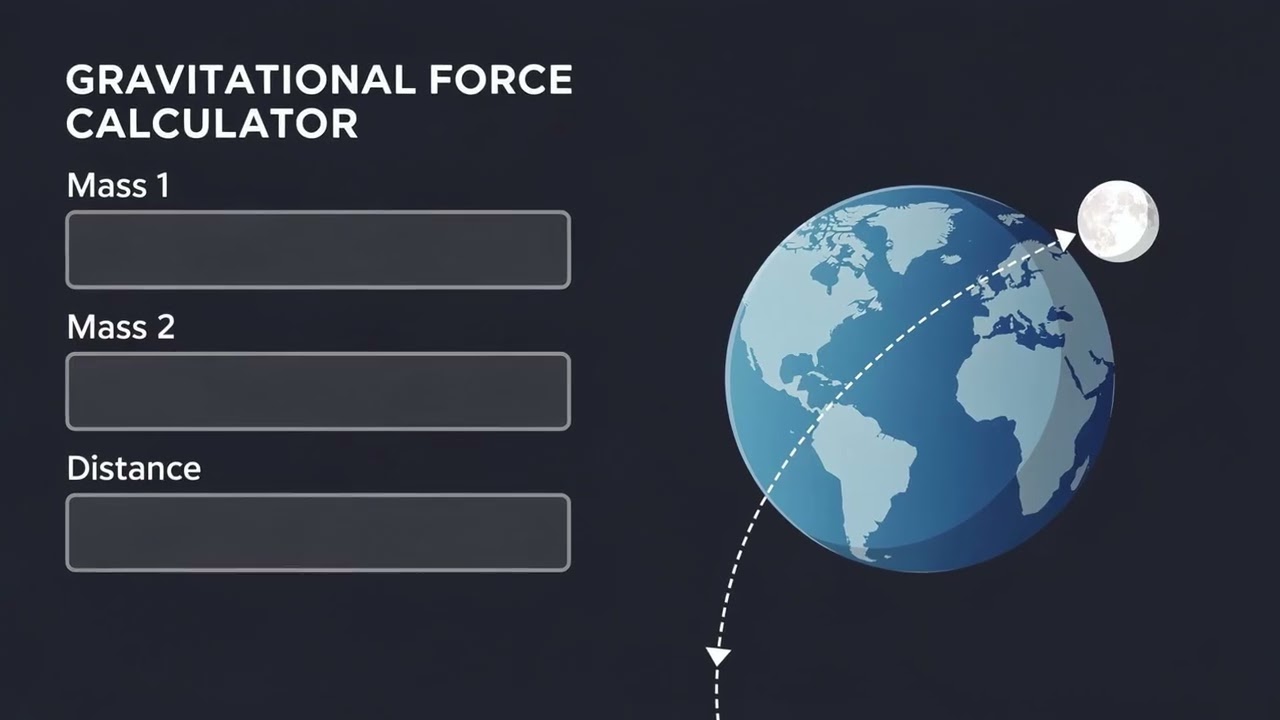
Gravitational Force Interactive Calculator
How to Use This Calculator
This calculator is intended for education, concept evaluation, and preliminary design. Results are based on the equations and assumptions described on this page, but cannot account for every real-world load case, tolerance, material property, environmental condition, installation detail, safety factor, code, or regulatory requirement. Verify all inputs, assumptions, units, and results independently before selecting components or using the result in a real application. Safety-critical, structural, medical, lifting, transportation, or regulated applications must be reviewed by a qualified engineer.
- Choose what you want to calculate (force, mass, distance, mass product).
- Enter masses (m₁ and/or m₂) in kilograms. Scientific notation helps for big numbers (Earth’s mass is 5.972e24 kg).
- Type in the center-to-center distance in meters, or a known force if you’re solving for something else.
- Hit Calculate to show the result.
Gravitational Force Interactive Visualizer
Watch how mass and distance affect gravitational attraction between two objects. Adjust the masses and separation to see force calculations in real-time with visual scale representation.
GRAVITATIONAL FORCE
4.17e-6 N
ACCELERATION (m₁)
1.67e-10 m/s²
FORCE RATIO
1 : 1
FIRGELLI Automations — Interactive Engineering Calculators
Equations
You’ll need the following formula for the gravitational force:
Newton's Law of Universal Gravitation
F = G × (m₁ × m₂) / r²
Where:
- F = Gravitational force (N - Newtons)
- G = Gravitational constant = 6.67430 × 10⁻¹¹ N·m²/kg²
- m₁ = Mass of first object (kg)
- m₂ = Mass of second object (kg)
- r = Distance between centers of mass (m)
Solving for Mass 1
m₁ = (F × r²) / (G × m₂)
Solving for Distance
r = √[(G × m₁ × m₂) / F]
Acceleration Due to Gravity
a = F / m = (G - M) / r²
Where:
- a = Acceleration experienced by mass m (m/s²)
- M = Mass of the attracting body (kg)
Simple Example
If m₁ = 10 kg, m₂ = 10 kg, and r = 1 m, then:
F = 6.67430 × 10⁻¹¹ × 10 × 10 / 1² = 6.674 × 10⁻⁹ N
This result—around 6.67 nanoNewtons—is extremely small but can be picked up using modern lab setups like a torsion balance.
Theory & Practical Applications
Fundamental Physics of Gravitational Force
Newton’s gravity law is straightforward: any object with mass pulls on any other mass. The force increases with both masses and drops fast with more distance (square law). G—the gravitational constant—keeps showing up at 6.67430 × 10⁻¹¹ N·m²/kg². That’s not just a number; it’s tough to measure and part of what makes gravity so weak compared to other forces. Cavendish-style torsion balances in quiet labs are about the only practical way to measure G directly.
The force always acts between centers of mass—not the surfaces. If you’re calculating for odd-shaped or close-together objects, that’s not just nitpicking. You need corrections if your objects aren’t small or spherical (the simple r² law only holds exactly for those cases). For low satellite orbits, for instance, even minor departures from “perfect sphere” on Earth can throw results off; engineers track these with gravity models and harmonics to avoid navigation drift.
Orbital Mechanics and Satellite Design
You can’t plan a real satellite orbit or calculate required delta-v for launch without starting with gravity calculations. Take geostationary satellites: at 35,786 km altitude, gravity on a 1,000 kg satellite still comes out to about 4,570 N—just enough for the centrifugal effect to balance things. Escape velocity for Earth (11.2 km/s) comes straight out of integrating gravity.
The International Space Station, for example, still “feels” about 90% of Earth’s gravity at its 408 km altitude; what’s different is that it’s falling around the planet, not “floating.” Satellite constellations like GPS get their orbits thrown around by lunar and solar gravity, with lunar pulls alone shifting positions by up to 5 meters per day. It’s not just a side note: engineers must include Earth’s mass distribution (harmonics up to J₆ or more) for high-precision orbits.
Tidal Forces in Astrophysics and Engineering
Tidal forces matter when gravity acting “here” is measurably different from gravity acting “there” on the same object. The Moon’s pull on Earth's near side is stronger than at the far side, so you get stretching—tides. The effect drops off as the cube of distance (1/r³), so it’s very sensitive to how close things are. You have to account for this with long spacecraft or for material stresses near planets or in binary star systems.
The Roche limit, about 2.46 times the main body's radius for a fluid satellite, is where tidal forces can rip apart incoming moons or loose rubble. Saturn’s rings sit inside this disruption zone. Over time, tidal torques can also lock a body’s rotation to its orbit, which is why the Moon always shows the same face to Earth. For engineering, you need to check for tidal torque effects when building long-term satellites or planning close planetary passes.
Geophysical Surveying and Mass Detection
Gravimeters detect subsurface features by picking up modest changes in local gravity. For example, a 1% denser buried sphere 100 meters across and 50 meters below can create a surface gravity blip of about 0.04 mGal. Modern superconducting versions pick up changes a thousand times smaller. This is practical—petroleum surveys use it to hunt for salt domes and reservoirs, but tidal, atmospheric, and drift corrections are always necessary to see the real anomaly.
The GRACE satellites mapped Earth's mass variations using minute changes in the satellites’ separation, detecting seasonal groundwater loss or ice melt. They’re picking up force shifts as small as a single raindrop, which shows both what’s possible and that the calculation here is fundamental to real measurements.
Precision Laboratory Measurements
When measuring G in the lab, you’re working with test masses weighing kilos and forces a tiny fraction of a Newton. In practice, most of your work is controlling error—thermal noise, air currents, magnetic fields, and even seismic vibration are significant compared to your actual measurement. Modern setups need vacuum chambers, thermal stabilization measured in millikelvins, and magnetic shielding.
Disagreement between G measurements is still a known headache. The best labs still report differences at the scale of 250 parts per million. That trickles down to real-world consequences: planetary mass estimates, orbital trajectory predictions, and similar calculations carry this underlying uncertainty.
Worked Example: Earth-Moon System Analysis
Problem: Find the gravitational force between Earth and Moon, then (a) work out the Moon’s acceleration, (b) Earth’s acceleration from the Moon, (c) where their system’s barycenter is, and (d) the tidal acceleration across Earth’s diameter.
Given Parameters:
- Earth mass: m₁ = 5.972 × 10²⁴ kg
- Moon mass: m₂ = 7.348 × 10²² kg
- Earth-Moon distance (center-to-center): r = 3.844 × 10⁸ m
- Earth radius: R_E = 6.371 × 10⁶ m
- Gravitational constant: G = 6.674 × 10⁻¹¹ N·m²/kg²
Solution Part (a): Gravitational Force
Plug straight into Newton’s law:
F = G × (m₁ × m₂) / r²
F = (6.674 × 10⁻¹¹) × (5.972 × 10²⁴) × (7.348 × 10²²) / (3.844 × 10⁸)²
Numerator = 6.674 × 10⁻¹¹ × 5.972 × 10²⁴ × 7.348 × 10²² = 2.929 × 10³⁷ N·m²
Denominator = (3.844 × 10⁸)² = 1.478 × 10¹⁷ m²
F = 1.982 × 10²⁰ N
This force is what actually holds the Moon in orbit.
Solution Part (b): Orbital Accelerations
Moon’s acceleration toward Earth:
a_Moon = F / m₂ = 1.982 × 10²⁰ / 7.348 × 10²² = 2.697 × 10⁻³ m/s²
This is the centripetal acceleration (about 2.7 mm/s²) that keeps the Moon in orbit.
Earth’s acceleration toward the Moon:
a_Earth = F / m₁ = 1.982 × 10²⁰ / 5.972 × 10²⁴ = 3.319 × 10⁻⁵ m/s²
Earth still “orbits” the common barycenter, but the effect is much less—around 81 times less since the mass ratio is 81.
Solution Part (c): System Center of Mass
Earth and Moon orbit a common barycenter. The barycenter’s distance from Earth’s center is:
r_barycenter = r × m₂ / (m₁ + m₂) = 3.844 × 10⁸ × 7.348 × 10²² / (5.972 × 10²⁴ + 7.348 × 10²²)
r_barycenter = 3.844 × 10⁸ × 0.01215 = 4.671 × 10⁶ m = 4,671 km
Since Earth’s radius is 6,371 km, the barycenter sits about 1,700 km below Earth’s surface.
Solution Part (d): Tidal Acceleration Gradient
Gravitational acceleration from the Moon is slightly different at Earth’s near and far sides. Find the difference:
At near surface: r_near = 3.844 × 10⁸ - 6.371 × 10⁶ = 3.780 × 10⁸ m
a_near = G × m₂ / r_near² = 6.674 × 10⁻¹¹ × 7.348 × 10²² / (3.780 × 10⁸)² = 3.432 × 10⁻⁵ m/s²
At far surface: r_far = 3.844 × 10⁸ + 6.371 × 10⁶ = 3.908 × 10⁸ m
a_far = G × m₂ / r_far² = 6.674 × 10⁻¹¹ × 7.348 × 10²² / (3.908 × 10⁸)² = 3.213 × 10⁻⁵ m/s²
Tidal acceleration:
Δa = a_near - a_far = 3.432 × 10⁻⁵ - 3.213 × 10⁻⁵ = 2.19 × 10⁻⁶ m/s²
This differential—about 2.19 μm/s²—explains the basics of ocean tides. The Sun, despite its massive size, delivers less than half the tidal force of the Moon due to the much greater distance.
Engineering Significance: These numbers feed directly into orbit and mission planning, from predicting the Moon’s slow drift away from Earth, to handling tiny but important orbital shifts in satellites.
Multi-Body Gravitational Systems
Spacecraft almost never experience a true two-body scenario, so engineers add up each body’s gravitational pull using superposition. Finding truly stable spots (Lagrange points) in systems like Sun-Earth-spacecraft or Earth-Moon-spacecraft needs full-on numerical simulation. For example, Sun-Earth L2, where the James Webb telescope parks, works because gravitational pulls and orbital motion balance there with only minor adjustments needed.
Gravity assist maneuvers use the gravity of massive planets to boost spacecraft velocity without burning extra fuel. Voyager 2, for instance, used carefully calculated swings by Jupiter, Saturn, Uranus, and Neptune to pick up most of its speed. These trajectories lean heavily on gravitational calculations, not guesswork.
Applications Beyond Classical Mechanics
The Newtonian formula covers most engineering cases, but sometimes relativity must be included. For example, GPS satellites need relativistic time adjustments every day, or their navigation errors quickly add up. Effects like Mercury’s orbital precession or gravitational lensing also need corrections beyond Newton for real accuracy. The same math can be turned around (on galactic scales) to measure dark matter when rotation curves don’t match up to visible mass.
For gravitational waves or spacecraft using gravity-gradient stabilization, engineers look for extraordinarily tiny force changes and gradients. These cases show the limits of both measurement and Newtonian theory, though the practical process still starts with Newton’s basic formula unless you see evidence it’s not enough.
FAQ
Free Engineering Calculators
Explore our complete library of free engineering and physics calculators.
Browse All Calculators →🔗 Explore More Free Engineering Calculators
- Trajectory Planner: S-Curve Velocity Profile
- Projectile Motion Calculator
- Bolt Torque Calculator — Preload and Clamp Force
- Vacuum Suction Cup Force Calculator
- Power To Weight Ratio Calculator
- Angular Acceleration Calculator
- Acceleration Using Force And Mass Calculator
- Worm Gear Calculator — Ratio Efficiency
- Linear Actuator Gear Reduction Calculator
- Tensile Stress Calculator — Force Over Area
About the Author
Robbie Dickson — Chief Engineer & Founder, FIRGELLI Automations
Robbie Dickson brings over two decades of engineering expertise to FIRGELLI Automations. With a distinguished career at Rolls-Royce, BMW, and Ford, he has deep expertise in mechanical systems, actuator technology, and precision engineering.
📹 Video Walkthrough — How to Use This Calculator
📹 Video Walkthrough — How to Use This Calculator
Need to implement these calculations?
Explore the precision-engineered motion control solutions used by top engineers.


