Linear Actuators
Linear Actuators 101: practical basics before you choose one
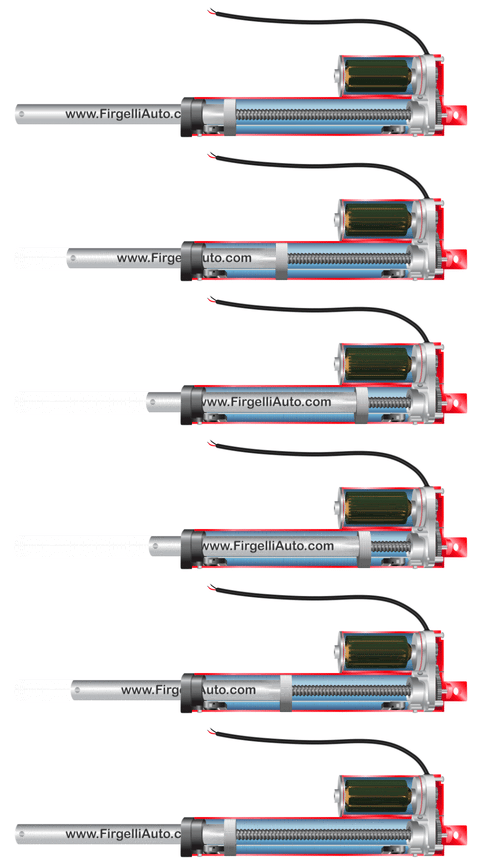
A linear actuator turns energy and a control signal into straight-line motion. In practical terms, it is the device you use when something needs to lift, lower, slide, tilt, open, close, push, or pull in a controlled way. This guide explains the engineering terms you will see on actuator specification sheets and how those terms affect a real installation.
The examples below assume common electric linear actuators used for automation, machinery, furniture, marine hatches, panels, doors, robotics, and similar projects. Always compare your final design against the specific actuator model’s datasheet because force, speed, duty cycle, ingress protection, feedback, and mounting style vary by product.
What’s covered in this guide
- What an actuator is
- How an electric linear actuator works
- Quick selection table
- Lifting columns and when to use them
- Electric vs. hydraulic actuation
- Real-world applications
- Loads, side loading, stroke, and mounting
- Motors, speed, power, feedback, and synchronization
- Reliability checks and common mistakes
- FAQ
What is an actuator?
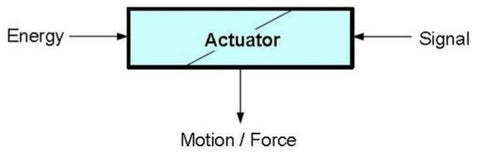
An actuator is a device that receives an energy input and a control input, then produces motion. That motion can be rotary, such as a motor shaft turning, or linear, such as a rod extending and retracting. The control input can be as simple as a switch or as advanced as a controller reading position feedback and commanding a precise move.
For this page, the focus is electric linear actuators. If you are sizing a new design, start by defining what the actuator must physically do: the load to move, the direction of movement, the stroke length, the required speed, the available voltage, the duty cycle, the environment, and the mounting geometry. If you already know the load and hinge geometry for a hatch or lid, the hatch lift calculator guide is a useful next step.
Click here for the Linear Actuator Calculator
What is an electric linear actuator?
An electric linear actuator converts the rotary motion of an AC or DC motor into straight-line motion. Most rod-style actuators use a motor, gearbox, lead screw or ball screw, drive nut, extension tube, end bearings, housing, and limit switches. When the motor turns the screw, the nut travels along the screw and pushes or pulls the actuator rod.
That simple mechanism gives you controlled extension and retraction without hydraulic pumps, compressors, hoses, or reservoirs. In a typical installation, reversing polarity on a DC actuator reverses travel direction. More advanced systems add relays, control boxes, wireless remotes, programmable controllers, or feedback sensors.
Common actuator specification terms include:
- Stroke: the usable travel distance from fully retracted to fully extended.
- Force: the push or pull capacity along the actuator’s centerline.
- Static load: the load the actuator can hold when stopped, within the rated conditions.
- Dynamic load: the load the actuator can move while extending or retracting.
- Speed: the travel rate, usually reduced as force capacity increases.
- Duty cycle: how long the actuator may run compared with rest time.
- IP rating: the enclosure’s resistance to dust and water ingress.
- Feedback: a sensor signal used to estimate or control position.
Quick actuator selection table
The table below is not a substitute for the model datasheet, but it helps narrow the type of actuator or accessory that usually fits a design problem. Treat the values as selection logic, not product specifications.
| Design need | Usually look for | Engineering checks before buying | Mistake to avoid |
|---|---|---|---|
| Lift a hinged hatch, lid, or engine cover | Rod actuator with correct stroke, force margin, and pivot brackets | Calculate torque around the hinge, actuator angle at the worst point, open and closed mounting distances, and whether the load changes with accessories added | Using the object weight alone as the actuator force requirement; hinge geometry can multiply the required force |
| Raise a work surface or vertical platform | Lifting column or guided lift mechanism | Check side loading, moment loading, column spacing, synchronization, and stability at full extension | Expecting a rod actuator shaft to act as a structural guide |
| Slide a drawer, panel, door, or tray | Actuator plus drawer slides or linear guide rails | Size the guide system for the weight and moments, then size the actuator for push/pull force and friction | Letting the actuator rod carry the weight sideways |
| Move an outdoor panel, vent, or solar tracker | Actuator with suitable IP rating, corrosion-aware mounting, and protected wiring | Check wind load, water exposure, temperature range, cable routing, and maintenance access | Only sizing for calm-weather force and ignoring wind or ice loads |
| Control position accurately | Feedback actuator with controller or closed-loop electronics | Choose potentiometer, Hall, or optical feedback based on controller compatibility and required repeatability | Assuming two non-feedback actuators will remain synchronized under unequal load |
| High speed and high force at the same time | Review gearing, motor voltage, current supply, and duty cycle carefully | Use the force-speed curve or datasheet; confirm power supply current at load | Assuming a faster actuator can provide the same force as a slower geared model |
What is a lifting column?

A lifting column is a telescoping linear actuator assembly with built-in guiding. Instead of only extending a rod, a column extends one or more nested sections. This allows a long travel distance while keeping the retracted height relatively compact.
The practical advantage is guidance. A standard rod actuator is excellent at pushing and pulling along its axis, but it is not intended to be the only structural support for side loads or bending moments. A lifting column is built to support a vertical guided motion more directly, which is why columns are common in height-adjustable desks, workstations, medical furniture, display lifts, and equipment positioning systems.
If the moving load can wobble, twist, or apply a moment to the actuator, do not assume a larger force rating solves the problem. You may need a lifting column, a pair of actuators with guides, or a mechanical frame that carries the side load while the actuator supplies only linear motion.
Why use an electric linear actuator instead of hydraulic?
Hydraulic systems can produce very high forces and are still the right choice for many heavy industrial machines. They also require pumps, fluid reservoirs, valves, hoses, seals, filtration, and leak management. Electric actuators are often preferred when the project needs clean installation, simple control, quiet operation, precise stopping, low routine maintenance, and compact packaging.
For a cabinet lift, marine hatch, adjustable workstation, automated vent, or prototype machine, the simplicity of an electric actuator can reduce the number of components dramatically. A basic DC actuator system may only need the actuator, mounting brackets, a suitably rated power supply or battery, and a reversing switch or controller.
From an engineering standpoint, the biggest difference is how motion is controlled. A hydraulic cylinder moves because pressurized fluid acts on a piston. An electric actuator moves because a motor turns a screw through a gearbox. That screw-based mechanism makes it straightforward to stop at internal limit switches, add position feedback, or command repeatable moves with electronics.
Real-world examples of what linear actuators can do

Linear actuators are used anywhere a controlled straight-line push or pull is useful. Typical applications include:
- Motorized hatches, engine covers, and access panels
- Kitchen appliance lifts and hidden storage mechanisms
- Marine engine hatches, slide-out steps, and compartment doors
- Snow plow blade adjustment and small equipment positioning
- Hoppers, chutes, dampers, vents, and diverter gates
- Hidden doors, sliding panels, and window treatments
- Solar panel tracking and adjustable outdoor fixtures
- Farming implements and light-duty agricultural automation
- Animatronics, robotics, exhibits, and simulation equipment
- Height-adjustable workstations, display lifts, and home automation
For example, imagine a 60 lb hatch that is 36 inches long and hinged at one end. The actuator does not simply lift 60 lb. It must overcome the torque created by the hatch weight around the hinge, and the actuator’s leverage changes throughout travel. At some mounting angles, especially near the closed position, the required actuator force can be several times higher than the hatch weight. That is why the mounting points and stroke length matter as much as the load.
Static load, dynamic load, and direction of force
Two load ratings matter when selecting an actuator. Dynamic load is the force the actuator can move while it is extending or retracting. Static load is the force it can hold while stopped, under the rated conditions. These are not interchangeable. A design that only needs to hold a load may still fail if the actuator cannot move that load through the full range of motion.
For a deeper explanation of the difference, see the FIRGELLI guide to static vs. dynamic load. When estimating required force, include the object weight, friction, acceleration, mechanical disadvantage from linkage geometry, wind or external loads, and any safety margin appropriate to the application.
Linear actuators should be loaded in tension, compression, or a combination along their centerline. Tension means the actuator is pulling. Compression means it is pushing. Side loading, also called radial loading, is force applied perpendicular to the actuator centerline. Eccentric loading occurs when the load’s center of gravity does not act through the actuator axis. Both can cause binding, noisy operation, bent shafts, premature wear, or internal damage.
If your mechanism slides, use a drawer slide, linear rail, or guided frame to carry the load. The actuator should provide the push or pull, while the guide system carries vertical weight and side forces. This is one of the most common differences between a reliable installation and one that fails early.
Stroke length and mounting geometry
Stroke length is the distance the actuator rod travels. It is tempting to choose a stroke that equals the movement you want, but many linkages do not work that way. On a hinged lid, a 12 inch actuator stroke might create much more or much less than 12 inches of lid edge movement depending on bracket locations. On a sliding drawer, stroke is usually closer to the required travel, but you still need to account for mechanical stops, bracket thickness, and clearance.
Before ordering, measure or model these four dimensions: fully retracted actuator length, fully extended actuator length, closed-position mounting distance, and open-position mounting distance. The actuator must physically fit both end positions without bottoming out before the mechanism reaches its stop. The stroke length calculation guide and the stroke selector can help when you are comparing possible strokes.
Do linear actuators have limit switches?

Most electric linear actuators include built-in limit switches that stop the actuator at full extension and full retraction. Depending on the actuator family, limit sensing may be electromechanical, magnetic, or cam-based. The purpose is to cut power to the motor at the end of travel while still allowing the actuator to run in the opposite direction.
Limit switches protect the actuator from trying to drive beyond its intended stroke. They are not a replacement for good mechanical design. Avoid driving an actuator into a hard stop before its internal limit switch is reached. If external limit switches or programmable controls are used, verify them at low speed and low load first, then test the full-load case.
Motors, speed, voltage, power, and feedback

Electric linear actuators are commonly built with DC motors, with 12 VDC and 24 VDC systems being widely used. Some actuator ranges use AC motors or specialized controls. The right voltage depends on the actuator model, available power source, current draw, controller, wiring distance, and required force. Higher voltage systems can be advantageous in higher-power installations because current can be lower for a given power level, but the complete system must be designed for that voltage.
Speed and force usually trade off against each other. With similar motor power, gearing that increases output force tends to reduce speed. Gearing that increases speed tends to reduce available force. If your application requires both high force and fast motion, check the datasheet carefully and confirm that the power supply can provide the required current. The amps, volts, and watts guide is useful when selecting wiring, power supplies, and controls.
Feedback actuators add position information. Common feedback types include potentiometers, Hall sensors, and optical sensors. Feedback is important when you need a controller to know actuator position, stop at intermediate points, or synchronize multiple actuators. Without feedback, two actuators of the same model may still move at slightly different speeds because of motor tolerance, friction, and unequal loading.
For exact synchronized motion, use a closed-loop controller and actuators with compatible feedback. This is especially important for wide lids, lifting platforms, dual-column systems, and equipment where twisting could jam the mechanism.
Duty cycle, enclosure, and operating environment
Duty cycle describes how much of a time period the actuator may run versus rest. An actuator used to open a hatch a few times per day has a very different thermal requirement than one cycling repeatedly in a production fixture. Exceeding duty cycle can overheat the motor, gearbox, or electronics and shorten service life.
Environment also matters. Dust, water, washdown, sunlight, temperature swings, vibration, and corrosive exposure can all influence actuator choice. IP ratings describe the level of ingress protection against solids and liquids, but the full installation still matters. Cable exits, connectors, mounting orientation, drainage, and protective covers can affect reliability even when the actuator itself is rated for the environment.

Common failure causes and checks before installation
Most actuator problems come from one of a few causes: overload, side loading, poor mounting alignment, water or debris exposure beyond the design rating, insufficient power supply current, incorrect wiring, excessive duty cycle, or hard-stop operation. A stronger actuator is not always the cure. If the geometry is wrong or the load is not guided, higher force can damage the mechanism faster.
Before final installation, run these checks:
- Move the mechanism by hand if possible. It should travel smoothly without tight spots before the actuator is installed.
- Confirm both end positions. The actuator should reach its internal limits without forcing the mechanism into a hard stop.
- Check alignment through the full stroke. Pivot brackets should not bind as the angle changes.
- Measure loaded current. Compare it with the controller and power supply capacity, allowing margin for startup and high-load points.
- Support side loads separately. Use rails, slides, hinges, or columns to carry moments and radial forces.
- Protect wiring. Leave strain relief and enough loop for motion without pinching or abrasion.
- Test duty cycle realistically. A prototype that works once may still overheat in repeated use.
Back-driving is another design consideration. Back-driving occurs when an external load forces the actuator to move while power is not being applied. Whether it occurs depends on the actuator design, screw type, gear ratio, load, and whether a brake is used. If the application must hold a raised load safely, verify the specific actuator’s holding behavior and consider mechanical locks, brakes, counterbalances, or redundant supports where appropriate.
If you are comparing actuator styles, the guide to six electric linear actuator styles can help you decide whether a rod actuator, track actuator, column, feedback actuator, or another configuration is the better starting point. For load cases on an incline with friction, use the incline force calculator guide. For repeated cycling, the actuator life cycle estimator can help frame the duty and cycle-count discussion.
Linear actuator FAQ
Can a linear actuator push and pull?
Yes. A typical rod-style electric linear actuator can extend to push and retract to pull, provided the load is aligned with the actuator axis and the mounting brackets are designed for the forces in both directions.
Can I stop an actuator halfway?
Yes, but the method depends on the control system. A simple switch can stop power at any point, while a feedback actuator and controller are used when you need repeatable intermediate positions.
Can two actuators run from one switch?
They can be wired to operate together if the electrical ratings are suitable, but they should not be expected to stay perfectly synchronized without feedback control. Unequal loads and normal motor variation can make one actuator arrive before the other.
What safety margin should I use for force?
There is no universal margin because applications differ. As a practical engineering habit, calculate the worst-case force using geometry, friction, and external loads, then select an actuator with suitable margin after checking speed, duty cycle, mounting strength, and environment. For people-supporting or safety-critical systems, use qualified engineering review and appropriate redundant safety measures.
Is a faster actuator always better?
No. Faster travel often means lower force for the same motor and gearbox family, and it can increase impact loads if the mechanism reaches the end of travel abruptly. Choose the speed that matches the task and allows safe, controlled motion.
Do I need external guide rails?
If the actuator is moving a sliding or offset load, usually yes. The actuator should create the linear force; rails, slides, hinges, or a frame should carry side loads and moments.
How do I choose stroke length?
Model or measure the mounting distance at the fully closed and fully open positions. The difference between those distances is related to the required actuator stroke, but bracket geometry and clearances must also be checked. Do not choose stroke length from the visible movement alone unless the actuator is directly driving a guided slide.
What happens if I overload an actuator?
Overload can slow or stall the actuator, increase current draw, overheat the motor, damage gears or screw components, trip controls, or shorten service life. If the actuator stalls during testing, stop and correct the load, geometry, or actuator selection rather than repeatedly applying power.