If you choose an aperture size or shape incorrectly, you lose light, detail, and signal quality. The math depends on whether your opening is circular, rectangular, elliptical, or specified by an f-number. This calculator figures out the open area based on whatever dimensions you know—diameter, radius, width, height, elliptical axes, or focal length and f-number. This matters when you’re designing for astronomy, photography, radar, or fiber optics. Below you'll find the actual formulas, a real example comparing two telescopes, notes on diffraction and f-numbers, and a FAQ with engineering context.
What is aperture area?
Aperture area is simply the part of your system where light, RF, or other energy can actually get through. Larger area = more signal, whether you’re after photons with a telescope or RF power with an antenna. That’s all it is—how much of your incoming stuff you can catch, and how much hits your sensor or detector after that has other dependencies.
Simple Explanation
The most basic analogy: catching rain in a bucket. A bigger opening catches more rain over the same time. In optics, the same logic applies—a larger aperture catches more light, so images are brighter and finer details are possible. Circumference shape (circle, rectangle, ellipse) decides which area formula gives you the correct value to use in your calculation.
📐 Browse all 1000+ Interactive Calculators
How to Use This Calculator
- Pick the Calculation Mode for your aperture—circular (by diameter or radius), reverse (from area), rectangular, elliptical, or based on f-number and focal length.
- Fill in the required size or dimensions for that mode—use what you have: diameter, radius, width/height, elliptical axes, or f-number and focal length.
- If you want to see how it works, hit Try Example and check the numbers.
- Click Calculate for the result.
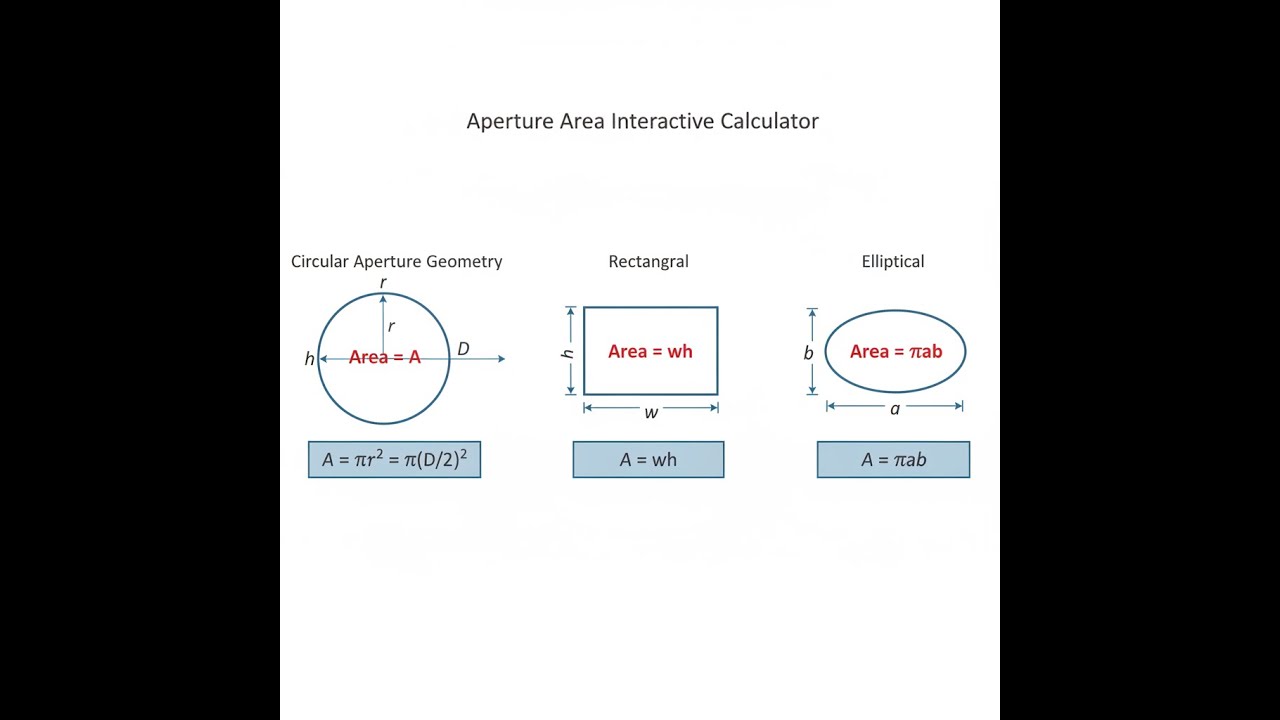
Aperture Geometry Diagram

Interactive Aperture Area Calculator
This calculator is intended for education, concept evaluation, and preliminary design. Results are based on the equations and assumptions described on this page, but cannot account for every real-world load case, tolerance, material property, environmental condition, installation detail, safety factor, code, or regulatory requirement. Verify all inputs, assumptions, units, and results independently before selecting components or using the result in a real application. Safety-critical, structural, medical, lifting, transportation, or regulated applications must be reviewed by a qualified engineer.
Aperture Area Interactive Visualizer
See how changing aperture shape and size alters light-gathering area and perimeter for circular, rectangular, and elliptical apertures. Watch real-time calculations update as you adjust the sliders.
AREA
5027
PERIMETER
251
EFFICIENCY
78.5%
FIRGELLI Automations — Interactive Engineering Calculators
Governing Equations
Here are the formulas for each basic aperture shape. Use the one matching your geometry to get area.
Circular Aperture Area
A = π r² or A = π (D/2)²
A = Aperture area (mm², m²)
r = Radius (mm, m)
D = Diameter (mm, m)
π ≈ 3.14159
Diameter from Area
D = 2√(A/π)
This lets you get the required diameter when you know the desired open area.
Rectangular Aperture Area
A = w × h
w = Width (mm, m)
h = Height (mm, m)
Elliptical Aperture Area
A = π a b
a = Semi-major axis (mm, m)
b = Semi-minor axis (mm, m)
f-number and Entrance Pupil Diameter
D = f / N
f = Focal length (mm, m)
N = f-number (dimensionless)
D = Entrance pupil diameter (mm, m)
To get the area in this case: use A = π (D/2)².
Simple Example
Circular aperture from diameter — mode: Circular Aperture from Diameter
- Input: Diameter = 50 mm
- Radius = 25 mm
- Area = π × 25² = 1963.495 mm²
- Circumference = π × 50 = 157.080 mm
Theory & Practical Applications
The open area of your aperture sets how much light (or other energy) you can gather and the theoretical limit for the detail you can resolve. For telescopes, doubling the aperture diameter increases your light collection by four—useful for seeing dimmer things, but costs and build complexity go up even faster. In camera work, aperture area interacts directly with depth of field (via the f-number), so you get to control whether only the subject is sharp (big aperture, low f-number) or you get everything focused (small aperture, high f-number). Radio folks sometimes engineer antennas where the effective aperture area, boosted by array gain, beats the actual physical dimensions. The formulas below don’t cover that—here we’re talking about the real or geometrically calculated aperture area.
Diffraction-Limited Resolution and the Airy Disk
Any circular hole gives you a diffraction pattern. You can’t get detail finer than θ = 1.22 λ/D (in radians), no matter how good your detector is. For example, visible light with a 100 mm aperture gives a best-case resolution of about 1.38 arcseconds—if the air above you was perfectly steady, which on Earth is rare. Turbulence ("seeing") usually means anything above 20 cm aperture is limited by the atmosphere, not the optics.
To get closer to the physics limit, observatories use adaptive optics—measuring distortion and compensating with actuators, typically several per 10–20 cm of aperture width. The gear has to correct faster than turbulence changes (~1 ms timescales) and the number of actuators scales with aperture area divided by the "Fried parameter" (r₀).
In microscopy, resolution and aperture are linked differently. Oil immersion objectives with NA (numerical aperture) values up to 1.45 let you hit ~190 nm resolution at 550 nm wavelength. The area over which you catch light is π(NA/M)² (M = objective magnification), so going for absolute resolution always has a tradeoff with field of view—no lens design can change that basic reality.
Light-Gathering Power and Photon Flux
If you’re imaging something extended (planet, nebula), more aperture = more photons per second. For point sources at constant f-number, though, more area just makes the star image bigger—it doesn’t make it brighter at the sensor. With aperture area A and star magnitude m, you can estimate photon rate as Φ = (2.52 × 10¹⁰) × A × 10^(-0.4m) photons/second/m² for green light. Halving your magnitude limit always takes four times more area. On the detector side, camera pixel size needs to sample the Airy disk properly (Nyquist: p ≤ λf/(2D)). Most pixel sizes in consumer cameras are too large; if you want to hit diffraction limit, look for pixel sizes of a few microns or figure on optical tricks to match.
Rectangular and Non-Circular Apertures
Rectangular holes give separate diffraction along each dimension. Slit apertures are used in spectroscopy—the width sets resolving power, but the height is made larger to capture more light. Big resolving power (R) over 100,000 means slits as narrow as 50 μm, usually with f/8 or faster optics. In telescopes with central obstructions (like Cassegrains), effective area is less than just the outer aperture (subtract out the secondary mirror’s shadow), and contrast also drops. The Airy disk gets wider, and the rings get stronger. A central obstruction ratio (secondary/primary) of 0.33 means you lose about 11% of the light, but the bigger hit is to image quality—don’t expect high contrast for planets if your central obscuration is large.
f-number, Aperture Stop, and Vignetting
f-number (N = f/D) tells you exposure needs and relates directly to depth of field and diffraction amount. Beware, though, that the physical aperture size (diaphragm opening) can differ from the "effective" aperture—the entrance pupil as seen from the object side—if there’s lensing in front of the diaphragm. Lenses with internal moving elements can have f-number creep (actual f-number changes) as you focus closer or farther, even if the ring stays at "f/2.8" or whatever. Vignetting is another practical limitation: the further off-center your image area is, the less clear aperture there is. Wide angle lenses show this strongly at big apertures; real world, you can lose up to half your light in the extreme corners, regardless of what’s written on the lens barrel. To minimize, lenses often use oversized front elements, which adds weight and cost.
Worked Example: Astronomical Telescope Light-Gathering and Resolution
Problem: Suppose you have two Newtonian reflectors—Telescope A with a 203 mm (8-inch) aperture, 1000 mm focal length, and Telescope B with 305 mm (12-inch) aperture, 1500 mm focal length. Both use a camera with 5.4 μm pixels. What’s the aperture area for each, the ratio, diffraction resolution at 550 nm, f-number, Airy disk size, and will those pixels sample the Airy disk well?
Solution:
(a) Aperture Areas and Light-Gathering Ratio:
For Telescope A with diameter D_A = 203 mm = 0.203 m:
Radius r_A = 0.203 / 2 = 0.1015 m
Area A_A = π r_A² = π (0.1015)² = 0.03237 m²
For Telescope B with diameter D_B = 305 mm = 0.305 m:
Radius r_B = 0.305 / 2 = 0.1525 m
Area A_B = π r_B² = π (0.1525)² = 0.07310 m²
Light-gathering power ratio:
Ratio = A_B / A_A = 0.07310 / 0.03237 = 2.258
Telescope B collects about 2.26 times as much light as A. In astronomer-speak, that’s a magnitude gain of 0.88 (because 2.512^0.88 ≈ 2.26).
(b) Diffraction-Limited Angular Resolution:
The Rayleigh diffraction formula: θ = 1.22 λ/D, where λ = 550 nm = 550 × 10⁻⁹ m.
For Telescope A:
θ_A = 1.22 × (550 × 10⁻⁹) / 0.203 = 3.306 × 10⁻⁶ radians
In arcseconds: θ_A = 3.306 × 10⁻⁶ × (206265) = 0.682 arcseconds
For Telescope B:
θ_B = 1.22 × (550 × 10⁻⁹) / 0.305 = 2.200 × 10⁻⁶ radians
In arcseconds: θ_B = 2.200 × 10⁻⁶ × (206265) = 0.454 arcseconds
B should give about 50% sharper theoretical detail than A, though atmospheric turbulence usually prevents you from seeing this unless the air is unusually stable.
(c) f-number Calculation:
f-number N = f / D
For A: N_A = 1000 mm / 203 mm = 4.93 (call it f/4.9). For B: N_B = 1500 mm / 305 mm = 4.92 (also f/4.9). So exposures and surface brightness for extended stuff will be about the same.
(d) Airy Disk Diameter in Focal Plane:
Formula is d = 2.44 λ f / D = 2.44 λ N.
For A: d_A = 2.44 × (550 × 10⁻⁶ mm) × 4.93 = 6.62 μm
For B: d_B = 2.44 × (550 × 10⁻⁶ mm) × 4.92 = 6.60 μm
Airy disk size barely changes, because f-numbers are near identical—aperture doesn’t matter here if the f-number is fixed.
(e) Nyquist Sampling Assessment:
To sample the Airy disk well, p ≤ d/4.88.
For both: p_max = 6.61 μm / 4.88 = 1.35 μm. Actual pixel is 5.4 μm. Sampling ratio = 5.4 / 1.35 = 4. So the pixels are too big to use all the optical detail—this system under-samples the diffraction pattern by about 4x. If you want critical sampling, swap for smaller pixels or add a Barlow to increase the image size on the chip. This is a common mismatch in real astro rigs: you need to check your optics and sensors together for best results, not just buy the largest aperture you can afford.
For more optical system calculations, visit the FIRGELLI Engineering Calculator Hub.
Frequently Asked Questions
▼ How does aperture area affect camera exposure time?
▼ Why do telescopes use mirrors instead of lenses for large apertures?
▼ What is the difference between physical aperture and effective aperture?
▼ How does aperture shape affect image quality beyond just area?
▼ Can adaptive optics overcome diffraction limits set by aperture area?
▼ Why does aperture area matter differently for coherent versus incoherent light sources?
Free Engineering Calculators
Explore our complete library of free engineering and physics calculators.
Browse All Calculators →🔗 Explore More Free Engineering Calculators
About the Author
Robbie Dickson — Chief Engineer & Founder, FIRGELLI Automations
Robbie Dickson brings over two decades of engineering expertise to FIRGELLI Automations. With a distinguished career at Rolls-Royce, BMW, and Ford, he has deep expertise in mechanical systems, actuator technology, and precision engineering.
Video Walkthrough - How to Use This Calculator
Need to implement these calculations?
Explore the precision-engineered motion control solutions used by top engineers.


