Picking the wrong carburetor size is a frequent problem in engine builds. If it's too small, you'll choke the engine when you rev it out. Too big, and you'll get slow throttle response and poor mileage for day-to-day driving. This calculator figures out how much air your engine actually needs by using displacement (CID), max RPM, and a reasonable estimate for volumetric efficiency. It applies to everything from relaxed street builds to race engines. You'll find the actual CFM formula, a step-by-step example, sizing tips for different uses, and a FAQ that gets into altitude, cams, and how CFM ties to horsepower.
What is Carburetor CFM?
Carburetor CFM (Cubic Feet per Minute) is just the airflow the engine can pull through the carb at full RPM. It's the basic number you check so the carb doesn't become a restriction at the top end.
Simple Explanation
An engine is basically an air pump. The pistons pull air in whenever they're moving. Bigger engines and higher RPM simply mean greater airflow needs. CFM tells you what that demand is so you know not to put a bottleneck before the engine has a chance to breathe.
📐 Browse all 1000+ Interactive Calculators
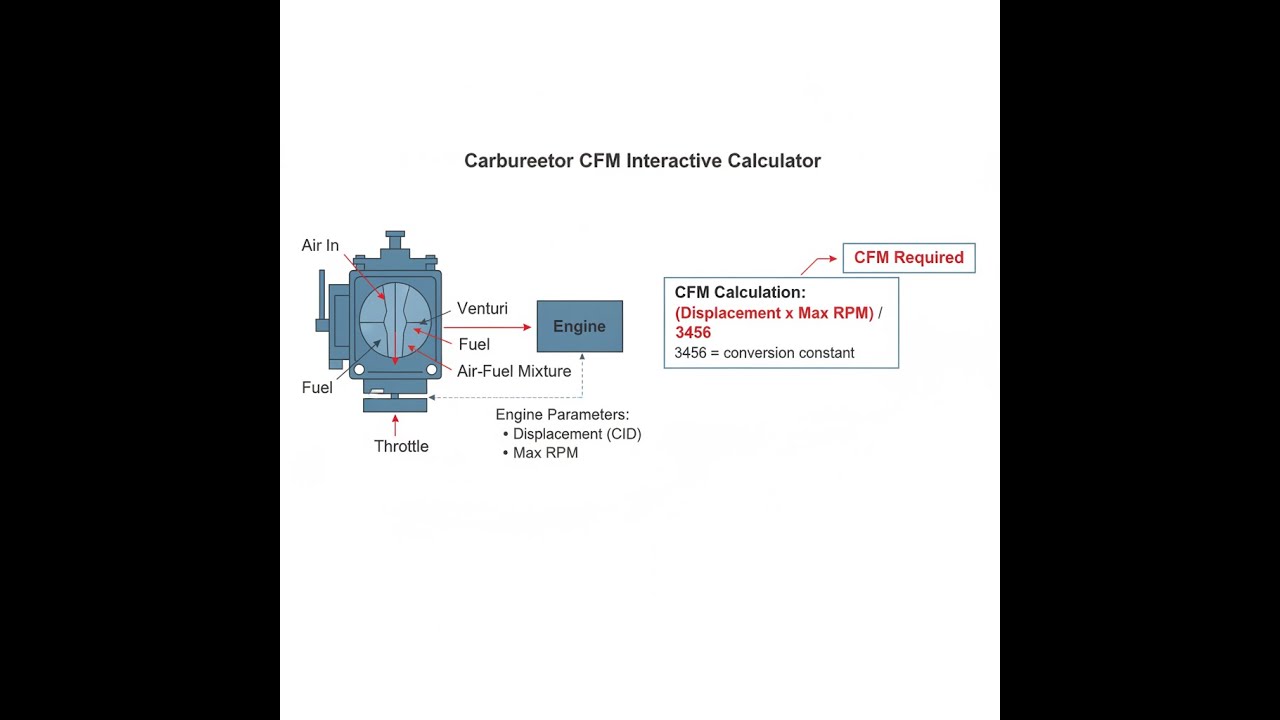
Carburetor Airflow System Diagram

How to Use This Calculator
- Select your calculation mode from the dropdown — choose from CFM required, displacement, RPM, volumetric efficiency, horsepower estimate, or sizing recommendation.
- Enter your engine displacement in cubic inches (CID), your maximum RPM, and your estimated volumetric efficiency percentage.
- If your selected mode requires a CFM rating, target horsepower, or application type, fill in those fields as they appear.
- Click Calculate to see your result.
Carburetor CFM Calculator
This calculator is intended for education, concept evaluation, and preliminary design. Results are based on the equations and assumptions described on this page, but cannot account for every real-world load case, tolerance, material property, environmental condition, installation detail, safety factor, code, or regulatory requirement. Verify all inputs, assumptions, units, and results independently before selecting components or using the result in a real application. Safety-critical, structural, medical, lifting, transportation, or regulated applications must be reviewed by a qualified engineer.
Carburetor CFM Interactive Visualizer
You can see how displacement, RPM, and volumetric efficiency add up to real airflow needs—watch how changes in these values affect velocity through the carb. This shows in real terms why CFM sizing isn't just a number, but directly affects how your engine behaves when you put your foot down.
CFM REQUIRED
473 CFM
EST. HORSEPOWER
285 HP
CARB SIZE
500 CFM
FIRGELLI Automations — Interactive Engineering Calculators
Carburetor CFM Equations
Use the formula below to calculate carburetor CFM required for your engine.
Primary CFM Calculation
CFM = (CID × RPM × ηv) / 3456
Where:
CFM = Carburetor airflow requirement (cubic feet per minute)
CID = Engine displacement (cubic inches)
RPM = Maximum engine speed (revolutions per minute)
ηv = Volumetric efficiency (decimal, typically 0.80-0.95)
3456 = Conversion constant (2 revolutions per cycle × 1728 in³/ft³)
Volumetric Efficiency
ηv = (CFM × 3456) / (CID × RPM)
Solving for volumetric efficiency when CFM and engine parameters are known
Horsepower Estimation
HP ≈ (CFM × 60 × ρair) / (BSFC × (AFR + 1))
Where:
ρair = Air density at sea level (0.0765 lb/ft³)
BSFC = Brake specific fuel consumption (typically 0.45-0.55 lb/hp-hr)
AFR = Air-fuel ratio (typically 12.5-13.5:1 at peak power)
Maximum Supported RPM
RPMmax = (CFM × 3456) / (CID × ηv)
Determines the maximum engine speed a given carburetor can support without airflow limitation
Simple Example
A 350 CID V8 engine spinning to 5500 RPM with 85% volumetric efficiency:
CFM = (350 × 5500 × 0.85) / 3456 = 472.5 CFM
Street sizing (90%): 425 CFM — a 450 CFM carburetor works well.
Race sizing (110%): 520 CFM — a 600 CFM carburetor gives headroom with no restriction.
Theory & Practical Applications
Fundamental Principles of Carburetor Airflow
If you break it down, the basic CFM calculation comes straight from counting how much air the engine displaces with every two crank revolutions—because it’s a four-stroke—and then scaling that up for time and converting units. That’s where the 3456 constant comes from: 2 (rev per air cycle) × 1728 (in³ per ft³).
Volumetric efficiency (ηv) is just the ratio of what your engine actually draws in versus its displacement. Factory engines—especially those with stock intakes, mild cams, or emissions gear—are often limited to 75–85% efficiency at their torque peak. You’ll see better numbers if you have decent heads and a good intake, sometimes up to 100% in a properly tuned high-performance or race build. In some race conditions, with components set up for resonance or ram effect, efficiency can go over 100%—but only at specific RPM and just for a narrow band.
That 3456 denominator is used any time you have a naturally aspirated four-stroke. For two-strokes, swap 3456 for 1728 to reflect that every revolution is a power cycle instead of every two revolutions. It’s a straight shot calculation, the rest comes down to plugging in honest numbers for your motor.
Carburetor Selection Strategies Across Applications
For street cars, it usually pays to size a bit under the calculated CFM. A carb about 10–15% smaller keeps intake velocity up at low-to-mid throttle, which helps with fuel mixing and responsiveness. Most street carbs run vacuum-operated secondaries, so they won’t dump air the engine can’t use—this helps avoid bogs or stalling when you crack the throttle at low speed.
If the car is driven harder or set up for performance street use, aim closer to the calculated CFM, maybe within 5%. Mechanical secondary carbs open up right away, but you have to tune those linkages or springs or you’ll get a stumble. Now you’re trading a little economy for better high-end pull. Don’t expect both.
Race engines need at least what’s calculated, if not a little more (5–10% over), so you don’t hit an artificial airflow cap at high RPM. These carbs are designed for all-out flow. You’ll see high-flow boosters, big venturis, and a lot more tuning options. If you’re running a very big-inch engine, Dominator-style carbs are built to move serious air.
One thing that’s easy to overlook is air speed through the venturi. For proper atomization, you want velocity in the 240–280 ft/s range at full throttle and peak RPM. Too slow—below 200 ft/s—and the fuel won’t stay mixed. Too fast—over 320 ft/s—and you start seeing big vacuum drops and flow limitations. Area of the venturi and total number of barrels matter here, not just CFM.
Altitude Corrections and Environmental Factors
Go up in altitude and air gets thinner—about 3% less density for every 1000 feet. So, a carb that’s right at sea level is now oversized as you get higher, because the engine simply won’t move the same amount of air mass, even though displacement and RPM haven’t changed. The engine loses power at altitude—about 3% per 1000 feet—for that same reason.
That also means you have to run smaller jets with higher altitude to avoid running too rich. A good rule of thumb: back the main jets off by 4–6% for every 3000 feet higher. Or, if you move a car from sea level to 5000 feet, a 2–4% leaner mix is about right. Sometimes you’ll bump timing up slightly (1–2 degrees) since the risk of knock goes down with thinner air.
Temperature makes this worse. Hotter air is less dense, so on a hot day your engine behaves like it’s running at higher altitude. For reference, standard air density is 0.0765 lb/ft³ at 59°F. Crank that up to 95°F, density drops, and it’s about like driving 2000 feet higher. Fueling really needs to change in hot and cold weather—especially on a performance build where you care about making the most of what you have.
Worked Engineering Example: Small Block V8 Carburetor Sizing
Scenario: Engine builder has a 383 small block Chevy with aluminum heads, decent cam (0.525" lift, 230° @ 0.050"), and a single-plane intake. It’ll see 6200 RPM at the track, but should run okay for casual cruising. Based on similar combos, figure volumetric efficiency at 88%.
Given:
- Displacement: 383 in³
- Max RPM: 6200
- Volumetric efficiency: 0.88
- Usage: Street/strip (does a bit of both)
- Goal: Find best carb CFM
Step 1: Calculate theoretical maximum CFM requirement
Plug into the main formula:
CFM = (383 × 6200 × 0.88) / 3456
CFM = (2,094,640) / 3456
CFM = 606.0 ft³/min
Step 2: Adjust for actual usage
If you bias toward street, cut to 90%: 0.90 × 606 = 545 CFM.
If you bias toward all-out, up to 105%: 1.05 × 606 = 636 CFM.
For a true compromise, 98% is about right: 0.98 × 606 = 594 CFM.
Step 3: Pick a real-world carb
Mass-market options are 600, 650, 750, and 850 CFM. Here, 600–650 are realistic.
- 600 CFM is 99% of calculated, great street manners, a slight pinch at RPM limit.
- 650 CFM is 107%, no limit at the top, but possibly a little lazy when off the throttle due to less velocity.
Step 4: Check venturi velocity
If you use a 600 CFM Holley (1.375" venturi per primary):
Two primaries: π × (1.375/2)² = 1.485 in² × 2 = 2.970 in² = 0.0206 ft² per pair. But all four venturis is 5.94 in² = 0.0412 ft² total.
Velocity = CFM / Area = 606 / 0.0412 = 14,709 ft/min = 245 ft/s, which is right where you want for street or moderate track use.
Step 5: Make the call and dial in jets later
Best bet for this build: 650 CFM vacuum secondary 4-barrel (mechanical if you’re mostly racing).
Start with main jets 4–6% rich, check plugs or AF ratio, and dial it back as needed.
What to expect:
- No choke-off below 6400 RPM
- Should drive well on the street with vacuum secondaries
- Fuel economy is average for a build like this—don’t expect miracles
If the focus is only racing, a 750 CFM carb buys you safety margin for any future upgrades, but don’t run that if you expect crisp street cruising below 3000 RPM—it'll be slow to respond off idle or cruise.
Carburetor CFM in Modern Engine Management
Even as new cars switched to EFI, the math for air demand hasn’t changed. You still use these CFM calculations when sizing throttle bodies or cross-checking intake system design, especially for modified or older engines. Mass airflow sensors in EFI cars still spit out values you can compare with CFM to see if you’re creating intake restrictions anywhere. If real flow is lower than expected from displacement and RPM, something is choking it—could be the air filter, intake tract, small cam, or valve timing.
Forced induction throws a multiplier on the entire equation. Every pound of boost increases air density, not just air volume. At 14.7 psi (one atmosphere above ambient), the engine's effective VE (for CFM purposes) doubles. For boosted carbureted setups, the carb needs to handle both airflow and extra fueling required under boost. In practice, for supercharged or turboed carbs, don’t cut corners: size it up and make sure fuel pressure matches, or you risk running lean as soon as boost hits.
Frequently Asked Questions
Free Engineering Calculators
Explore our complete library of free engineering and physics calculators.
Browse All Calculators →🔗 Explore More Free Engineering Calculators
- Pneumatic Valve Flow Coefficient (Cv) Calculator
- Reynolds Number Calculator — Laminar or Turbulent
- Hydraulic Pump Flow Rate Calculator
- Orifice Flow Rate Calculator
- Pump Horsepower Calculator
- Mach Number Calculator
- Stokes Law Calculator
- Water Hammer Calculator — Pressure Surge in Pipes
- Bolt Torque Calculator — Preload and Clamp Force
- Flow Rate Converter — GPM LPM CFM
About the Author
Robbie Dickson — Chief Engineer & Founder, FIRGELLI Automations
Robbie Dickson brings over two decades of engineering expertise to FIRGELLI Automations. With a distinguished career at Rolls-Royce, BMW, and Ford, he has deep expertise in mechanical systems, actuator technology, and precision engineering.
Video Walkthrough - How to Use This Calculator
Need to implement these calculations?
Explore the precision-engineered motion control solutions used by top engineers.


